National Health Accounts and Out of Pocket Health Expenditure
Source:The Hindu ↗
Why It Matters
The data from National Health Accounts provides vital insights into health financing trends, public expenditure provisioning, and the reduction of out-of-pocket expenditure, which are central to evaluating India's progress toward Universal Health Coverage and social sector development.
Summary
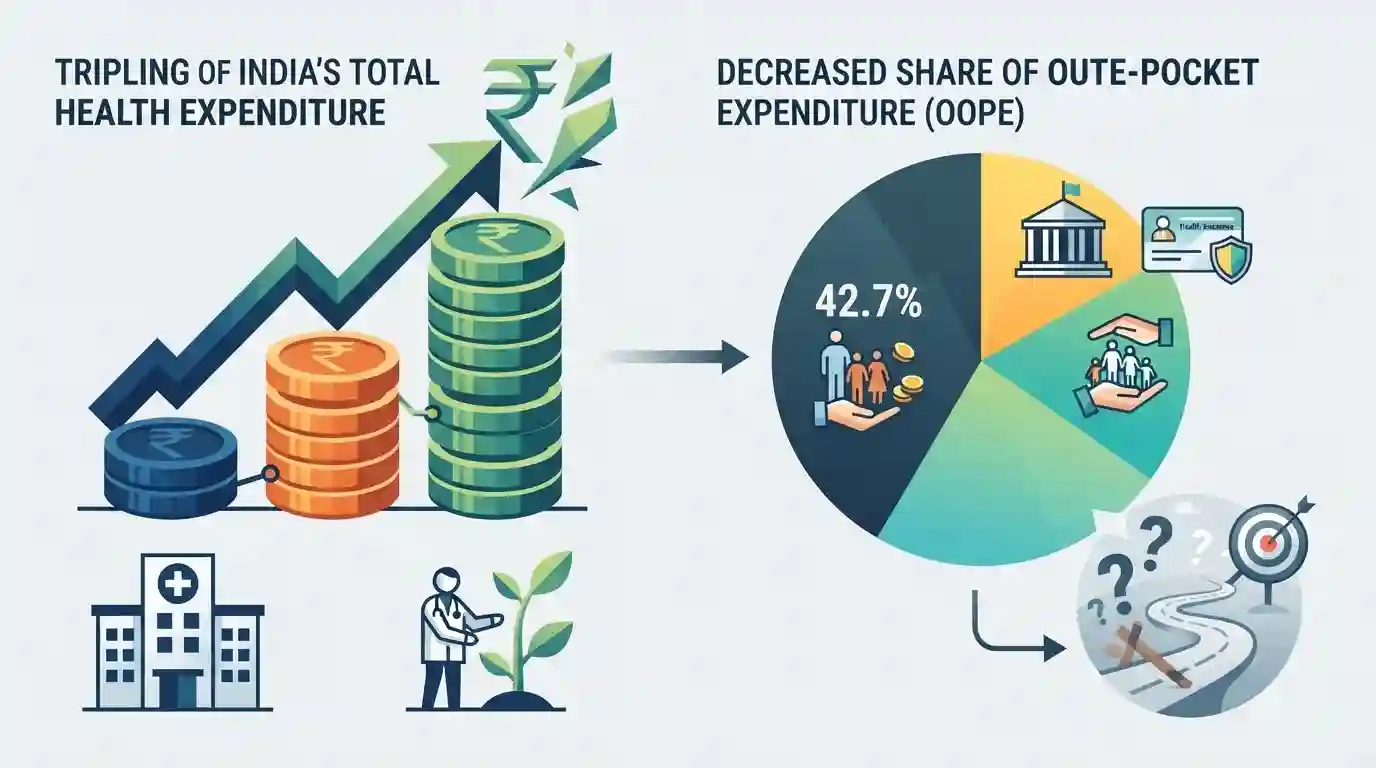
According to the National Health Accounts (NHA) estimates, India's total health expenditure has tripled to ₹4.14 lakh crore, while the out-of-pocket expenditure (OOPE) share has decreased to 42.7%. This indicates a positive trend in public health financing and reduced financial burdens on individual households, though challenges in universal health coverage remain.
Key Points
- India's total health expenditure tripled to ₹4.14 lakh crore, showing a significant expansion in financial allocation for health.
- Out-of-pocket expenditure (OOPE) as a share of total health expenditure dropped to 42.7%, reflecting a positive shift towards financial risk protection for households.
- Government health expenditure as a percentage of GDP and general government health expenditure have seen structural increments, enhancing public provisioning of healthcare services.
Important Terms
National Health Accounts

A standardized framework used to systematically track, measure, and analyze health expenditures and resource flows across both public and private sectors in India according to international guidelines.
UPSC context
UPSC GS Paper 2 (Social Sector - Health): Important tool to track government health spending trends, resource allocation, and progress toward universal health coverage.
Out-of-Pocket Expenditure
Direct payments made by individuals at the point of receiving healthcare services (like doctor visits and medicines) without third-party reimbursement or insurance coverage.
UPSC context
UPSC GS Paper 2 (Health & Poverty): Key indicator of financial hardship and catastrophic health spending that pushes vulnerable households into poverty.
Ministry of Health and Family Welfare
The nodal ministry responsible for formulating, implementing, and monitoring national health policies, family welfare programs, and public health schemes in India.
UPSC context
UPSC GS Paper 2 (Governance): Core institutional body responsible for public health management, welfare schemes, and releasing periodic health accounts data.
Static Concepts Connected
What are the key components and objectives of the National Health Accounts (NHA) in India?
- System Framework: NHA tracks health expenditures from all financing sources — government, private, external — following the international System of Health Accounts framework.
- Core Metrics: It provides crucial metrics like Out-of-Pocket Expenditure (OOPE), Government Health Expenditure (GHE), and Total Health Expenditure (THE) to guide policy.
- Policy Target: It helps measure progress toward Universal Health Coverage (UHC) and National Health Policy targets (such as increasing GHE to 2.5% of GDP).
Cross-Topic Patterns
Health Financing vs. Multidimensional Poverty Index
High OOPE is a primary driver of catastrophic health shocks that push households into multi-dimensional poverty, linking health financing directly to poverty alleviation metrics.
National Health Mission & Rural Governance
Decentralised primary healthcare delivery relies heavily on rural health infrastructure and local bodies (Panchayati Raj Institutions) under National Health Mission fund flows.

National Health Accounts data shifts (OOPE drop vs global average) are prime candidates for statements in Prelims and Mains GS2.
Linked PYQs · 3
Linked PYQs · 3
- 2024MainsGS2
In a crucial domain like the public healthcare system the Indian State should play a vital role to contain the adverse impact of marketisation of the system. Suggest some measures through which the State can enhance the reach of public healthcare at the grassroots level.
- 2020MainsGS2
In order to enhance the prospects of social development, sound and adequate health care policies are needed particularly in the fields of geriatric and maternal health care. Discuss.
- 2018MainsGS2
Appropriate local community-level healthcare intervention is a prerequisite to achieve 'Health for All' in India. Explain.
