National Health Accounts Trends in Public Health Spending and OOPE
Source:The Hindu ↗
Why It Matters
Crucial for assessing India's progress toward universal health coverage, financial risk protection, and reducing catastrophic health expenditures for households.
Summary
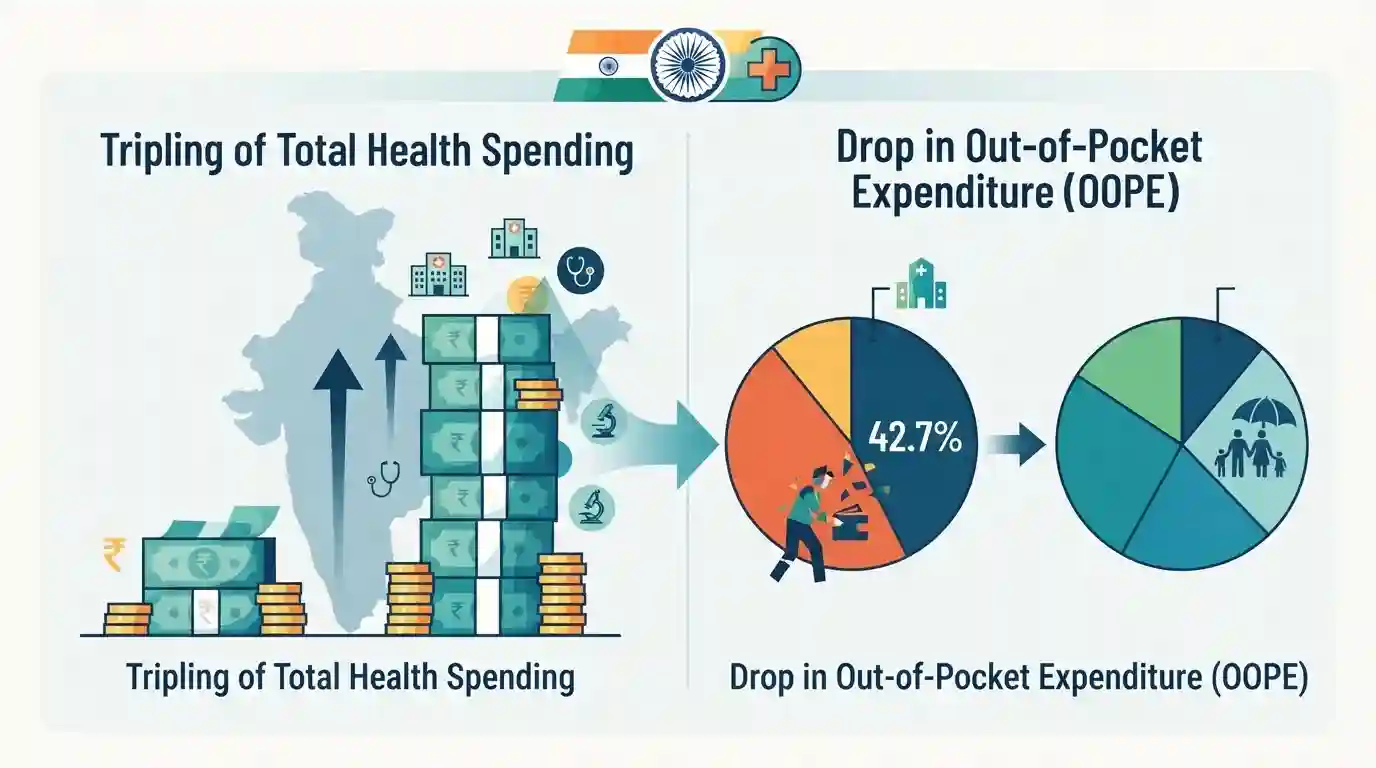
Recent National Health Accounts data reveals that India's total health spending tripled to ₹4.14 lakh crore, while the out-of-pocket expenditure share dropped to 42.7%, marking a positive shift towards financial risk protection in public health financing.
Key Points
- India's total health spending has tripled to ₹4.14 lakh crore, reflecting enhanced government priority towards public health systems.
- Out-of-pocket expenditure (OOPE) as a share of total health expenditure has declined significantly to 42.7%, indicating reduced direct financial burden on households.
- Government health expenditure as a share of total GDP has seen a steady increase, moving towards policy targets.
- Increased public spending on primary healthcare and social protection mechanisms help bridge equity gaps in healthcare access.
Important Terms
National Health Accounts

An official tracking framework that measures health expenditures in India, including total government spending, household out-of-pocket expenses, and private sector contributions, using standardized international accounting methods.
UPSC context
UPSC GS Paper II: Social Justice/Health. Tests understanding of healthcare financing, public expenditure trends, and out-of-pocket expenditure data.
National Health Authority
The apex central government body responsible for implementing flagship healthcare schemes like Ayushman Bharat PM-JAY and managing digital health infrastructure in India.
UPSC context
UPSC GS Paper II: Governance/Health. Tests institutional frameworks for universal health coverage and government social protection schemes.
Ministry of Health and Family Welfare
The Union government ministry tasked with formulating national health policies, implementing public health programs, regulating medical education, and overseeing family welfare initiatives.
UPSC context
UPSC GS Paper II: Polity & Governance. Tests organizational roles, policy implementation, and administration of public sector health interventions.
Prelims Trap
Out-of-pocket expenditure dropping to 42.7% means households are spending less absolute money on healthcare.
Aspirants often assume that a drop in out-of-pocket expenditure percentage means absolute household spending has also fallen, whereas absolute household OOP spending remains substantial at over ₹4 lakh crore.
Static Concepts Connected
What is the System of Health Accounts (SHA) framework used by National Health Accounts?
- Global Framework: Global standard for health accounting developed by WHO, OECD, and Eurostat to track health expenditures systematically.
- Comparability: Enables cross-country comparability by categorizing spending along functional, provider, and financing schemes.
- Indian Adoption: Adopted by India via National Health Accounts (NHA) to generate reliable, policy-relevant health accounts data.
Cross-Topic Patterns
Public Health Expenditure + Fiscal Federalism
The decline in out-of-pocket health spending directly reflects the expanded coverage of Ayushman Bharat and NHM, linking social sector allocations to inclusive growth indices.
Health Accounts + SDG 3 Targets
NHA estimates follow the SHA-2011 framework, connecting domestic health financing data to global WHO tracking standards and SDG indicator monitoring.

NHA out-of-pocket expenditure trends + SHA-2011 framework likely tested via statement-based questions on public health financing.
Linked PYQs · 1
Linked PYQs · 1
- 2024MainsGS3
Examine the pattern and trend of public expenditure on social services in the post-reforms period in India. To what extent this has been in consonance with achieving the objective of inclusive growth?
