Haemophilia Diagnosis Gap in India Leading to Preventable Vision Loss
Source:The Hindu ↗
ఇది ఎందుకు ముఖ్యం
It provides a perfect real-world intersection of General Science (genetic diseases/blood clotting) and Governance (public health diagnosis gaps), which is highly relevant for both Prelims (Science) and Mains GS-2 (Issues relating to health).
సారాంశం
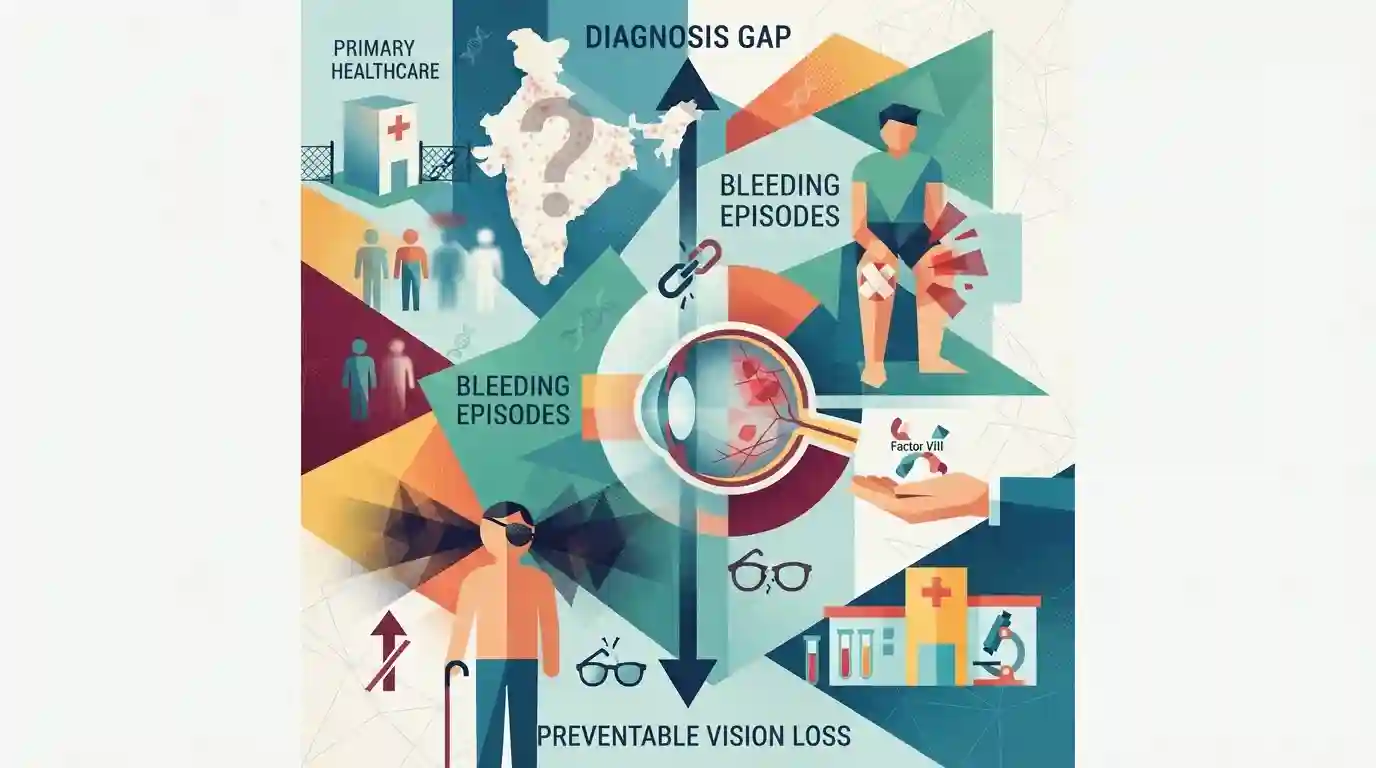
The article highlights a critical, yet often neglected, consequence of India's significant diagnosis gap in haemophilia: preventable vision loss. Haemophilia is an inherited genetic disorder that prevents normal blood clotting due to a deficiency in specific clotting factors. In India, inadequate diagnostic infrastructure and low awareness at the primary healthcare level leave a large proportion of cases undetected. This delayed or missed diagnosis leads to severe bleeding episodes, including spontaneous or trauma-induced intraocular bleeding, which can result in irreversible blindness. Addressing this issue requires strengthening grassroots public healthcare, implementing proactive screening for genetic disorders, and ensuring better access to treatment to prevent avoidable, lifelong disabilities.
ముఖ్య అంశాలు
- Haemophilia is a hereditary genetic disorder characterized by a deficiency in blood clotting factors, leading to prolonged and uncontrolled bleeding.
- India suffers from a severe diagnosis gap in haemophilia due to inadequate diagnostic facilities, high costs, and low awareness at the primary healthcare level.
- An overlooked and severe consequence of undiagnosed or poorly managed haemophilia is preventable vision loss, which occurs due to untreated intraocular bleeding (bleeding inside the eyes).
- Mitigating these irreversible complications requires improving grassroots healthcare delivery, early genetic screening, and targeted interventions for rare diseases.
ముఖ్యమైన పదాలు
Haemophilia

An inherited genetic disorder in which blood does not clot properly due to deficient or malfunctioning clotting factors, leading to uncontrolled internal or external bleeding.
UPSC context
Important for GS Paper 3 (Science & Technology) to test knowledge of genetic disorders and India's disease burden.
National Policy for Rare Diseases, 2021
A central government framework offering financial assistance up to ₹50 lakh for the treatment of rare diseases at notified Centers of Excellence to improve healthcare access.
UPSC context
Critical for GS Paper 2 (Health Policy) regarding state intervention, healthcare funding, and addressing marginalized medical needs.
Ocular Bleeding
Sudden bleeding within the eye, which can occur spontaneously in undiagnosed haemophilia patients, potentially leading to irreversible blindness if not treated swiftly.
UPSC context
Relevant to GS Paper 2 (Health). Highlights the consequences of diagnostic gaps in primary healthcare leading to preventable disabilities.
Activated Partial Thromboplastin Time (APTT) Test
A specialized blood test that measures how long it takes for blood to clot, used alongside factor assays to diagnose hidden bleeding disorders like haemophilia.
UPSC context
Connects to GS Paper 3 (Science & Tech). Tests awareness of medical diagnostics crucial for preventive public health strategies.
ప్రిలిమ్స్ ఉచ్చు
Haemophilia exclusively affects males, while females can only ever act as asymptomatic carriers of the disease.
It predominantly affects males, but females CAN manifest the disease if they inherit mutated genes from both parents. Beware of "exclusively" in UPSC options.
అనుసంధానమైన స్థిర భావనలు
How do X-linked recessive genetic disorders like Haemophilia function?
- Chromosomal locus: The mutated gene responsible for the disorder is located on the X chromosome.
- Male vulnerability: Since males (XY) possess only one X chromosome, inheriting a single mutated copy is enough to cause the disease.
- Female inheritance: Females (XX) must inherit mutated genes from both parents to manifest the disease. With one mutation, they remain asymptomatic carriers.
What are the core provisions of the National Policy for Rare Diseases (NPRD) 2021?
- Financial aid: Provides up to ₹50 lakh per patient for treatment at designated Centres of Excellence (CoEs).
- Universal access: The financial support was amended to cover all patients suffering from rare diseases treated at CoEs, not just those from BPL families.
- Crowdfunding mechanism: Incorporates a government-backed digital platform to encourage voluntary corporate and individual crowdfunding for high treatment costs.
అంతర-అంశ నమూనాలు
Rare Diseases + Indigenous MedTech
ICMR’s recent low-cost rapid tests for haemophilia merge rare disease management with the 'Make in India' push for affordable, accessible diagnostics.
Genetics + RPwD Act 2016
Haemophilia is explicitly recognized as a specified disability under the Rights of Persons with Disabilities (RPwD) Act, 2016, linking genetic diagnostics to disability rights.

Expect a 2026 prelims question pairing X-linked genetic inheritance rules with the NPRD 2021's ₹50 lakh treatment funding provisions.
అనుసంధాన PYQలు · 3
అనుసంధాన PYQలు · 3
- 1998PrelimsGS1
Haemophilia is a genetic disorder which leads to
- 2024MainsGS2
In a crucial domain like the public healthcare system the Indian State should play a vital role to contain the adverse impact of marketisation of the system. Suggest some measures through which the State can enhance the reach of public healthcare at the grassroots level.
- 2021PrelimsGS1
In the context of hereditary diseases, consider the following statements : 1. Passing on mitochondrial diseases from parent to child can be prevented by mitochondrial replacement therapy either before or after in vitro fertilization of egg. 2. A child inherits mitochondrial diseases entirely from mother and not from father. Which of the statements given above is/are correct?
