Discrepancies Between Official GDP Growth and Ground Economic Reality
Source:The Hindu ↗
Why It Matters
GDP calculation methodology, employment statistics, and the quality of economic growth are core topics in GS Paper 3. Understanding the limitations of macroeconomic indicators and the debate around 'jobless growth' is crucial for answering questions on India's economic development and formulating critical arguments in essays.
Summary
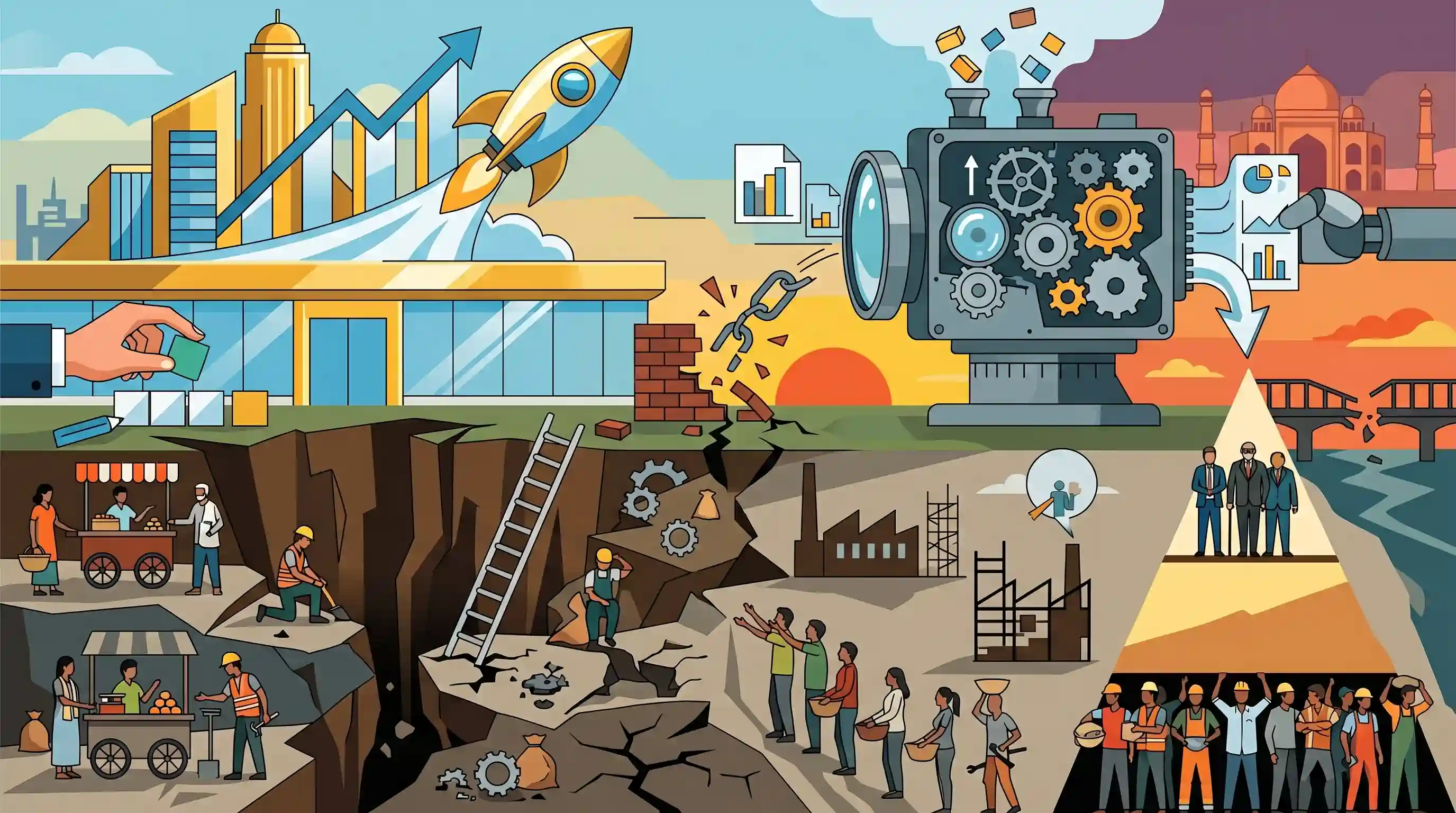
The article critically examines the narrative surrounding India's rapid economic growth, pointing out a significant clash between official macroeconomic claims and actual data realities. It highlights inconsistencies between high aggregate GDP figures and sluggish ground-level indicators such as employment generation, household consumption, and private investment. Furthermore, the piece underscores underlying methodological issues—especially regarding the accurate representation of the informal sector—arguing that statistical optimism often masks structural economic distress, jobless growth, and widening inequality.
Key Points
- There is a noticeable discrepancy between India's high official GDP growth figures and ground realities reflected in high-frequency indicators.
- Methodological issues in computing GDP, particularly concerning the informal sector, can lead to an overestimation of actual economic health.
- Sluggish household consumption and lagging private investment contradict the narrative of broad-based robust growth.
- The persistent phenomenon of 'jobless growth' raises concerns about structural unemployment and widening inequality despite high GDP numbers.
- Relying solely on headline aggregate figures obscures the distress faced by MSMEs and marginalized sections of the workforce.
Important Terms
National Statistical Office (NSO)

The nodal agency formed in 2019 by merging CSO and NSSO. It is responsible for compiling National Accounts (GDP) and conducting large-scale socio-economic surveys across India.
UPSC context
GS-III: Economy; tests knowledge of data-collection machinery and issues in GDP estimation/planning.
Periodic Labour Force Survey (PLFS)
A nationwide survey launched in 2017 to provide frequent labor market data. It offers quarterly updates for urban areas and annual estimates for the entire country.
UPSC context
GS-III: Employment; vital for analyzing 'jobless growth' and labor force participation rate (LFPR) trends.
Household Consumption Expenditure Survey (HCES)
A survey measuring household spending patterns to estimate poverty levels, track living standards, and provide data for revising the Consumer Price Index (CPI) basket.
UPSC context
GS-III: Inclusive Growth; essential for assessing real consumption growth versus aggregate macroeconomic claims.
Ministry of Statistics and Programme Implementation (MoSPI)
The nodal ministry for official statistics and project monitoring. It oversees the NSO and manages the implementation of infrastructure projects and the MPLADS scheme.
UPSC context
GS-II: Government Policies; tests understanding of administrative structures governing India's statistical systems.
Reserve Bank of India (RBI)
India's central bank, responsible for monetary policy and financial stability. It publishes the 'Handbook of Statistics on the Indian Economy' and monitors growth through a monetary lens.
UPSC context
GS-III: Monetary Policy; relevant for understanding the interplay between inflation, interest rates, and economic growth.
Prelims Trap
An increase in GDP growth rate invariably reflects proportionate growth in informal sector output and job creation.
GDP calculations often use formal sector data as a proxy for the unorganized sector. This mathematical assumption obscures informal sector distress.
Static Concepts Connected
How is the informal sector accounted for in India's official GDP calculations?
- Proxy Methodology: The NSO often relies on formal sector data to estimate informal sector output, assuming both segments grow at a similar pace.
- Asymmetric Shocks: During periods of economic distress, formal proxies fail to capture unorganized sector contractions, leading to GDP overestimation.
What is Gross Fixed Capital Formation (GFCF) and its macroeconomic significance?
- Definition: GFCF measures the net increase in physical assets (investment) within the economy, excluding land purchases and depreciation.
- Investment Barometer: It serves as a core barometer for private and public sector investment; a lagging GFCF contradicts robust broad-based growth narratives.
Cross-Topic Patterns
GDP methodology + K-shaped recovery
Sluggish household consumption alongside high headline GDP highlights a K-shaped reality, linking macroeconomic data directly to GS-2 poverty and widening inequality themes.
Jobless growth + Demographic dividend
Capital-intensive growth failing to absorb labor actively threatens India's demographic dividend, bridging GS-3 economy with GS-1 population dynamics.

Expect a 2026 Prelims multi-statement question linking MSME distress, informal sector proxy methodology in GDP calculation, and GFCF trends.
Linked PYQs · 5
Linked PYQs · 5
- 2021MainsGS3
Explain the difference between computing methodology of India's Gross Domestic Product (GDP) before the year 2015 and after the year 2015.
- 2020MainsGS3
Define potential GDP and explain its determinants. What are the factors that have been inhibiting India from realizing its potential GDP?
- 2015MainsGS3
The nature of economic growth in India in recent times is often described as jobless growth. Do you agree with this view ? Give arguments in favour of your answer.
- 2023MainsGS3
Most of the unemployment in India is structural in nature. Examine the methodology adopted to compute unemployment in the country and suggest improvements.
- 2022MainsGS3
Economic growth in the recent past has been led by increase in labour productivity." Explain this statement. Suggest the growth pattern that will lead to creation of more jobs without compromising labour productivity.
