Reforming Environmental Impact Assessment Baselines in India
Source:The Hindu ↗
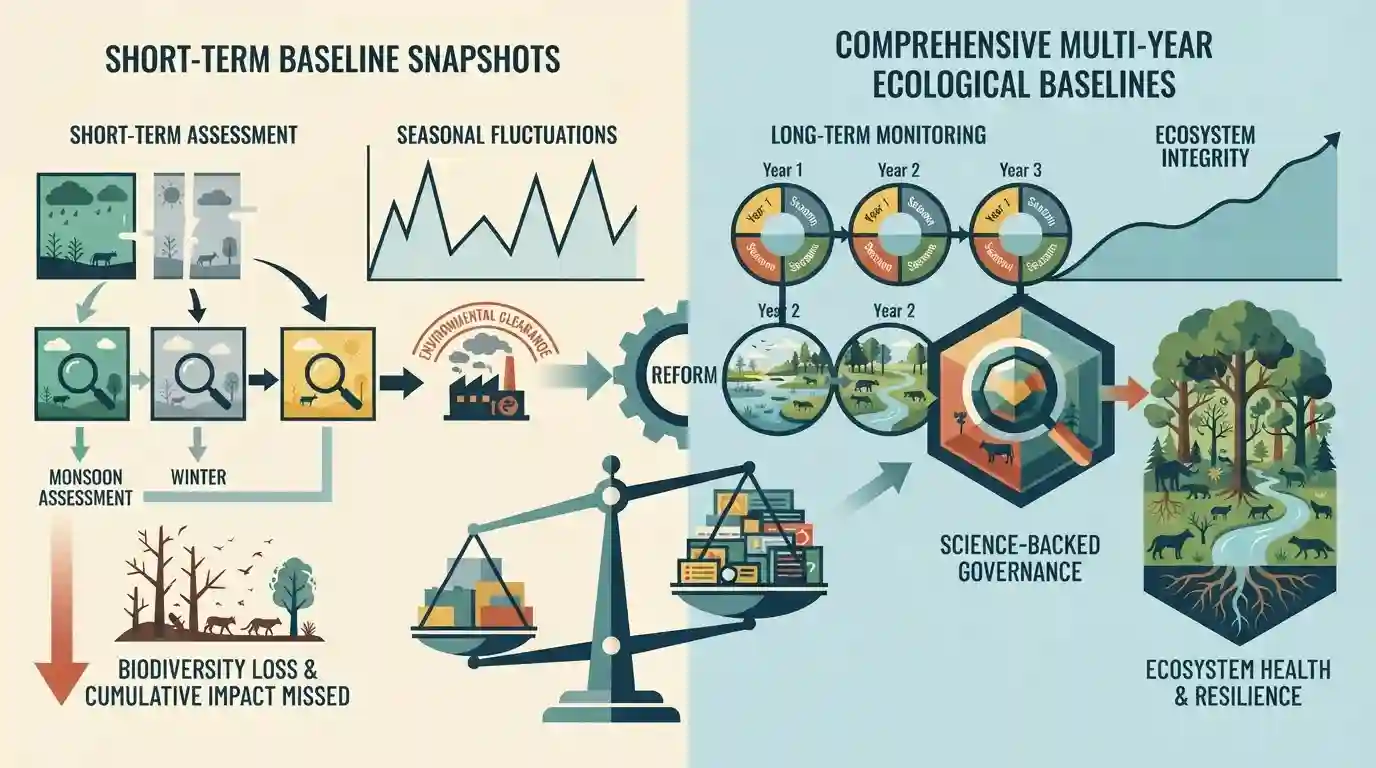
Why It Matters
It addresses critical gaps in India's environmental regulatory architecture and EIA process, frequently tested in UPSC Mains GS3 under environmental conservation and governance.
Summary
The article critiques India's environmental regulation framework, particularly the Environmental Impact Assessment (EIA) process, for relying on short-term baseline snapshots instead of comprehensive multi-year ecological baselines. It highlights how seasonal snapshots fail to capture cumulative impacts, long-term ecosystem degradation, and biodiversity losses, calling for science-backed reforms in environmental governance.
Key Points
- India's environmental impact assessment (EIA) framework often relies on short-term seasonal snapshots rather than robust multi-year ecological baselines.
- Relying on snapshots misses long-term ecological trends, cumulative impacts, and seasonal variations necessary for true environmental conservation.
- The article emphasizes shifting from procedural check-box clearances to comprehensive, science-driven baselines to protect vulnerable ecosystems and biodiversity.
- Strengthening environmental jurisprudence requires structural reforms in data collection, transparent public consultations, and rigorous post-clearance monitoring.
Important Terms
Environment Impact Assessment Notification 2006

A key statutory framework issued under the Environment Protection Act 1986 that governs environmental clearance procedures for developmental projects in India by categorizing them into Category A and Category B.
UPSC context
UPSC Mains Paper III (Environment): Tests understanding of environmental governance, regulatory clearances, and statutory procedures for project appraisal.
Environment Protection Act
India's umbrella environmental legislation enacted under Article 253 to implement decisions of the Stockholm Conference, empowering the Central Government to coordinate environmental protection and control pollution.
UPSC context
UPSC Mains Paper III (Environment): Critical for questions on environment legislation, pollution control, and statutory powers of the center.
Prelims Trap
The Environmental Impact Assessment Act of India mandates prior environmental clearance for listed developmental projects.
The EIA Notification is not an independent legislative act passed by Parliament; it is delegated legislation issued under Section 3 of the Environment (Protection) Act, 1986.
Static Concepts Connected
What are the key statutory stages in India's Environmental Impact Assessment (EIA) process?
- Screening stage: Initial identification of project categories (Category A and Category B) requiring prior environmental clearance under the EIA Notification 2006.
- Scoping stage: Determining the terms of reference (ToR) for impact studies, which currently suffer from short-term baseline data limitations.
- Public Consultation: Conducting public hearings through State Pollution Control Boards to record grievances of affected local populations.
- Appraisal stage: Final evaluation by Expert Appraisal Committees (EAC) or State Level Expert Appraisal Committees (SEAC) leading to approval or rejection.
Cross-Topic Patterns
EIA Baselines + Biological Diversity Act
EIA baseline data flaws directly undermine statutory biodiversity registries like People's Biodiversity Registers (PBRs) under the Biological Diversity Act, 2002.
Environmental Jurisprudence + Regulatory Institutional Capacity
Short-term environmental clearances reflect institutional capacity gaps in regulatory bodies like the Central Pollution Control Board and state EIA authorities.

EIA Notification 2006 vs EPA 1986 statutory framework & judicial precedents by NGT/Supreme Court are high-yield for Prelims statements.
Linked PYQs · 2
Linked PYQs · 2
- 2024MainsGS3
What role do environmental NGOs and activists play in influencing Environmental Impact Assessment (EIA) outcomes for major projects in India? Cite four examples with all important details.
- 2020MainsGS3
How does the draft Environment Impact Assessment (EIA) Notification, 2020 differ from the existing EIA Notification, 2006?
