Macroeconomic headwinds challenge India growth momentum
Source:Indian Express ↗
Why It Matters
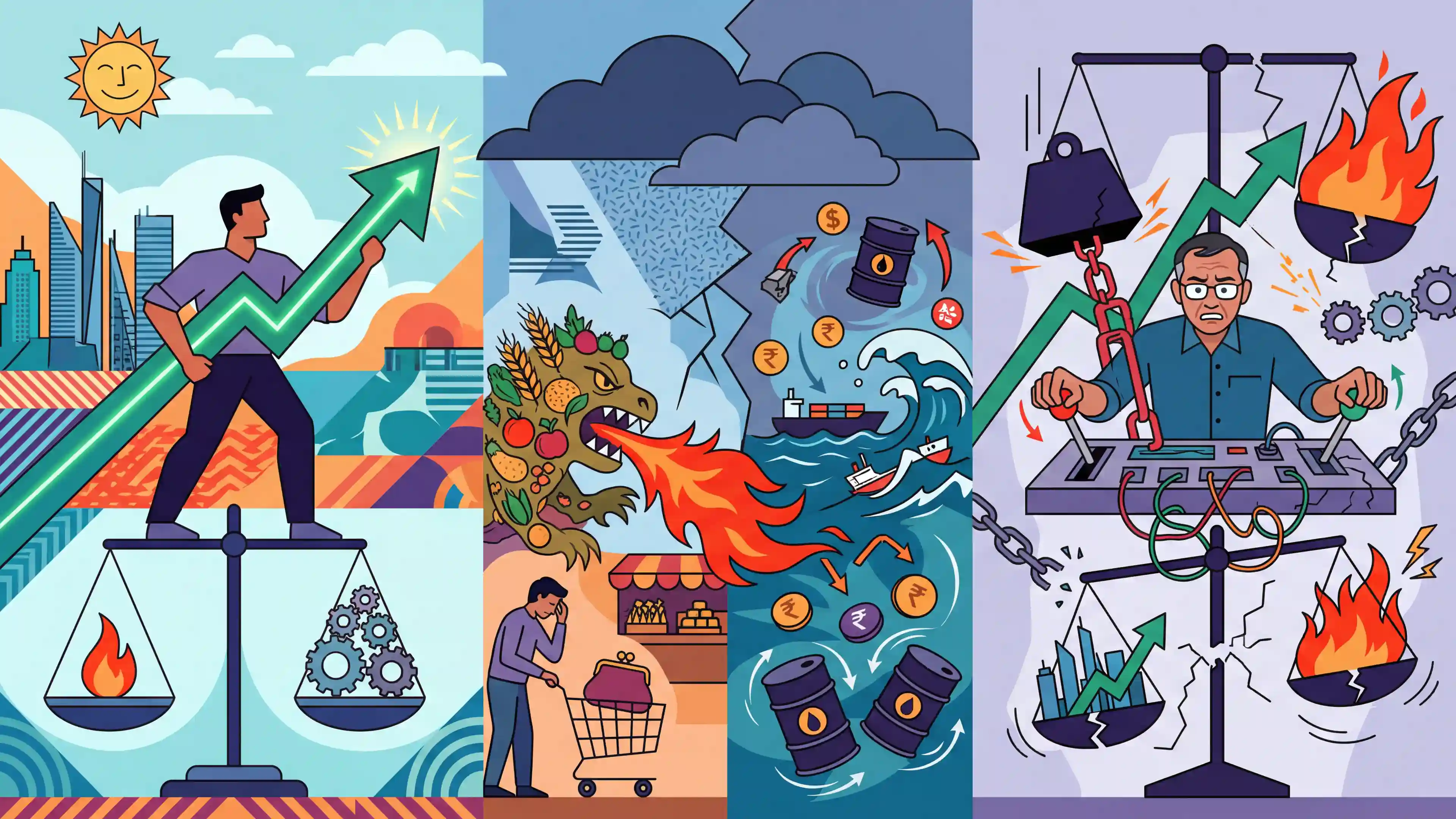
The concept of a 'Goldilocks economy' is central to understanding the business cycle and the delicate balance required in macroeconomic policymaking. It directly addresses GS3 themes of inflation management, growth prospects, and the role of the RBI, offering candidates critical terminology and analytical frameworks for answers evaluating India's current economic health.
Summary
The article argues that India’s recent 'Goldilocks moment'—a period characterized by high economic growth coupled with manageable inflation and stable macroeconomic indicators—is coming to an end. It warns of a worsening macroeconomic environment driven by structural bottlenecks such as persistent food inflation, subdued private consumption, and potential vulnerabilities in the external sector. As global economic conditions shift, bringing headwinds like fluctuating commodity prices, the alignment of favorable domestic indicators is likely to unravel. Consequently, policymakers, including the Reserve Bank of India (RBI), will face an increasingly complex challenge in balancing monetary tightening to curb inflation without prematurely choking off economic growth.
Key Points
- A 'Goldilocks economy' describes an ideal macroeconomic state featuring steady, robust economic growth alongside low inflation—an economy that is neither 'too hot' nor 'too cold.'
- India has recently benefited from this favorable macroeconomic alignment, evidenced by strong GDP growth figures, controlled fiscal deficits, and relatively stable inflation.
- The article argues that this phase is temporary and ending, pointing to underlying structural vulnerabilities such as persistent, sticky food inflation and subdued private consumption.
- Global headwinds, including fluctuating commodity prices and persistently high interest rates in developed economies, threaten to exert pressure on India's external sector and overall macroeconomic stability.
- Policymakers will face a challenging trade-off: the RBI must carefully calibrate monetary policy to rein in stubborn inflation without stifling the country's economic growth momentum.
Important Terms
Goldilocks Economy

An ideal economic state characterized by moderate, sustainable growth and low inflation—neither "too hot" to cause high inflation nor "too cold" to lead to recession.
UPSC context
GS Paper III (Indian Economy). Tests understanding of growth-inflation dynamics and the delicate balance required for sustainable economic development.
Reserve Bank of India (RBI)
India's central bank and apex monetary authority. It regulates the banking system, manages the rupee, and formulates monetary policy to ensure price and financial stability.
UPSC context
GS Paper III (Banking). Fundamental for questions regarding institutional roles, regulatory frameworks, and central bank independence.
Monetary Policy
The strategy used by the central bank (RBI) to manage money supply and interest rates to achieve specific goals like controlling inflation and fostering growth.
UPSC context
GS Paper III (Growth and Inflation). Key for understanding the Monetary Policy Committee (MPC) and the 4% inflation-targeting mandate.
Food Inflation
A sustained increase in the price of food items. In India, food carries a weight of nearly 46% in the Consumer Price Index (CPI).
UPSC context
GS Paper III (Agriculture/Inflation). Crucial for analyzing supply-side constraints, weather shocks, and their impact on household real income.
Private Final Consumption Expenditure (PFCE)
The market value of all final goods and services purchased by resident households and non-profit institutions; it is the largest component of India's GDP.
UPSC context
GS Paper III (Growth). Essential for analyzing domestic demand-led growth and consumer confidence as a driver of national income.
Macroeconomic Stability
A condition where an economy's fundamental indicators (inflation, fiscal deficit, and debt) are balanced, minimizing vulnerability to external shocks and ensuring predictable growth.
UPSC context
GS Paper III (Indian Economy). Tests the ability to evaluate systemic resilience and the impact of external trade/commodity price fluctuations.
Prelims Trap
The RBI targets Core CPI instead of Headline CPI because food and fuel prices are highly volatile.
The RBI's flexible inflation targeting framework legally mandates maintaining Headline CPI at 4% (±2%), not Core CPI. Food's high weight restricts RBI rate cuts.
Static Concepts Connected
What characterizes a Goldilocks economy and the growth-inflation trade-off?
- Goldilocks State: An economy operating at an optimal level—steady growth and low inflation, avoiding both recession and inflationary overheating.
- The Trade-off: Central banks hiking rates controls inflation but depresses private investment and growth; cutting rates boosts growth but triggers inflation.
How do persistently high interest rates in developed economies impact India?
- FPI Outflows: Higher yields in markets like the US attract foreign portfolio investors, causing capital flight from emerging markets like India.
- Imported Inflation: Capital flight weakens the Rupee, making crucial imports like crude oil more expensive, which feeds back into domestic inflation.
Cross-Topic Patterns
Climate change & sticky food inflation
Erratic monsoons and climate events like El Niño create structural supply-side food inflation, complicating the RBI's demand-side monetary policy maneuvers.
Monetary policy & twin deficit risks
FPI outflows and a weaker Rupee strain the Current Account Deficit, while high domestic borrowing costs to fight inflation pressure the fiscal deficit.

Expect a 2026 Prelims question linking sticky food inflation, US interest rate cycles, and the RBI's growth-inflation trade-off.
Linked PYQs · 3
Linked PYQs · 3
- 2019MainsGS3
Do you agree with the view that steady GDP growth and low inflation have left the Indian economy in good shape? Give reasons in support of your arguments.
- 2024MainsGS3
What are the causes of persistent high food inflation in India? Comment on the effectiveness of the monetary policy of the RBI to control this type of inflation.
- 2021PrelimsGS1
Which one of the following is likely to be the most inflationary in its effects?
