Challenges to Macroeconomic Stability and Growth Momentum
Source:Indian Express ↗
Why It Matters
Understanding the shift in macroeconomic indicators is crucial for GS-3. Aspirants must be able to analyze how external shocks (global interest rates, crude oil) and internal factors (food inflation) interact to affect monetary policy, growth trajectories, and currency stability.
Summary
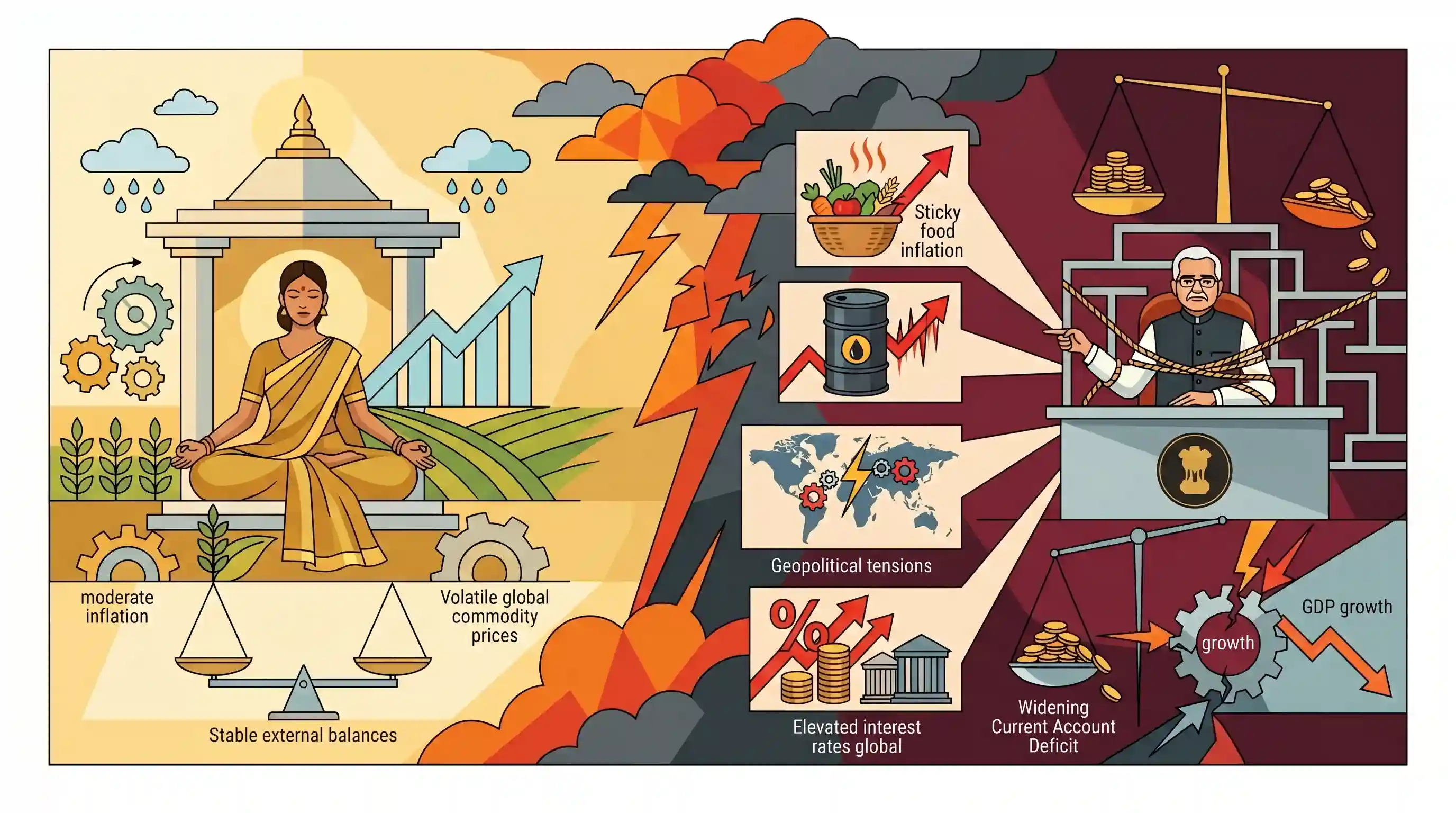
The article argues that India's 'Goldilocks' economic moment—a period characterized by robust GDP growth, moderate inflation, and stable external balances—is coming to an end. It highlights that the macroeconomic situation is poised to worsen due to a combination of sticky domestic food inflation, volatile global commodity prices (especially crude oil), and challenging global headwinds such as geopolitical tensions and elevated interest rates in advanced economies. These factors will likely constrain the Reserve Bank of India's (RBI) monetary policy options, making it harder to sustain high growth without risking macroeconomic instability and widening the Current Account Deficit.
Key Points
- India's 'Goldilocks' macroeconomic phase—marked by optimal economic growth alongside manageable inflation—is concluding as domestic and global challenges mount.
- Persistent food inflation remains a significant concern, restricting the RBI's ability to cut interest rates and ease monetary policy despite moderating core inflation.
- Global headwinds, including geopolitical tensions, supply chain fragmentation, and 'higher-for-longer' interest rates in advanced economies, threaten to disrupt capital inflows and pressure the Rupee.
- Volatility in global commodity markets, particularly crude oil, poses risks of widening the Current Account Deficit (CAD) and importing inflation.
- Policymakers face the difficult task of balancing fiscal consolidation with the need for sustained capital expenditure to prevent a sharp growth slowdown.
Important Terms
Goldilocks Economy

An ideal economic state where growth is robust and steady while inflation remains moderate, preventing the economy from either overheating or falling into recession.
UPSC context
GS Paper III: Indian Economy. Relevant for understanding the growth-inflation trade-off and business cycles.
Macroeconomic Stability
A condition where an economy's fundamental indicators—inflation, fiscal deficit, and exchange rates—are balanced and predictable, minimizing vulnerability to external shocks.
UPSC context
GS Paper III: Growth and Development. Tests ability to analyze resilience against global and domestic shocks.
Current Account Deficit (CAD)
The shortfall when a country’s total imports of goods, services, and transfers exceed its total exports, indicating it is a net borrower from the rest of the world.
UPSC context
GS Paper III: External Sector. Critical for understanding the Balance of Payments and currency stability.
Monetary Policy
The framework used by a central bank (RBI) to manage money supply and interest rates to ensure price stability and support economic growth.
UPSC context
GS Paper III: Indian Economy. Key for questions on inflation targeting (4% +/- 2% mandate).
US Federal Reserve
The central banking system of the United States. Its interest rate decisions significantly influence global capital flows, exchange rates, and India’s external financial environment.
UPSC context
GS Paper III: Indian Economy & Global Issues. Tests the impact of external monetary shocks on domestic policy.
Reserve Bank of India (RBI)
India's central bank responsible for regulating the banking system, controlling inflation through monetary policy, and managing the country's foreign exchange reserves.
UPSC context
GS Paper III: Indian Economy. Fundamental institution for all fiscal and monetary policy discussions.
Prelims Trap
The RBI uses Core CPI as the primary anchor for its inflation targeting framework.
The RBI targets Headline CPI (4% ± 2%), which includes volatile food and fuel. Therefore, sticky food inflation blocks rate cuts even if core inflation falls.
Static Concepts Connected
What characterizes a 'Goldilocks Economy'?
- Ideal Balance: An economy that is neither too hot (high inflation) nor too cold (recession), exhibiting steady GDP growth alongside moderate inflation.
- Policy Stance: Usually accompanied by an accommodative or neutral monetary policy, as the central bank doesn't need to aggressively raise or cut interest rates.
How do advanced economy interest rate hikes impact the Indian macroeconomy?
- Capital Flight: Higher yields in safe-haven US bonds prompt Foreign Portfolio Investors (FPIs) to pull capital out of emerging markets like India.
- Rupee Depreciation: The outflow of dollars reduces dollar supply in the domestic forex market, causing the Rupee to depreciate against the Dollar.
- Imported Inflation: A weaker Rupee makes inelastic imports (like crude oil) costlier, directly feeding into domestic headline inflation.
Cross-Topic Patterns
The Impossible Trinity (Macro Trilemma)
India's struggle with US Fed rates, Rupee depreciation, and independent monetary policy perfectly illustrates the 'Impossible Trinity' (Mundell-Fleming trilemma) often tested in UPSC.
Fiscal Consolidation vs. Capital Expenditure
Connects directly to the FRBM Act. The government’s balancing act of funding infrastructure (capital expenditure) without breaching fiscal deficit targets is a recurring GS3 Mains theme.

Expect a multi-statement prelims question linking US Fed rate hikes, FPI outflows, Rupee depreciation, and RBI's imported inflation response.
Linked PYQs · 4
Linked PYQs · 4
- 2024MainsGS3
What are the causes of persistent high food inflation in India? Comment on the effectiveness of the monetary policy of the RBI to control this type of inflation.
- 2018MainsGS3
How would the recent phenomena of protectionism and currency manipulations in world trade affect macroeconomic stability of India?
- 2021PrelimsGS1
With reference to Indian economy, demand-pull inflation can be caused/ increased by which of the following? 1. Expansionary policies 2. Fiscal stimulus 3. Inflation-indexing wages 4. Higher purchasing power 5. Rising interest rates Select the correct answer using the code given below.
- 2011PrelimsGS1
Economic growth is usually coupled with
