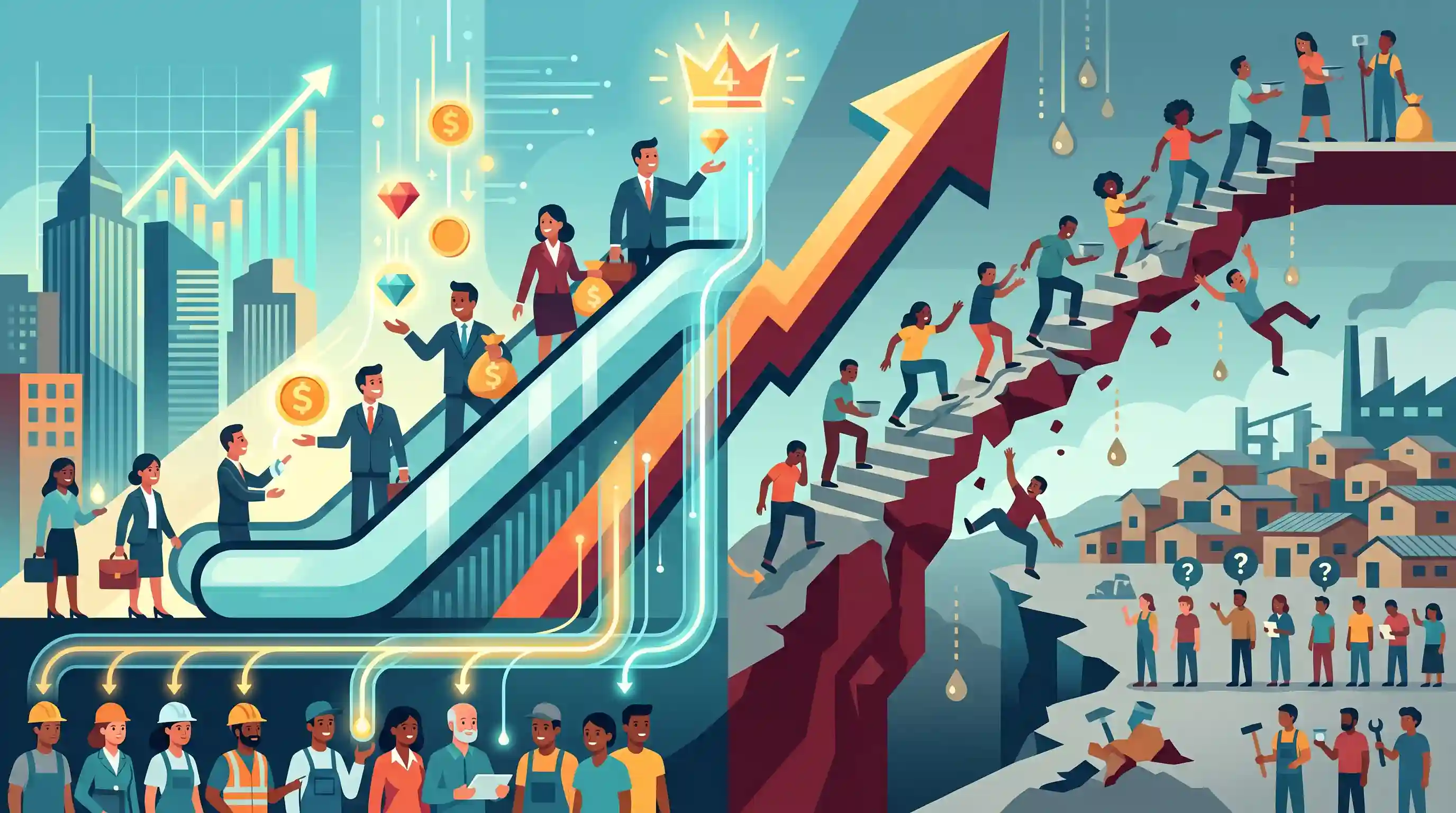
GDP Growth versus Inclusive Development Challenges
Source:Indian Express ↗
Why It Matters
Understanding the distinction between GDP growth and inclusive development is crucial for GS3. UPSC frequently tests candidates on the structural challenges of the Indian economy, such as jobless growth, widening inequality, and the failure of trickle-down economics, demanding critical analysis of current growth models.
Summary
The article critiques the narrative celebrating India's ascent to becoming the world's fourth-largest economy by highlighting the lack of inclusive growth. It argues that the impressive GDP figures are an 'illusion' for the masses, as the economic expansion has primarily resulted in a concentrated accumulation of wealth among the top tiers of society rather than equitable prosperity. The commentary underscores the urgent need for policies that bridge the inequality gap, address jobless growth, and ensure that economic development reaches the marginalized sections.
Key Points
- While India's aggregate GDP is growing, making it a top global economy, this growth masks deep underlying economic disparities.
- The current economic trajectory is characterized by wealth concentration, where a small section of society accumulates a disproportionate share of the economic gains.
- High GDP growth numbers do not automatically translate to inclusive development or sufficient employment generation for the broader population.
- There is a need to shift focus from mere quantitative GDP growth to qualitative metrics of economic development that prioritize equitable distribution of wealth and broad-based prosperity.
Prelims Trap
Rapid GDP growth automatically translates to higher employment elasticity and job creation in developing economies.
Aspirants often confuse rapid GDP growth with proportional job creation. In reality, India's employment elasticity has sharply declined below 0.1, signifying severe 'jobless growth'.
Static Concepts Connected
How are income inequality and wealth concentration measured in macroeconomics?
- Lorenz Curve: A graphical representation of wealth distribution; the further the curve sags from the 45-degree line of perfect equality, the higher the inequality.
- Gini Coefficient: A mathematical ratio derived from the Lorenz curve, ranging from 0 (perfect equality) to 1 (perfect inequality).
What is the 'Employment Elasticity of Growth'?
- Core Definition: It measures the percentage change in employment associated with a 1% change in economic growth (GDP).
- Economic Implication: An elasticity nearing zero indicates 'jobless growth', meaning the economy is expanding but failing to generate a proportional number of new jobs.
Cross-Topic Patterns
Regressive Taxation and GST Burden
High GST contribution from the bottom 50% links GS3 indirect tax reforms to GS2 social justice, showing how consumption taxes can exacerbate structural wealth inequality.
Jobless Growth vs Demographic Dividend
Jobless growth directly threatens India's demographic dividend, connecting GS3 macroeconomic indicators to GS1 population dynamics and social empowerment themes.

Expect a 2026 Prelims question testing the inverse relationship between India's high GDP growth and its declining employment elasticity.
Linked PYQs · 5
Linked PYQs · 5
- 2020MainsGS3
Explain intra-generational and inter-generational issues of equity from the perspective of inclusive growth and sustainable development.
- 2022MainsGS3
Is inclusive growth possible under market economy ? State the significance of financial inclusion in achieving economic growth in India.
- 2019MainsGS3
It is argued that the strategy of inclusive growth is intended to meet the objectives of inclusiveness and sustainability together. Comment on this statement.
- 2010PrelimsGS1
Inclusive growth as enunciated in the Eleventh Five Year Plan does not include one of the following:
- 2014PrelimsGS1
The main objective of the 12th Five-Year Plan is
