BJP Defends India Gaza Policy Amid Domestic Political Row
Source:The Hindu ↗
Why It Matters
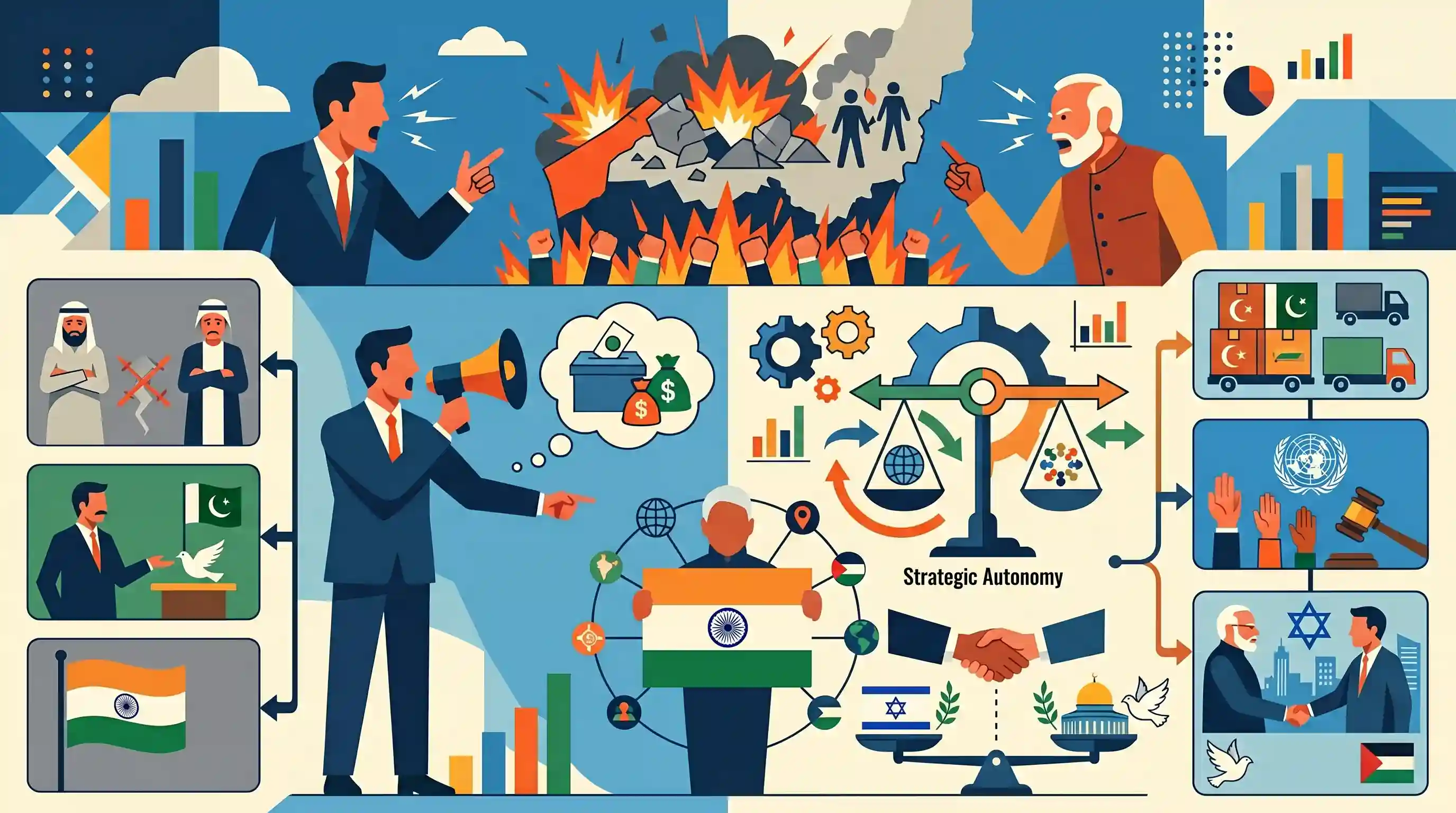
Highlights the debate between strategic autonomy (multi-alignment) and traditional non-alignment in India's foreign policy, especially concerning the complex Israel-Palestine issue. It also demonstrates how domestic political narratives intersect with external relations.
Summary
A political row erupted over India's foreign policy approach to the Gaza conflict. The Congress accused the government of remaining silent on the issue and alienating historical allies, thereby allowing countries like Pakistan to mediate. In response, the BJP defended India's stance as balanced and rooted in strategic autonomy ('all-alignment'), citing humanitarian aid to Gaza and UN votes for a ceasefire. The BJP dismissed the Congress's criticism as domestic 'vote bank politics' and highlighted PM Modi's diplomatic successes with both Israel and Palestine.
Key Points
- Congress leader Sonia Gandhi criticized the Modi government's 'stony silence' on the Gaza conflict, accusing it of alienating historical allies like Palestine and Iran.
- The BJP countered that India's Gaza policy is balanced, criticizing Congress for prioritizing domestic 'vote bank politics' over national interest.
- BJP spokesperson Shehzad Poonawalla emphasized India's strategic autonomy and 'all-alignment' approach, successfully navigating complex ties between Israel-Palestine, America-Russia, and the West-Iran.
- The BJP highlighted India's ongoing humanitarian aid to Gaza, its voting record at the UN supporting a ceasefire, and the conferment of Palestine's highest civilian honour on PM Modi as proof of a balanced policy.
Important Terms
Strategic Autonomy

A nation's ability to make sovereign foreign policy and defense decisions based on national interest, without being constrained by external pressures or rigid alliance obligations.
UPSC context
GS Paper II (International Relations). Core tenet testing India’s ability to balance rivalries (e.g., US-Russia) while maintaining policy independence.
Multi-alignment
A pragmatic foreign policy approach where a country builds parallel, issue-based partnerships with multiple major powers simultaneously to maximize strategic gains.
UPSC context
GS Paper II. Tests understanding of the evolution from Nehruvian Non-Alignment to contemporary 'all-alignment' in a multipolar world.
Two-State Solution
A diplomatic framework for the Israeli-Palestinian conflict envisaging an independent State of Palestine existing peacefully alongside the State of Israel within secure, recognized borders.
UPSC context
GS Paper II (Bilateral Relations). Central to India’s long-standing balanced stance in West Asia and its UN voting pattern.
Domestic Determinants of Foreign Policy
Internal factors—including public opinion, historical legacy, and party politics—that influence or constrain a sovereign state’s external diplomatic choices and posture.
UPSC context
GS Paper II. Tests the interplay between domestic political interests (e.g., 'vote bank politics') and international diplomatic credibility.
West Asia Geopolitics
The complex interplay of regional power rivalries, energy wealth, and maritime trade routes in the Middle East impacting global and Indian strategic interests.
UPSC context
GS Paper II. Vital for analyzing India's energy security (70% oil imports), diaspora welfare, and maritime security.
UNGA Resolutions
Formal expressions of the collective will of UN member states which, while generally non-binding, carry significant moral weight and reflect international consensus.
UPSC context
GS Paper II (International Institutions). Tests India’s multilateral diplomacy and its voting record on global humanitarian crises.
Prelims Trap
India has formally abandoned its support for the two-state solution to prioritize its defense partnership with Israel.
India's "de-hyphenation" policy separates its bilateral relations, but New Delhi continues to officially back a sovereign Palestinian state alongside Israel and has voted for UN humanitarian ceasefires.
Static Concepts Connected
What is India's 'De-hyphenation' policy in West Asia?
- Independent tracks: Treating relations with Israel and Palestine as independent, standalone bilateral ties rather than a zero-sum game.
- Paradigm shift: Discarding the historical approach where ties with Israel were viewed strictly through the prism of the Palestinian cause.
- Diplomatic milestones: Formalized when the Prime Minister visited Israel in 2017 and Palestine in 2018 in separate, unconnected trips.
What is the mandate of UNRWA in the context of Palestine?
- Refugee Relief: Created by the UN in 1949 to provide direct relief, education, and healthcare for Palestine refugees.
- Indian contribution: India balances its West Asia policy by regularly contributing (approx. $5 million annually) to UNRWA's operations.
Cross-Topic Patterns
Strategic Autonomy & Energy Security
India's "all-alignment" in West Asia is directly tied to its energy security. Managing ties with Israel, Iran, and Arab states simultaneously secures oil imports and diasporic remittances.
Domestic Determinants of Foreign Policy
The row over Gaza mirrors past instances where regional or domestic electoral dynamics influenced foreign policy debates, similar to the Tamil issue with Sri Lanka or Teesta waters with Bangladesh.

Expect a GS2 Mains question evaluating the success of India's "De-hyphenation" policy in West Asia amidst the Gaza crisis.
Linked PYQs · 1
Linked PYQs · 1
- 2018MainsGS2
“India’s relations with Israel have, of late, acquired a depth and diversity, which cannot be rolled back.” Discuss.
