India Demographic Transitions and Regional Disparities
Source:The Hindu ↗
Why It Matters
Population dynamics directly dictate national economic planning, resource allocation, and welfare policies. Understanding these shifts—such as the transition toward an ageing society and dropping fertility rates—is critical for answering UPSC questions on the demographic dividend, regional disparity, and social sector management.
Summary
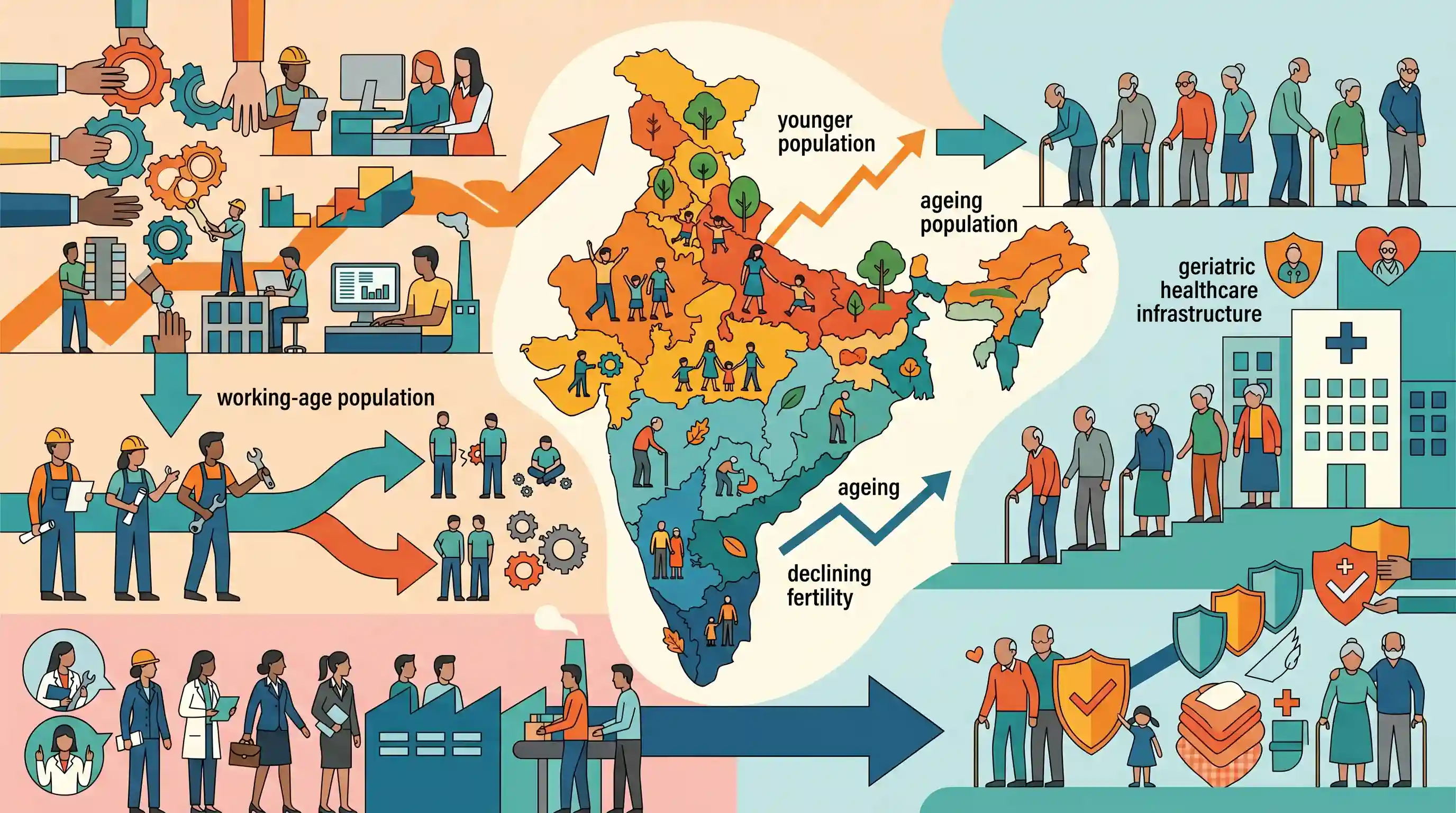
The article explores the multifaceted demographic challenges India faces as it transitions from a high-growth population phase toward stabilization. While India currently boasts a massive working-age cohort, this "demographic dividend" is unevenly distributed; southern states are ageing rapidly due to declining fertility rates, while northern states remain comparatively young. The piece warns against the looming threat of a "demographic winter" in certain regions and highlights the critical need for robust job creation, skill enhancement, and increased female labour force participation to prevent the demographic advantage from turning into a crisis. Furthermore, the impending surge in the elderly population underscores an urgent policy imperative to build comprehensive social security systems and geriatric healthcare infrastructure.
Key Points
- Uneven Demographic Transition: Southern and western Indian states have reached sub-replacement fertility levels, while northern states continue to drive population growth, leading to stark regional demographic disparities.
- Demographic Winter & Ageing: Declining Total Fertility Rates (TFR) hint at a future shrinking workforce and a rapidly growing elderly population, which will strain social security networks and necessitate dedicated geriatric care infrastructure.
- Employability vs. Population Size: Possessing a massive working-age cohort is insufficient on its own; without robust skill development and adequate job creation, the demographic dividend risks turning into a demographic disaster.
- Gender Dividend: Enhancing the Female Labour Force Participation Rate (FLFPR) remains critical. Women's empowerment through education and employment correlates strongly with demographic stability and economic growth.
Prelims Trap
"India's national Total Fertility Rate (TFR) continues to remain above the replacement level."
India's overall TFR dropped to 2.0 (NFHS-5), below the 2.1 replacement level. The population still grows largely due to "population momentum"—a massive youth cohort in their reproductive years.
Static Concepts Connected
What drives population growth even after reaching replacement fertility?
- Replacement Level: The exact fertility rate (2.1) at which a population replaces itself from one generation to the next, factoring in infant mortality without migration.
- Population Momentum: A phenomenon where a population continues to grow despite a TFR drop to 2.1, driven by a previously existing large concentration of youth in reproductive age groups.
What are the three main phases of Demographic Transition Theory?
- First Stage: Characterized by both high birth rates and high death rates (due to lack of healthcare), leading to a largely stable but low population base.
- Second Stage: Death rates fall rapidly due to medical advances and sanitation while birth rates remain high, creating an explosive population boom.
- Third Stage: Birth rates decline due to education, urbanization, and contraception, narrowing the gap with death rates. India is currently transitioning through this late-expanding stage.
Cross-Topic Patterns
Demography & pending delimitation crisis
The North-South fertility divide threatens to penalize Southern states with reduced Lok Sabha seats and lower Finance Commission devolution, creating friction in India's fiscal federalism.
FLFPR and the Gender Dividend
A true demographic dividend requires unlocking the "gender dividend." Pushing female labor force participation (FLFPR) through care infrastructure and formalization is essential to offset an ageing population.

Expect a 2026 Mains question linking regional demographic disparities to friction in fiscal federalism and the impending delimitation debate.
Linked PYQs · 4
Linked PYQs · 4
- 2024MainsGS1
What is the concept of a 'demographic winter'? Is the world moving towards such a situation? Elaborate.
- 2014MainsGS3
While we flaunt India's demographic dividend, we ignore the dropping rates of employability. What are we missing while doing so? Where will the jobs that India desperately needs come from? Explain.
- 2020MainsGS2
In order to enhance the prospects of social development, sound and adequate health care policies are needed particularly in the fields of geriatric and maternal health care. Discuss.
- 2024MainsGS1
What is regional disparity? How does it differ from diversity? How serious is the issue of regional disparity in India?
