Forests as foundations for India's sustainable bioeconomy transition
Source:The Hindu ↗
Why It Matters
The intersection of environmental conservation and economic growth is a central theme in UPSC. The newly launched BioE3 policy and the role of forests in the bioeconomy provide critical fodder for GS3 questions on sustainable development, circular economy, and inclusive growth.
Summary
The article explores the potential of India's forests to drive a sustainable bioeconomy, especially in light of the recently announced BioE3 policy. It emphasizes that a successful transition to a bio-based, circular economy relies heavily on the sustainable utilization of forest resources, particularly non-timber forest products (NTFPs). By empowering forest-dependent communities, leveraging traditional ecological knowledge, and promoting value addition through biotechnology, India can balance economic growth with ecological conservation. The piece argues that positioning forests at the core of the bioeconomy strategy will be vital for generating green jobs, ensuring rural livelihood security, and meeting international climate commitments.
Key Points
- India's new BioE3 policy provides a framework to transition towards a sustainable, circular bioeconomy driven by biotechnology and bio-based industries.
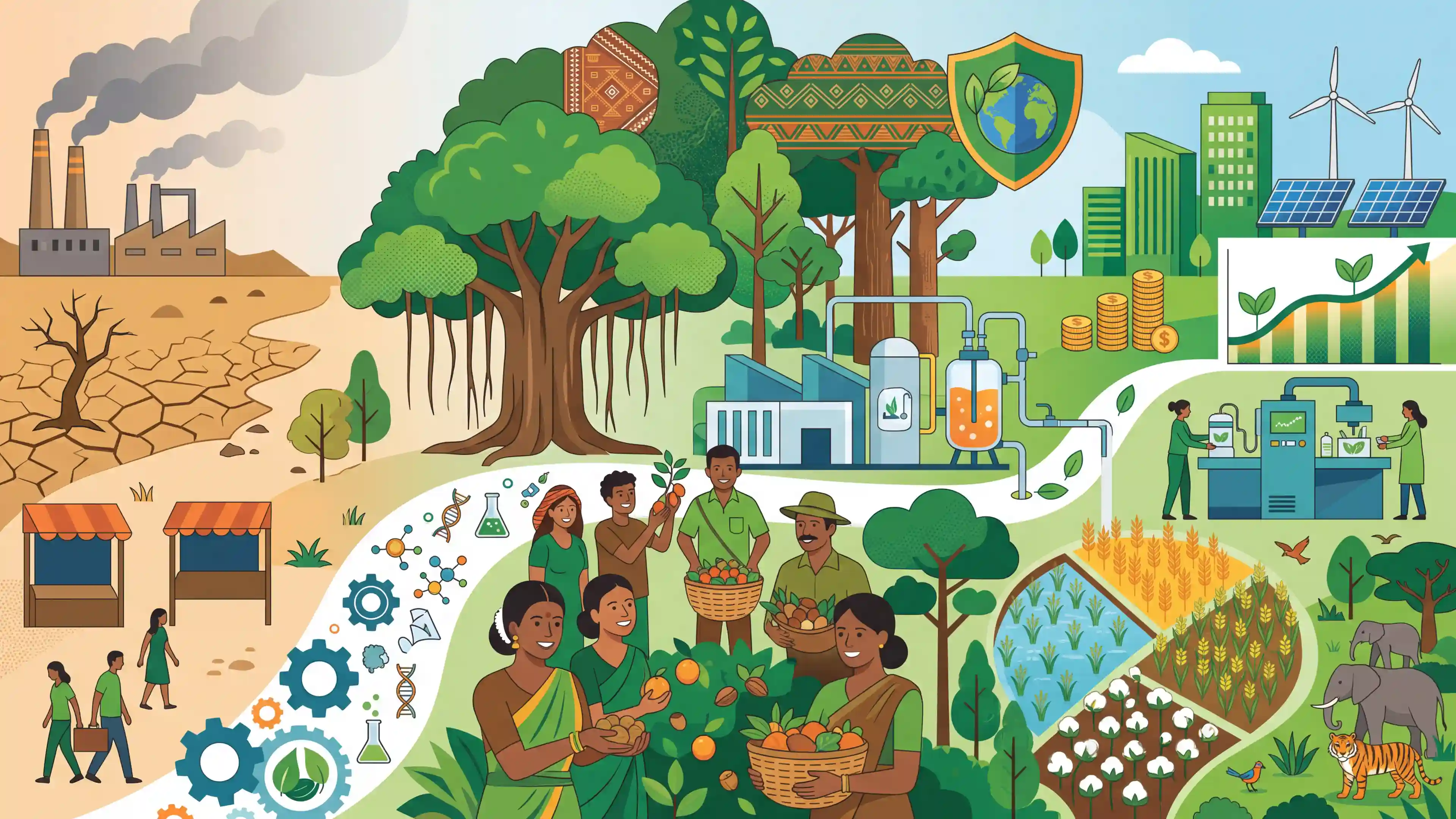
- Forests form the foundational bedrock for this transition by supplying non-timber forest products (NTFPs), medicinal plants, and essential ecosystem services.
- Sustainable harvesting and value addition of forest produce can significantly enhance rural livelihoods and empower forest-dependent communities, fostering inclusive growth.
- Integrating traditional knowledge with modern biotechnology can unlock new economic opportunities while ensuring the long-term conservation of forest ecosystems.
- Aligning forestry practices with bioeconomy objectives is critical for India to achieve its sustainable development goals and Net Zero targets by 2070.
Important Terms
BioE3 Policy

A 2024 national framework fostering high-performance biomanufacturing to drive India's bioeconomy to $300 billion by 2030. It emphasizes innovation, green growth, and employment across agriculture, healthcare, and industrial sectors.
UPSC context
GS III (S&T, Economy): Tests knowledge of emerging technologies, sustainable industrial growth, and national economic targets.
Forest Rights Act (FRA), 2006
Formally the Scheduled Tribes and Other Traditional Forest Dwellers (Recognition of Forest Rights) Act, 2006. It recognizes individual and community rights of forest-dwelling communities over land and resources.
UPSC context
GS II (Governance) & GS III (Environment): Vital for questions on social justice, tribal rights, and community-led conservation.
Non-Timber Forest Products (NTFPs)
Biological materials other than timber extracted from forests, such as fruits, resins, and medicinal plants. They provide critical livelihood support for nearly 275 million people in India.
UPSC context
GS III (Economy, Environment): Relevant for rural livelihoods, inclusive growth, and the economic value of biodiversity.
Circular Bioeconomy
An economic system using renewable biological resources to produce food, energy, and goods while minimizing waste through reuse and recycling, aligning growth with ecological sustainability.
UPSC context
GS III (Environment): Tests understanding of sustainable development models and climate change mitigation strategies.
Department of Biotechnology (DBT)
The nodal agency under the Ministry of Science and Technology responsible for promoting biotechnology research and industrial applications. It is the lead implementer of the BioE3 Policy.
UPSC context
GS III (S&T): Relevant for institutional frameworks governing scientific innovation and industrial biotechnology in India.
Ministry of Environment, Forest and Climate Change (MoEFCC)
The central ministry responsible for planning and implementing India's environmental and forestry policies, including conservation, climate change mitigation, and sustainable forest management.
UPSC context
GS III (Environment): Fundamental for understanding executive oversight of environmental protection and forest governance.
Prelims Trap
The State Forest Department retains exclusive ownership and transit rights over Minor Forest Produce used for biomanufacturing.
Under the Forest Rights Act (2006), the right of ownership, access to collect, use, and dispose of Minor Forest Produce is legally vested in forest-dwelling communities and the Gram Sabha.
Static Concepts Connected
What constitutes Minor Forest Produce (MFP) under the Forest Rights Act?
- Statutory Definition: It includes all non-timber forest produce of plant origin, such as bamboo, brush wood, stumps, cane, tussar, cocoons, honey, wax, lac, tendu leaves, and medicinal plants.
- Ownership Rights: The FRA 2006 formally vests ownership, collection, use, and disposal rights of MFP with forest-dwelling Scheduled Tribes and Other Traditional Forest Dwellers.
- MSP Support: A centrally sponsored scheme (Mechanism for Marketing of MFP through MSP) is implemented by TRIFED to ensure fair returns to gatherers.
What are the foundational principles of a Circular Bioeconomy?
- Renewable Substitution: Transitioning from fossil-based resources to renewable biological resources (plants, algae, organic waste) for energy, chemicals, and materials.
- Cascading Use: Prioritizing higher-value applications (pharmaceuticals, food, bioplastics) before lower-value applications (energy recovery or incineration) to maximize resource utility.
- Waste Elimination: Designing out waste by ensuring bio-based materials are looped back into the biosphere safely or reused in the industrial economy.
Cross-Topic Patterns
Traditional Knowledge & Biopiracy Regulations
Leveraging Traditional Ecological Knowledge (TEK) for biomanufacturing directly links to the Biological Diversity Act, 2002, testing the role of the National Biodiversity Authority in ensuring equitable benefit-sharing and preventing biopiracy.
Tribal Livelihoods & TRIFED Interventions
Commercialization of NTFPs for the bioeconomy intersects with TRIFED's Van Dhan Vikas Kendras. UPSC often tests how value-addition bridges ecological conservation with tribal poverty alleviation.

Expect a multi-statement question linking the BioE3 policy's biomanufacturing goals with the FRA 2006 definitions of Minor Forest Produce.
Linked PYQs · 4
Linked PYQs · 4
- 2019MainsGS3
It is argued that the strategy of inclusive growth is intended to meet the objectives of inclusiveness and sustainability together. Comment on this statement.
- 2020MainsGS3
Explain intra-generational and inter-generational issues of equity from the perspective of inclusive growth and sustainable development.
- 2023PrelimsGS1
Consider the following statements: Once the Central Government notifies an area as a 'Community Reserve' 1. the Chief Wildlife Warden of the State becomes the governing authority of such forest 2. hunting is not allowed in such area 3. people of such area are allowed to collect non-timber forest produce 4. people of such area are allowed traditional agricultural practices How many of the above statements are correct?
- 2019MainsGS3
Define the concept of carrying capacity of an ecosystem as relevant to an environment. Explain how understanding this concept is vital while planning for sustainable development of a region.
