India First Quantum Computing Test Beds Planned in Amaravati
Source:The Hindu ↗
Why It Matters
Quantum computing is a transformative frontier in S&T. For UPSC aspirants, understanding India's transition from being a software-reliant consumer to an indigenous hardware manufacturer in quantum tech is crucial for questions on Aatmanirbhar Bharat, technology sovereignty, and the National Quantum Mission in GS Paper 3.
Summary
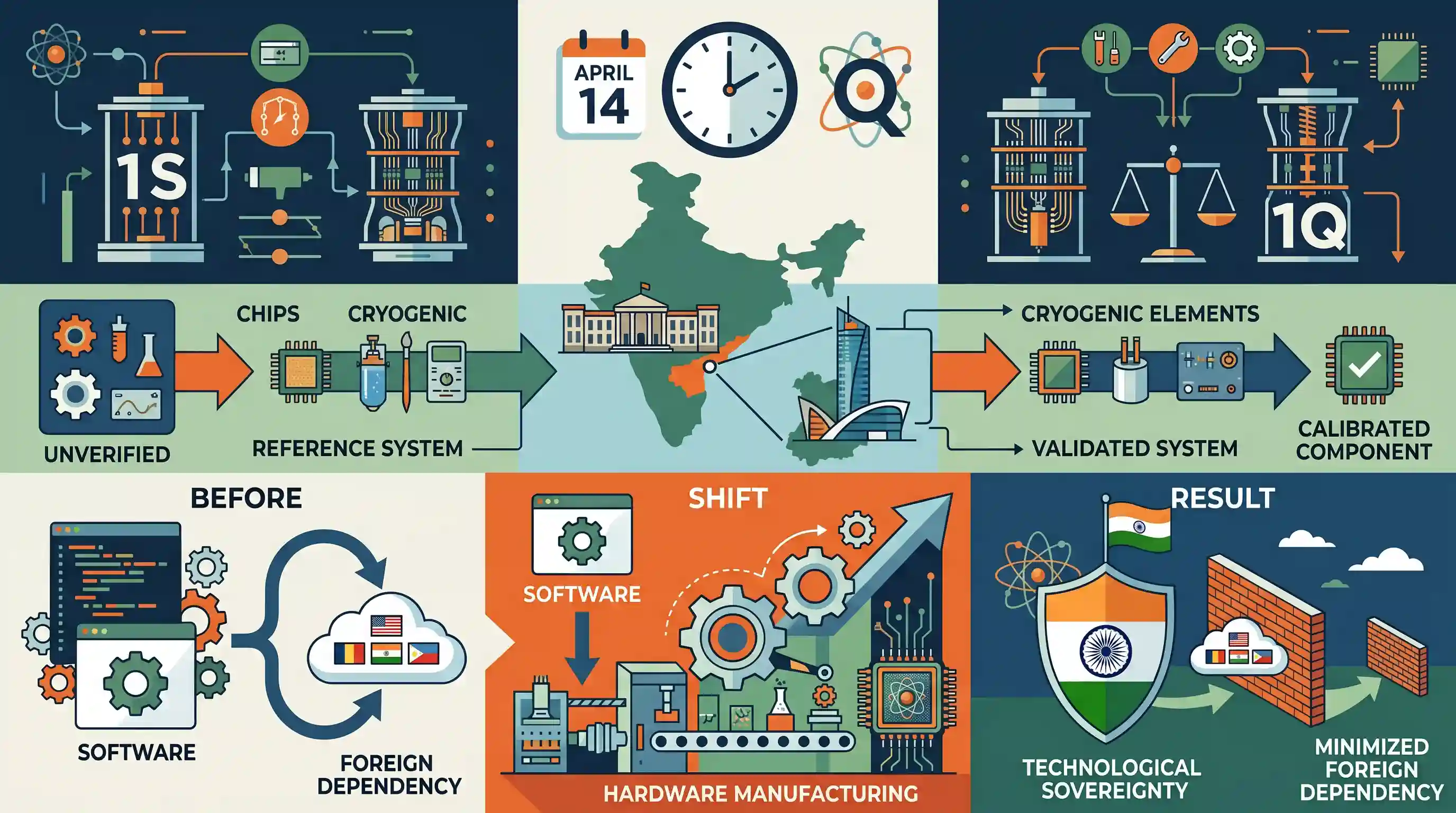
India’s first indigenous quantum computing test beds are set to be launched in Amaravati, Andhra Pradesh, to coincide with World Quantum Day. Housed at SRM University-A.P. and Medha Towers, these dual test beds will function as reference systems for testing and calibrating domestic quantum computing components. The project underscores a vital shift in India's technology strategy: focusing on hardware manufacturing rather than just software applications. By building local capacity to produce physical quantum infrastructure, the initiative aims to minimize foreign dependency and build genuine technological sovereignty in the emerging quantum landscape.
Key Points
- India's first locally built quantum computing test beds are being established in Amaravati, Andhra Pradesh, coinciding with World Quantum Day on April 14.
- The two testing beds, located at SRM University-A.P. and Medha Towers, will serve as crucial reference benchmarks to test and validate quantum components.
- The initiative marks a strategic shift towards indigenous hardware manufacturing in emerging technologies, reducing reliance on foreign hardware imports.
- By prioritizing hardware alongside software development and skills research, this regional initiative complements the broader self-reliance goals of India's National Quantum Mission.
Important Terms
National Quantum Mission (NQM)

India’s ₹6,003 crore flagship initiative (2023-2031) aiming to build 50-1000 qubit computers. It focuses on quantum computing, communication, sensing, and materials to establish India as a global technological leader.
UPSC context
GS3 (Science & Tech); essential for topics on emerging technologies, digital sovereignty, and national mission-mode R&D projects.
Quantum Computing Test Bed
Specialized physical infrastructure (e.g., Amaravati 1S and 1Q) used to test, calibrate, and certify quantum hardware. These systems operate near absolute zero to maintain quantum coherence for component validation.
UPSC context
GS3 (S&T/Indigenization); tests understanding of the shift from software applications to domestic hardware manufacturing and technological self-reliance.
Indigenization of Technology
The domestic development and manufacturing of technology to reduce foreign dependency. In quantum tech, this involves building indigenous dilution refrigerators, superconducting circuits, and cryogenic hardware for technological sovereignty.
UPSC context
GS3 (S&T/Economy); core theme regarding 'Atmanirbhar Bharat' and reducing strategic vulnerabilities in critical infrastructure.
Qubit
The fundamental unit of quantum information. Unlike classical bits (0 or 1), qubits can exist in a superposition of both states simultaneously, allowing for exponentially faster processing of complex data.
UPSC context
GS3 (S&T); a frequent Prelims topic testing basic conceptual clarity in modern physics and computing.
Amaravati Quantum Valley
A regional ecosystem initiative in Andhra Pradesh designed to host indigenous test beds and research facilities. It aims to integrate startups, academia, and industry into a specialized quantum technology cluster.
UPSC context
GS3 (Regional Innovation); demonstrates sub-national roles in national deep-tech missions and the creation of specialized industrial hubs.
Thematic Hubs (T-Hubs)
Four specialized centers established under NQM at IISc and various IITs. They focus on Computing, Communication, Sensing, and Materials using a hub-and-spoke model to drive collaborative research.
UPSC context
GS3 (S&T/Institutional Framework); highlights the organizational structure of India’s scientific research and public-private partnerships.
Prelims Trap
India has launched its first fully functional, indigenous commercial quantum computer in Amaravati under the National Quantum Mission.
Aspirants often confuse testing infrastructure with end-products. These test beds are for calibrating/validating hardware components, not functional commercial quantum computers capable of solving algorithms.
Static Concepts Connected
What are the core operating principles of Quantum Computing?
- Superposition: The ability of a quantum bit (qubit) to exist in multiple states (0 and 1) simultaneously, enabling massive parallel processing.
- Entanglement: A phenomenon where qubits become intrinsically linked; changing the state of one instantly changes the other, regardless of distance.
- Decoherence: The fragile nature of quantum states, which easily collapse back to classical states when disturbed by environmental noise or temperature fluctuations.
What is the structure of India's National Quantum Mission (NQM)?
- Nodal Agency: Spearheaded by the Department of Science and Technology (DST) to scale up R&D and seed a vibrant quantum technology ecosystem by 2031.
- Thematic Hubs (T-Hubs): The mission operates through four specific hubs: Quantum Computing, Quantum Communication, Quantum Sensing & Metrology, and Quantum Materials & Devices.
- Hardware Focus: Focuses heavily on indigenization, aiming to develop intermediate-scale quantum computers (50-1000 physical qubits) to reduce foreign dependency.
Cross-Topic Patterns
Hardware Sovereignty + Semiconductor Mission
Establishing quantum test beds mirrors India's Semiconductor Mission—shifting the national economic focus from IT software prowess to building indigenous, physical high-tech hardware manufacturing capacity.
Quantum Technology + Internal Cybersecurity
Advances in quantum hardware accelerate risks to standard RSA encryption, elevating the strategic urgency for Quantum Key Distribution (QKD) infrastructure within India's internal security framework.

Expect a 2026 Prelims question merging NQM’s 4 thematic hubs, hardware test beds, and qubit properties like superposition.
Linked PYQs · 3
Linked PYQs · 3
- 2022PrelimsGS1
Which one of the following is the context in which the term "qubit" is mentioned ?
- 2024PrelimsGS1
Consider the following statements: I. It is expected that Majorana 1 chip will enable quantum computing. II. Majorana 1 chip has been introduced by Amazon Web Services (AWS). III. Deep learning is a subset of machine learning. Which of the statements given above are correct?
- 2025PrelimsGS1
Consider the following statements: I. It is expected that Majorana 1 chip will enable quantum computing. II. Majorana 1 chip has been introduced by Amazon Web Services (AWS). III. Deep learning is a subset of machine learning. Which of the statements given above are correct?
