Geosynchronous Orbit Imaging Satellite Launch by ISRO
Source:Indian Express ↗
ఇది ఎందుకు ముఖ్యం
Understanding advancements in space technology, particularly the shift towards geosynchronous imaging satellites, is crucial for UPSC aspirants as it impacts national security, disaster management, and India's growing commercial space footprint.
సారాంశం
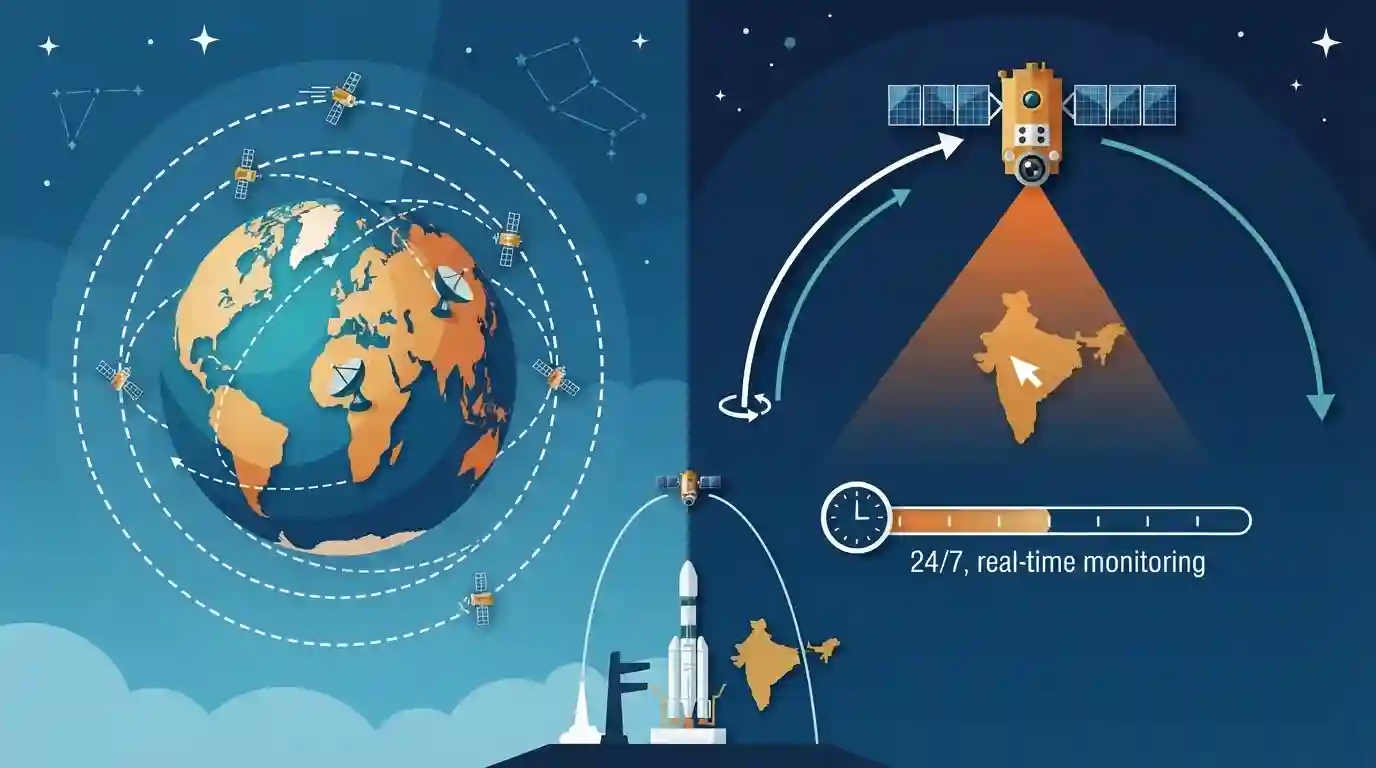
India successfully launched its first imaging satellite into a geosynchronous orbit, marking a significant milestone in Earth observation and remote sensing capabilities by enabling continuous, real-time monitoring of specific regions rather than periodic passes associated with lower orbits.
ముఖ్య అంశాలు
- India successfully launched its first imaging satellite in a geosynchronous orbit.
- Geosynchronous orbit imaging enables continuous monitoring of specific regions, which is a departure from traditional low earth orbit or sun-synchronous earth observation satellites.
- This technological advancement enhances India's capabilities in weather tracking, disaster management, and strategic surveillance.
ముఖ్యమైన పదాలు
ISRO

India's national space agency responsible for planning, executing, and promoting space exploration, satellite launches, and cosmic research programs.
UPSC context
Important for GS Paper III (Science & Technology - Space). Tests understanding of institutional bodies, technological milestones, and indigenous space capabilities.
అనుసంధానమైన స్థిర భావనలు
What are the key orbital differences between Sun-Synchronous Orbit (SSO) and Geosynchronous Orbit (GSO)?
- SSO Characteristics: SSO is a nearly polar orbit where satellites pass over any given point of the planet at the same local solar time, ideal for global periodic mapping.
- GSO Characteristics: GSO satellites match the Earth's rotational period (~24 hours) at ~36,000 km, allowing persistent, continuous staring capability over specific regional targets.
- Altitude & Launch: SSO satellites operate in Low Earth Orbit (LEO, 600-800 km) requiring lower energy launches, whereas GSO requires high-energy GSLV vehicles with cryogenic stages.
అంతర-అంశ నమూనాలు
Space Tech + National Security Surveillance
Geosynchronous earth observation satellites serve dual purposes, bridging civilian meteorological tracking with continuous strategic border surveillance capabilities.
GSLV Cryogenic Tech + Heavy-Lift Capabilities
Deploying heavier payloads into sub-GTO using indigenous GSLV vehicles underscores the critical role of cryogenic engine technology in heavy-lift missions.

Expect a statement-based Prelims question contrasting the persistent monitoring advantages of Geosynchronous vs Sun-Synchronous orbits.
అనుసంధాన PYQలు · 2
అనుసంధాన PYQలు · 2
- 2018PrelimsGS1
With reference to India's satellite launch vehicles, consider the following statements: 1. PSLVs launch the satellites useful for Earth resources monitoring whereas GSLVs are designed mainly to launch communication satellites. 2. Satellites launched by PSLV appear to remain permanently fixed in the same position in the sky, as viewed from a particular location on Earth. 3. GSLV Mk III is a four-staged launch vehicle with the first and third stages using solid rocket motors; and the second and fourth stages using liquid rocket engines. Which of the statements given above is/are correct?
- 2022MainsGS3
Launched on 25th December, 2021, James Webb Space Telescope has been much in the news since then. What are its unique features which make it superior to its predecessor Space Telescopes ? What are the key goals of this mission ? What potential benefits does it hold for the human race?
