Palk Bay Dugong Reserve Receives Global Recognition at IUCN
Source:The Hindu ↗
Why It Matters
Dugongs are a flagship marine species whose conservation highlights the health of seagrass ecosystems (blue carbon sinks). Questions on dugong habitats and conservation status (e.g., 2009 Prelims), as well as protected area classifications under the Wildlife Protection Act, are recurring UPSC themes.
Summary
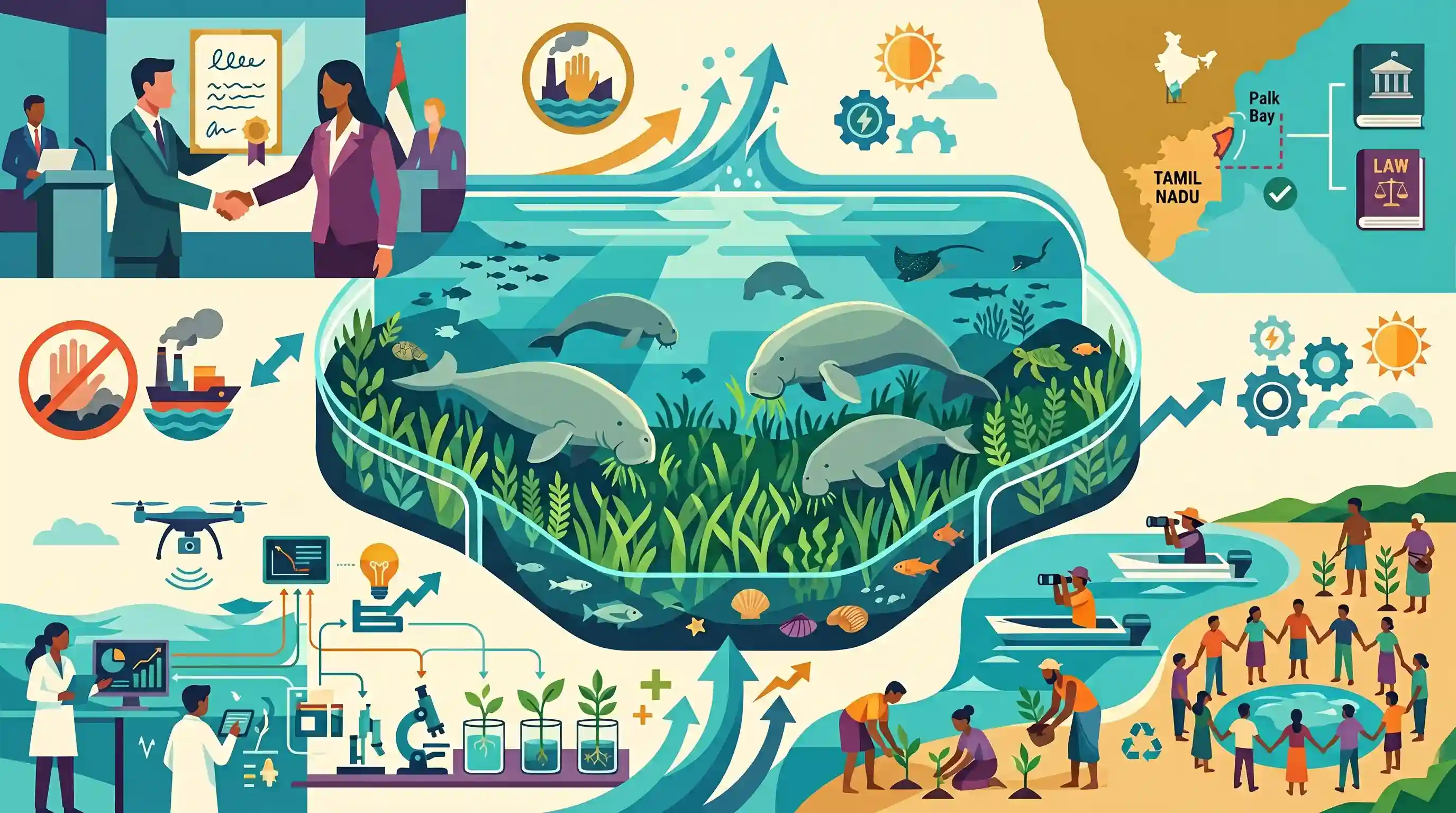
The IUCN has formally recognized India's first Dugong Conservation Reserve, located in Tamil Nadu's Palk Bay, at the World Conservation Congress in Abu Dhabi. Established in 2022 under the Wildlife (Protection) Act, the 448 sq. km reserve protects vulnerable dugongs and their primary habitat, over 12,250 hectares of seagrass meadows. The global recognition highlights India's commitment to marine ecosystem restoration, emphasizing innovative scientific techniques and the active participation of local coastal communities to combat habitat loss and climate change.
Key Points
- The IUCN formally recognized India's first Dugong Conservation Reserve in Palk Bay by adopting a motion at the 2025 World Conservation Congress in Abu Dhabi.
- The reserve, established by the Tamil Nadu government in 2022 under the Wildlife (Protection) Act, spans 448.34 sq. km and protects critical seagrass meadow habitats.
- Dugongs (sea cows) are marine mammals listed as Vulnerable on the IUCN Red List, facing severe threats from habitat degradation, destructive fishing practices, and climate change.
- The initiative incorporates ecological restoration techniques, such as attaching seagrass sprigs to biodegradable bamboo and coconut rope frames, actively involving local fishing communities.
Important Terms
Wildlife (Protection) Act, 1972

Enacted in 1972, this Indian legislation provides the legal framework for protecting wild animals, plants, and habitats through schedules of protection and the establishment of protected areas.
UPSC context
GS Paper 3 (Environment/Governance); tests knowledge of legal safeguards, schedules, and conservation amendments.
Dugong
A herbivorous marine mammal, often called the 'sea cow,' found in India in Palk Bay, Gulf of Mannar, Gulf of Kutch, and Andaman & Nicobar Islands.
UPSC context
GS Paper 3 (Biodiversity); frequent Prelims topic testing species' habitat, diet, and conservation status.
IUCN Red List
The world's most comprehensive inventory of the global conservation status of biological species, classifying them into categories like Vulnerable, Endangered, and Critically Endangered.
UPSC context
GS Paper 3 (Conservation); core requirement for identifying protection priorities of global species.
IUCN (International Union for Conservation of Nature)
An international organization (founded in 1948) that works in the field of nature conservation and sustainable use of natural resources.
UPSC context
GS Paper 2/3 (International Institutions/Environment); tests knowledge of global environmental governance and mandates.
Seagrass Meadows
Underwater ecosystems consisting of flowering plants that provide critical habitat for marine life, stabilize sea floors, and act as significant carbon sinks.
UPSC context
GS Paper 3 (Environment/Climate Change); tests ecological functions and marine carbon sequestration (Blue Carbon).
Palk Bay
A semi-enclosed shallow water body between India and Sri Lanka, hosting a large portion of India’s seagrass and its first dugong reserve.
UPSC context
GS Paper 1 (Geography/Mapping); relevant for location-based questions and bilateral environmental issues.
Suganthi Devadason Marine Research Institute (SDMRI)
A Tamil Nadu-based non-governmental marine research organization specialized in the restoration of coral reefs and seagrass beds in India.
UPSC context
GS Paper 3 (Conservation); highlights the role of scientific institutions in implementing government conservation goals.
Prelims Trap
"Dugongs are endemic to Palk Bay and are classified as Critically Endangered by the IUCN."
Dugongs are found in Palk Bay, Gulf of Mannar, Gulf of Kutch, and A&N Islands. They are 'Vulnerable', not 'Critically Endangered'.
Static Concepts Connected
What is a Conservation Reserve under the WPA, 1972?
- Declaration: Declared by State Governments to protect landscapes, seascapes, and habitat linking protected areas.
- Land Ownership: Typically declared on government-owned lands, unlike Community Reserves which are on private/community lands.
- Community Rights: The rights of people living inside a Conservation Reserve are not affected by its declaration.
How do Seagrasses differ from Seaweeds?
- Biology: Seagrasses are vascular flowering plants with roots and veins. Seaweeds are multi-cellular marine algae (non-vascular).
- Nutrient Absorption: Seagrasses extract nutrients from sediment via roots. Seaweeds extract nutrients directly from the water column.
- Ecological Role: Seagrasses form dense underwater meadows crucial as blue carbon sinks and primary dugong food.
Cross-Topic Patterns
Seagrass as Blue Carbon Sinks
Dugong conservation protects seagrass meadows, which are powerful 'blue carbon' sinks. This directly links species protection to India's climate mitigation strategies and Nationally Determined Contributions (NDCs).
Aquatic Mammals: Dugongs vs. Dolphins
UPSC frequently tests aquatic mammals. Expect comparisons between Dugongs (marine herbivores, Vulnerable) and Gangetic or Irrawaddy Dolphins (freshwater/brackish carnivores, Endangered) regarding their habitats and diets.

Expect a Prelims 2026 question contrasting Dugong habitat (marine/herbivore/Vulnerable) with Gangetic/Irrawaddy dolphins.
Linked PYQs · 3
Linked PYQs · 3
- 2009PrelimsGS1
The marine animal called dugong which is vulnerable to extinction is a/an
- 2023PrelimsGS1
Consider the following statements: Once the Central Government notifies an area as a 'Community Reserve' 1. the Chief Wildlife Warden of the State becomes the governing authority of such forest 2. hunting is not allowed in such area 3. people of such area are allowed to collect non-timber forest produce 4. people of such area are allowed traditional agricultural practices How many of the above statements are correct?
- 2022PrelimsGS1
With reference to Indian laws about wildlife protection, consider the following statements : 1. Wild animals are the sole property of the government. 2. When a wild animal is declared protected, such animal is entitled for equal protection whether it is found in protected areas or outside. 3. Apprehension of a protected wild animal becoming a danger to human life is sufficient ground for its capture or killing. Which of the statements given above is/are correct?
