Structural challenges and fiscal federalism tensions in India
Source:The Hindu ↗
Why It Matters
Federalism is a core pillar of the Indian Constitution and a perennial theme in UPSC Mains GS-II. With the constitution of the 16th Finance Commission and debates surrounding the upcoming delimitation exercise, the structural frictions between the Union and the States (fiscal, legislative, and political) are highly relevant for analytical essay and governance questions.
Summary
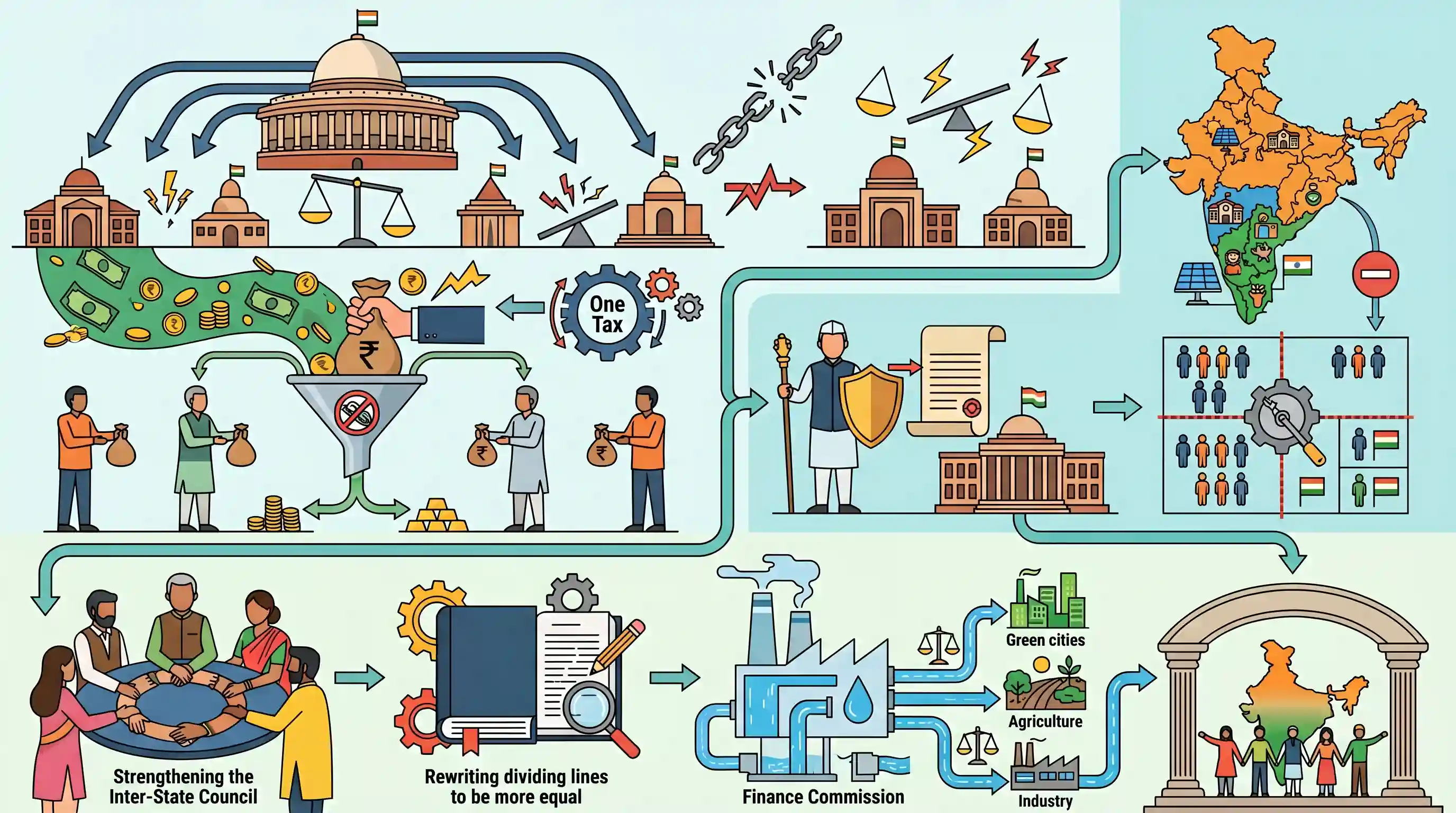
The article advocates for a comprehensive structural reset of India's federal framework in response to growing centralisation and increasing Centre-State friction. It highlights critical challenges in fiscal federalism, particularly the states' reduced revenue-raising capabilities post-GST and the shrinking divisible pool due to the Union's use of cesses and surcharges. Furthermore, the politicised role of Governors in obstructing state legislation and the acute anxieties of southern states regarding the demographic penalties of the upcoming delimitation exercise exacerbate the federal divide. To build trust and restore constitutional balance, the piece suggests strengthening institutional mechanisms like the Inter-State Council, revisiting the Seventh Schedule, and ensuring more equitable financial devolution through the Finance Commission.
Key Points
- Increasing centralisation tendencies have strained the traditional framework of Indian federalism, necessitating a structural reset to restore Centre-State balance.
- Fiscal federalism has been progressively weakened by states' loss of taxation autonomy post-GST and the Union's increasing reliance on non-divisible cesses and surcharges.
- Recurrent friction between Governors and elected state governments, particularly over withholding assent to Bills, violates the spirit of cooperative federalism.
- The looming delimitation exercise poses a demographic penalty on southern states that have successfully controlled their population, sparking fears of reduced political representation and fiscal devolution.
- Key solutions include revisiting the division of powers in the Seventh Schedule, institutionalizing the Inter-State Council as an active dispute-resolution body, and ensuring equitable resource distribution via the Finance Commission.
Important Terms
Fiscal Federalism

The financial relations and allocation of powers (taxation, expenditure, and transfers) between central, state, and local governments within a federal system.
UPSC context
GS Paper II & III; tests understanding of revenue sharing, financial autonomy, and cooperative federalism.
Finance Commission
A constitutional body under Article 280 that recommends the distribution of tax revenues between the Union and States and among individual States.
UPSC context
GS Paper II; central to questions on financial devolution and balancing vertical/horizontal fiscal imbalances.
Inter-State Council
A constitutional body established under Article 263 to investigate disputes and coordinate policy between the Union and the States.
UPSC context
GS Paper II; tests knowledge of institutional mechanisms for resolving Centre-State friction and promoting cooperation.
GST Council
A constitutional forum (Article 279A) chaired by the Union Finance Minister to make joint decisions on GST rates, exemptions, and administration.
UPSC context
GS Paper II & III; essential for discussing indirect tax reforms and collaborative fiscal decision-making.
Seventh Schedule
The constitutional framework (Article 246) that delineates legislative jurisdiction through the Union, State, and Concurrent Lists.
UPSC context
GS Paper II; core to questions regarding the division of powers and legislative federalism.
Delimitation
The process of redrawing territorial boundaries of electoral constituencies based on census data to ensure equal representation for equal population.
UPSC context
GS Paper II; relevant for discussing democratic representation and political anxieties regarding North-South demographic shifts.
Cesses and Surcharges
Additional taxes levied by the Centre for specific purposes (cess) or higher income groups (surcharge) which do not enter the divisible tax pool.
UPSC context
GS Paper III; critical for analyzing the shrinking of state revenues and Centre-State fiscal friction.
Prelims Trap
Cesses and surcharges levied by the Union government form part of the divisible pool of taxes shared with States.
Under Article 271, cesses and surcharges are explicitly excluded from the divisible pool. The Union retains 100% of these revenues, which is a major friction point in fiscal federalism.
Static Concepts Connected
What are the constitutional provisions for a Governor's assent to State Bills?
- Article 200 Options: The Governor can grant assent, withhold, return (if not a Money Bill), or reserve the Bill for the President's consideration.
- Return Obligation: If the state legislature passes a returned bill again, with or without amendments, the Governor is constitutionally bound to give assent.
- SC Clarification: The Supreme Court ruled that Governors cannot indefinitely delay assent without returning the bill to the legislature, effectively preventing a de facto pocket veto.
How is the divisible pool of taxes constitutionally structured?
- Union Taxes (Art 270): Taxes levied and collected by the Union are distributed between the Centre and States based on Finance Commission recommendations.
- Exclusions (Art 271): Cesses and surcharges are strictly excluded from the divisible pool, allowing the Union government to retain their entire revenue.
- GST Impact (Art 279A): The 101st Amendment pooled indirect taxes, altering states' independent taxation powers and increasing their reliance on centralized devolution.
Cross-Topic Patterns
Delimitation & Population Demographics
The lifting of the post-2026 delimitation freeze directly links structural polity frameworks (Article 82) to the demographic divergence and historical family planning successes of Southern states.
Statutory vs Constitutional Federal Bodies
UPSC often contrasts the Constitutional Inter-State Council (Article 263) with statutory bodies like Zonal Councils (States Reorganisation Act, 1956) when testing Centre-State dispute resolution mechanisms.

The impending post-2026 delimitation freeze makes a combined question on demographic penalties, Article 271, and Article 200 highly likely.
Linked PYQs · 4
Linked PYQs · 4
- 2025MainsGS2
Examine the evolving pattern of Centre-State financial relations in the context of planned development in India. How far have the recent reforms impacted the fiscal federalism in India?
- 2024MainsGS2
What changes has the Union Government recently introduced in the domain of Centre-State relations ? Suggest measures to be adopted to build the trust between the Centre and the States and for strengthening federalism.
- 2015MainsGS2
The concept of cooperative federalism has been increasingly emphasized in recent years. Highlight the drawbacks in the existing structure and the extent to which cooperative federalism would answer the shortcomings.
- 2022MainsGS2
“While the national political parties in India favour centralisation, the regional parties are in favour of State autonomy.” Comment.
