India Merchandise Export Growth and External Sector Trade Deficit
Source:The Hindu ↗
Why It Matters
Understanding trade dynamics is crucial for the UPSC syllabus as it directly impacts India's Balance of Payments (BoP), foreign exchange reserves, and currency valuation. The widening trade deficit despite rising exports underscores structural import dependencies, making it a highly relevant topic for GS-3 (Economy) and GS-2 (International Relations, especially concerning West Asia).
Summary
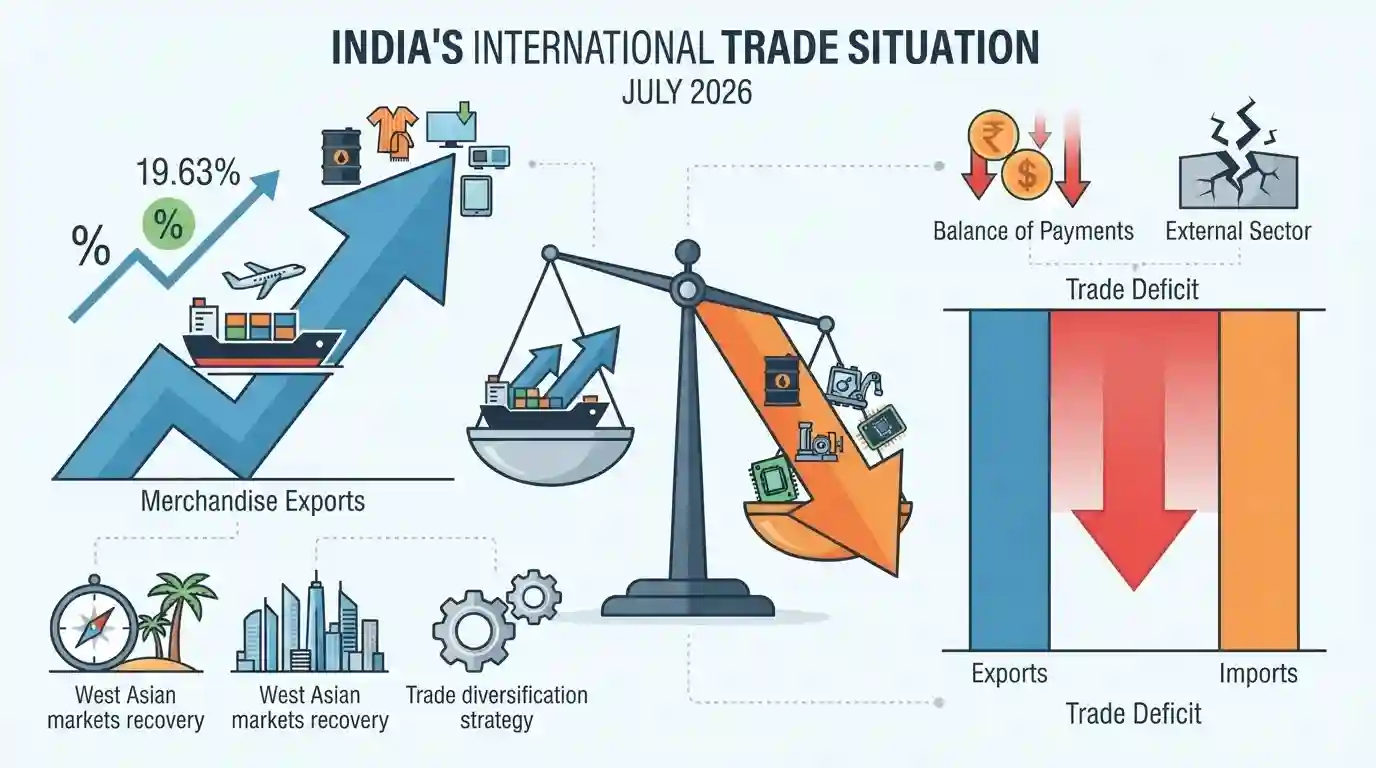
India's merchandise exports witnessed a significant 19.63% growth in July 2026, reaching $44.24 billion. This surge was primarily fueled by a demand recovery in West Asian markets and the country's strategic focus on trade diversification. However, despite the strong export performance, the overall trade deficit widened to $31.98 billion as imports continued to grow, highlighting structural pressures on India's balance of payments and external sector stability.
Key Points
- India's merchandise exports surged by 19.63% to reach $44.24 billion in July 2026.
- Despite the robust export growth, the overall trade deficit widened to $31.98 billion due to a significant rise in imports.
- The export boost was primarily driven by economic recovery in West Asia and India's ongoing efforts toward trade diversification.
- The data highlights ongoing structural challenges in India's balance of trade, where import dependence outpaces export gains.
Important Terms
Merchandise exports

The export of tangible, physical goods to foreign countries, such as electronics, engineering items, and petroleum products, excluding intangible services.
UPSC context
GS Paper 3 (Economy); crucial for assessing external sector performance, manufacturing competitiveness, and trade deficit dynamics.
Trade diversification
A strategic approach to expanding a country's export destinations and product offerings to reduce over-reliance on a few traditional markets or commodities.
UPSC context
GS Paper 3 (Economy); vital for mitigating external economic shocks and ensuring sustainable, resilient export growth.
Trade deficit
An economic condition where the total value of a country's imported goods exceeds the value of its exported goods over a specific period.
UPSC context
GS Paper 3 (Economy); a key indicator of balance of payments health, currency pressure, and domestic manufacturing capabilities.
Balance of Payments (BoP)
A comprehensive accounting ledger that records all economic transactions between a country's residents and the rest of the world during a specific timeframe.
UPSC context
GS Paper 3 (Economy); fundamental macroeconomic concept for analyzing external stability, currency valuation, and foreign exchange reserves.
Ministry of Commerce and Industry
The central government ministry responsible for formulating and implementing India's foreign trade policies, promoting exports, and driving domestic industrial development.
UPSC context
GS Paper 2 & 3; tested on foreign trade policy (FTP), industrial growth initiatives, and FDI regulations.
Prelims Trap
"A steep surge in merchandise exports naturally leads to a narrowing of India's overall merchandise trade deficit."
Due to India's high import intensity of exports (importing intermediates to export finished goods) and inelastic imports, trade deficits often widen despite record export surges.
Static Concepts Connected
How does India manage its merchandise trade deficit in the Current Account?
- Visible Account Deficit: Merchandise trade consistently records a deficit due to India's structural dependence on inelastic imports like crude oil, gold, and electronics.
- Invisible Account Surplus: The Current Account relies heavily on structural surpluses from services exports (like IT) and inward remittances (transfers) to offset the massive goods deficit.
What explains the high 'import intensity' of India's merchandise exports?
- Intermediate Goods Reliance: Indian manufacturing heavily relies on imported raw materials and components (like pharmaceutical APIs, electronic chips, and rough diamonds) to produce value-added final exports.
- The Export-Import Paradox: Consequently, policies or global trends that successfully boost India's manufactured exports often trigger a simultaneous surge in its import bill.
Cross-Topic Patterns
Look West to Trade Realities
India’s diplomatic shift from energy-dependency to strategic trade in West Asia (like India-UAE CEPA) directly drives external sector stability and boosts labor-intensive merchandise exports.
Currency pressure & Imported Inflation
A persistently widening trade deficit exerts depreciating pressure on the Rupee, complicating the RBI's inflation management due to the rising cost of inelastic imports like crude oil.

Expect a 2026 Prelims question testing the paradox of simultaneous export growth and widening trade deficits due to import-intensity.
Linked PYQs · 4
Linked PYQs · 4
- 2020PrelimsGS1
With reference to the international trade of India at present, which of the following statements is/are correct? 1. India's merchandise exports are less than its merchandise imports. 2. India's imports of iron and steel, chemicals, fertilisers and machinery have decreased in recent years. 3. India's exports of services are more than its imports of services. 4. India suffers from an overall trade/current account deficit. Select the correct answer using the code given below:
- 2017MainsGS3
Account for the failure of manufacturing sector in achieving the goal of labour-intensive exports. Suggest measures for more labour-intensive rather than capital-intensive exports.
- 2017MainsGS2
The question of India's Energy Security constitutes the most important part of India's economic progress. Analyze India's energy policy cooperation with West Asian countries.
- 2026PrelimsGS1
Ships from which of the following countries have to cross the Strait of Hormuz to reach out to the Indian Ocean ? 1. Bahrain 2. Syria 3. Qatar 4. Egypt Select the answer using the code given below :
