FIEO export projection and global trade headwinds for India
Source:Indian Express ↗
Why It Matters
Exports are a core engine of India's GDP growth and foreign exchange reserves. Candidates must understand how domestic trade policies interact with external vulnerabilities like geopolitical chokepoints (Red Sea) and global protectionist trends.
Summary
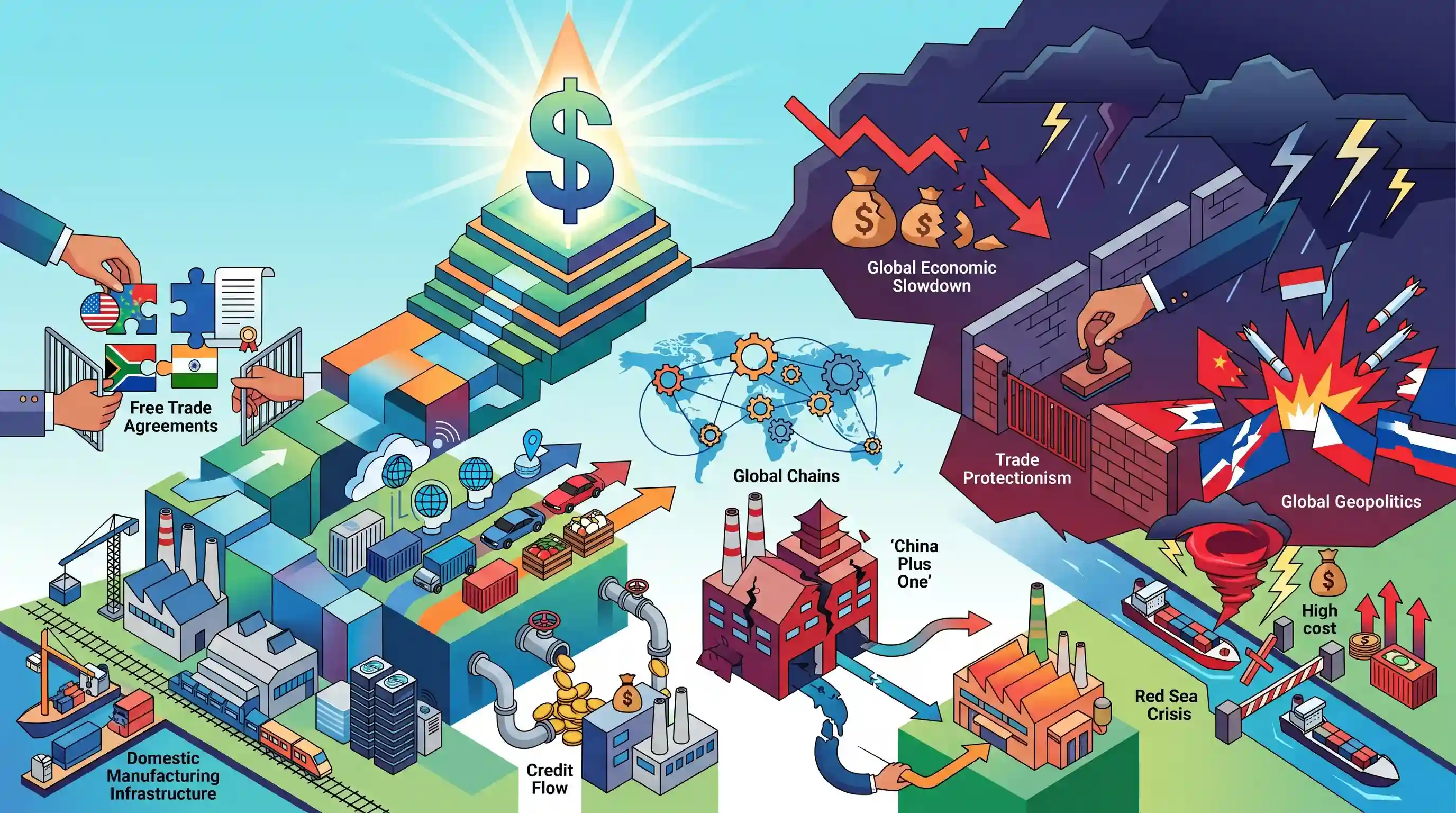
The Federation of Indian Export Organisations (FIEO) projects that India's combined exports of goods and services could touch $1 trillion by the financial year 2025-26. While the target reflects India's growing integration into global value chains and its benefit from 'China Plus One' supply chain shifts, significant headwinds persist. Global economic slowdowns, rising trade protectionism, and geopolitical tensions—particularly logistical hurdles and freight cost spikes from the Red Sea crisis—threaten to dampen export momentum. To secure this growth, India must leverage Free Trade Agreements (FTAs), bolster domestic manufacturing infrastructure, and ensure adequate credit flow to export-driven sectors.
Key Points
- FIEO anticipates India's overall exports (merchandise and services) could reach the $1 trillion mark by FY26, signaling strong structural growth.
- Global headwinds remain a major concern, including demand slowdown in developed economies, rising protectionism, and logistical disruptions stemming from the Red Sea crisis.
- India is positioning itself as a reliable alternative under the 'China Plus One' supply chain strategy, buoyed by expanding manufacturing capacity.
- Achieving the target requires focused policy interventions, enhanced credit availability for export-oriented MSMEs, and finalizing strategic Free Trade Agreements (FTAs).
Important Terms
Free Trade Agreements (FTAs)

International treaties where member countries reduce or eliminate tariffs and non-tariff barriers to facilitate the free flow of goods, services, and investments across borders.
UPSC context
GS Paper 2 & 3: Critical for trade policy, regional integration, and bilateral relations.
FIEO (Federation of Indian Export Organisations)
The apex body for Indian export promotion organizations, established in 1965 by the Ministry of Commerce to support exporters and advocate for trade-friendly policies.
UPSC context
GS Paper 3: Key institutional framework for export facilitation and economic growth.
China Plus One Strategy
A global business strategy where companies diversify their manufacturing and supply chains beyond China to reduce overdependence and mitigate geopolitical or economic risks.
UPSC context
GS Paper 3: Relevant for industrial growth, supply chain resilience, and FDI inflows.
Global Value Chains (GVCs)
The fragmented production of goods and services across multiple countries, where each stage—from design to final assembly—adds specific value to the product.
UPSC context
GS Paper 3: Tests understanding of modern international trade and manufacturing competitiveness.
Red Sea Crisis
Ongoing maritime disruptions in the Bab-el-Mandeb strait affecting the Suez Canal route, leading to increased freight costs and delayed shipments via the Cape of Good Hope.
UPSC context
GS Paper 2 & 3: Geopolitics affecting trade routes and energy security.
Trade Protectionism
Government policies such as high tariffs, quotas, and non-tariff barriers designed to restrict imports and protect domestic industries from foreign competition.
UPSC context
GS Paper 3: Challenges to globalization and export-oriented growth strategies.
Prelims Trap
India aims to achieve $1 trillion in merchandise exports by FY26.
The $1 trillion projection is for combined goods AND services exports, not just merchandise. India's services exports are crucial to hitting this overall target.
Static Concepts Connected
What is the difference between an FTA, CECA, and CEPA in India's trade diplomacy?
- Free Trade Agreement (FTA): Focuses primarily on eliminating tariffs on a specific list of goods, but may not deeply cover services or investment (e.g., India-ASEAN FTA).
- Comprehensive Economic Cooperation Agreement (CECA): Broader than an FTA; usually covers tariff reduction in goods and some services, serving as a stepping stone to deeper integration.
- Comprehensive Economic Partnership Agreement (CEPA): The deepest integration, covering trade in goods, services, investments, and broader economic cooperation (e.g., India-UAE CEPA).
Which chokepoints are bypassed when vessels reroute from the Red Sea to the Cape of Good Hope?
- Bab-el-Mandeb Strait: The critical 20-mile-wide strait connecting the Gulf of Aden to the Red Sea, bordered by Yemen and Djibouti.
- Suez Canal: The artificial waterway in Egypt connecting the Red Sea to the Mediterranean Sea, facilitating direct Asia-Europe trade.
- Economic Impact: Rerouting around southern Africa avoids Houthi attacks but adds 10-14 days to transit, escalating freight and insurance costs for Indian exports.
Cross-Topic Patterns
Supply Chains + Domestic PLI schemes
The 'China Plus One' export opportunity relies heavily on India's Production Linked Incentive (PLI) schemes, which aim to scale domestic manufacturing capacity to meet this shifting global demand.
Logistics Costs + Imported Inflation
Red Sea logistical hurdles don't just dampen exports; higher inbound freight costs also cause imported inflation, directly impacting the RBI's macroeconomic stability calculations and monetary policy.

Expect a 2026 Prelims question testing the composition of India's export basket (goods vs. services) alongside maritime trade chokepoints.
Linked PYQs · 4
Linked PYQs · 4
- 2018MainsGS3
How would the recent phenomena of protectionism and currency manipulations in world trade affect macroeconomic stability of India?
- 2024MainsGS2
‘The West is fostering India as an alternative to reduce dependence on China's supply chain and as a strategic ally to counter China's political and economic dominance.’ Explain this statement with examples.
- 2013PrelimsGS1
The balance of payments of a country is a systematic record of
- 2014PrelimsGS1
With reference to Balance of Payments, which of the following constitutes/constitute the Current Account? 1. Balance of trade 2. Foreign assets 3. Balance of invisibles 4. Special Drawing Rights Select the correct answer using the code given below.
