Ethanol Blending Targets and Emerging Food Security Trade Offs
Source:Indian Express ↗
Why It Matters
This article provides a critical analysis of India's Ethanol Blending Programme (EBP), making it highly relevant for GS3 topics like Energy Security, Environment, and Agriculture. It bridges the 'food vs. fuel' debate, which is a frequent theme in Mains exams when discussing sustainability, climate change, and agricultural challenges.
Summary
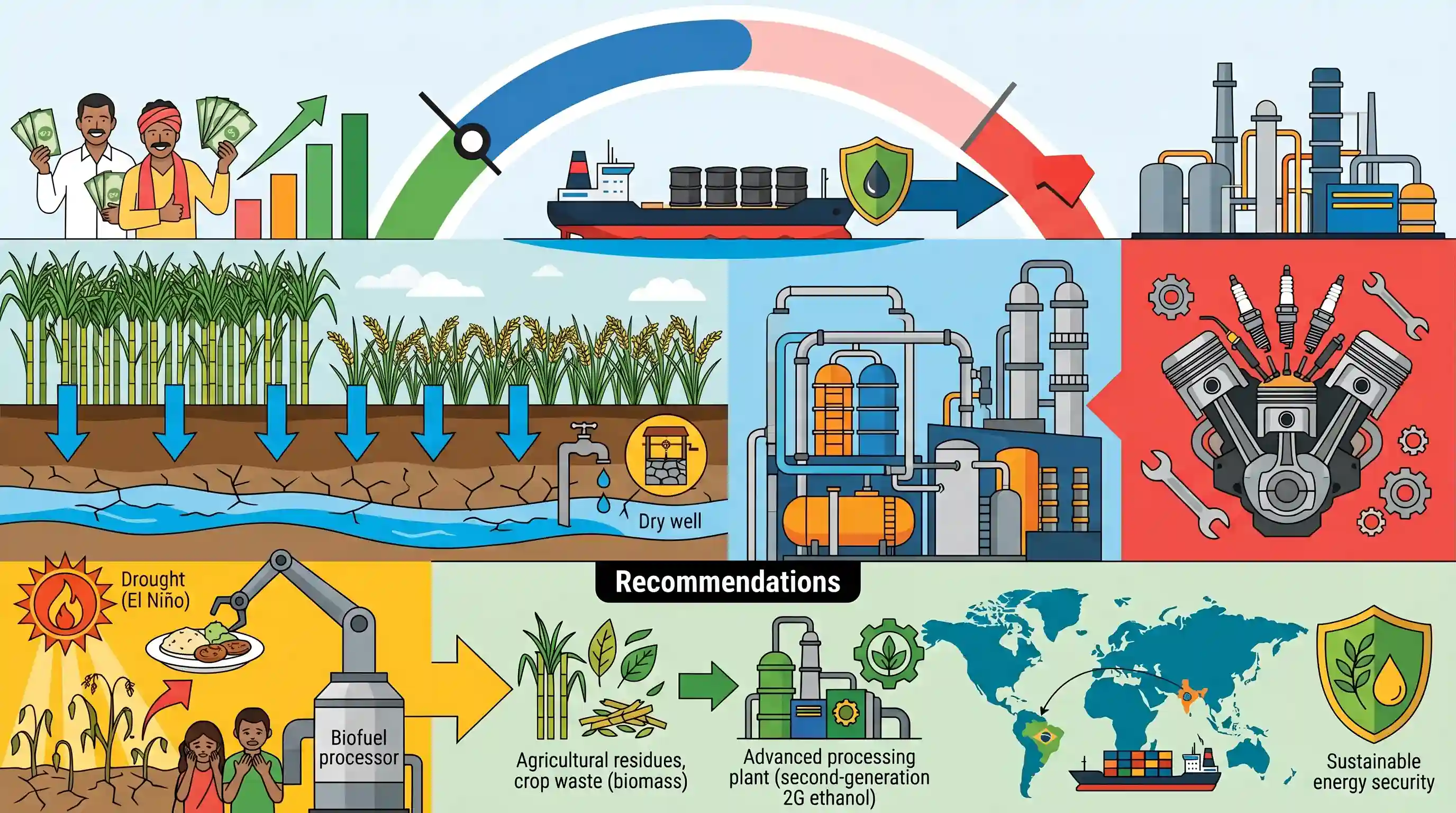
India's achievement of 20% ethanol blending (E20) is a major milestone for its energy transition, yet it highlights emerging trade-offs that complicate the push toward a 30% target (E30). While the Ethanol Blended Petrol (EBP) program has boosted farmer incomes and marginally reduced crude oil imports, the environmental and food security costs are rising. Relying heavily on water-intensive crops like sugarcane and rice for biofuel exacerbates groundwater depletion and risks diverting essential food resources during climate-stressed periods like El Niño. Moving to higher blending ratios also demands significant infrastructure investments and automobile engine modifications. To ensure sustainable energy security, the article recommends shifting away from food crops towards second-generation (2G) ethanol made from agricultural residues and considering strategic imports from countries like Brazil.
Key Points
- India has successfully reached its 20% ethanol blending target (E20) ahead of its initial 2030 deadline, saving Rs 94,000 crores for sugar mills and clearing 98.3% of cane dues.
- Despite achieving E20, the crude oil import bill substitution is less than 3%, with overall imports still rising due to increased vehicle demand.
- Pushing for an E30 blending target would require 1,700-1,800 crore litres of ethanol, introducing severe trade-offs involving environment and food security.
- Ethanol derived from sugarcane and rice is extremely water-intensive (2,860 litres of water for 1 litre of sugarcane ethanol), worsening groundwater depletion in states like UP, Maharashtra, and Karnataka.
- Diverting broken rice, maize, and sugarcane for fuel amid El Niño threats puts India's food security at risk, prompting the need for alternative approaches like 2G ethanol (using agricultural residue).
- Scaling beyond E20 requires substantial capital investments in new distilleries, storage, transportation, and engine modifications for non-compliant vehicles.
Important Terms
Ethanol Blended Petrol (EBP) Programme

A Ministry of Petroleum and Natural Gas initiative launched in 2003 to blend bio-ethanol with petrol, aimed at reducing crude oil imports, cutting carbon emissions, and boosting rural farmer incomes.
UPSC context
GS Paper 3: Infrastructure (Energy) and Agriculture. Tests knowledge of energy security policies and their multi-sectoral impacts.
National Policy on Biofuels (2018)
A policy framework classifying biofuels into 1G, 2G, and 3G; it was amended in 2022 to advance the 20% ethanol blending target to the 2025-26 Ethanol Supply Year.
UPSC context
GS Paper 2/3: Government Policies and Environment. Evaluates understanding of regulatory frameworks for sustainable development.
2G (Second Generation) Ethanol
Advanced biofuels produced from non-food lignocellulosic biomass like rice straw, bagasse, and forest residues. They help address the "food vs. fuel" trade-off and reduce agricultural waste burning.
UPSC context
GS Paper 3: Science & Technology and Environment. Tests knowledge of technological solutions for air pollution and food security.
E20 Fuel
A fuel blend consisting of 20% ethanol and 80% petrol. It requires specifically compliant engines and is the centerpiece of India's current energy transition roadmap to reduce import bills.
UPSC context
GS Paper 3: Economic Development and Environment. Tests technical understanding of clean energy targets and automotive industry challenges.
NITI Aayog Ethanol Roadmap (2020-25)
The primary policy document released by NITI Aayog in 2021 that details the demand-supply projections, infrastructure requirements, and phased rollout plan for achieving 20% ethanol blending by 2025.
UPSC context
GS Paper 2/3: Statutory/Non-statutory bodies and Planning. Crucial for understanding evidence-based policymaking and inter-ministerial coordination.
Prelims Trap
The National Policy on Biofuels prohibits the use of food grains like rice and maize for ethanol production.
The amended 2018 Biofuel Policy explicitly permits the use of surplus food grains (like FCI broken rice) and maize for ethanol, actively causing the food-vs-fuel debate.
Static Concepts Connected
What are the four generations of biofuels?
- First Gen (1G): Produced directly from food crops like sugarcane, corn, and edible oils via fermentation and distillation.
- Second Gen (2G): Produced from non-edible, lignocellulosic biomass such as agricultural residue (bagasse, rice stubble) and wood chips.
- Third Gen (3G): Derived from specially engineered algae that possess high lipid content and do not compete for arable land.
- Fourth Gen (4G): Produced from genetically engineered crops that consume high amounts of CO2, effectively acting as carbon sinks.
Why is sugarcane cultivation distorting India's water resource management?
- Agro-climatic mismatch: Cultivated extensively in semi-arid states like Maharashtra, where it occupies 4% of crop area but consumes 60% of irrigation water.
- High water footprint: Requires approximately 1,500 to 2,500 mm of rainfall equivalent, heavily relying on deep tube wells, accelerating aquifer depletion.
- Policy incentives: Statutory FRP mandates and sugar mill proximity create perverse incentives for farmers to grow cane even in drought-prone districts.
Cross-Topic Patterns
Global Biofuels Alliance (GBA) & EBP
India's domestic E20 success forms the backbone of its leadership in the Global Biofuels Alliance (launched at G20), aiming to drive global tech-transfers for 2G ethanol and sustainable biomass standards.
FRP pricing driving groundwater depletion
Assured sugarcane returns via FRP, coupled with ethanol blending demands, skew cropping patterns away from dryland pulses/oilseeds. This worsens the water crisis in semi-arid regions like Marathwada and northern Karnataka.

Expect a 2026 prelims question merging the National Biofuel Policy's allowed feedstocks (maize, broken rice) with water footprint impacts.
Linked PYQs · 4
Linked PYQs · 4
- 2023MainsGS3
Discuss several ways in which microorganisms can help in meeting the current fuel shortage.
- 2025MainsGS3
Examine the factors responsible for depleting groundwater in India. What are the steps taken by the government to mitigate such depletion of groundwater?
- 2009PrelimsGS1
In the context of alternative sources of energy, ethanol as a viable bio-fuel can be obtained from
- 2024PrelimsGS1
Consider the following materials: 1. Agricultural residues 2. Corn grain 3. Wastewater treatment sludge 4. Wood mill waste Which of the above can be used as feedstock for producing Sustainable Aviation Fuel?
