Biofuel Expansion Goals and Environmental Resource Pressures
Source:Indian Express ↗
Why It Matters
It highlights the critical trade-offs between renewable energy transition policies and resource constraints (water and food security), an essential aspect of the GS3 syllabus linking agriculture, energy, and environment.
Summary
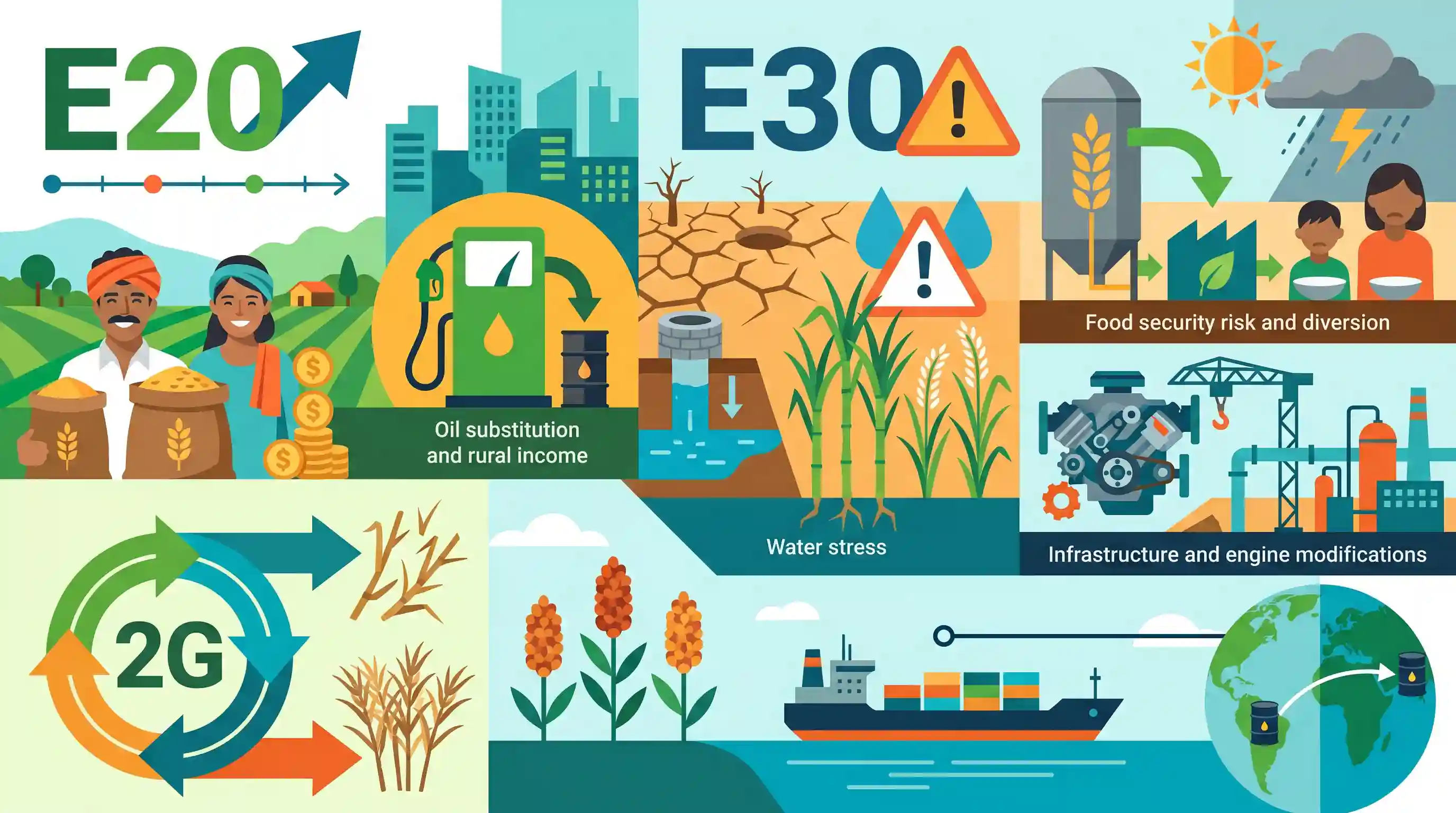
The article examines the achievements and emerging challenges of India's Ethanol Blended Petrol (EBP) program. While India successfully reached its E20 blending target ahead of 2030, proposing an ambitious E30 target brings several critical trade-offs. The authors highlight that despite generating rural income and achieving minor crude oil substitution, higher ethanol blending threatens both water and food security. Using water-intensive crops like sugarcane and rice exacerbates groundwater depletion in stressed regions, and diverting surplus food grains for fuel poses availability risks amidst climate uncertainties like El Niño. Furthermore, moving to E30 requires massive infrastructure investments and automotive engine modifications. The authors suggest adopting a calibrated approach by transitioning to second-generation (2G) ethanol from agricultural residues, promoting less water-intensive feedstocks, and potentially relying on ethanol imports from countries like Brazil to ensure sustainable energy security.
Key Points
- India achieved its 20% ethanol blending (E20) target ahead of the 2030 deadline, becoming the world's third-largest ethanol producer.
- The EBP program boosted sugar mill revenues by over Rs 94,000 crore in the past decade, but has reduced India's crude oil import bill by less than 3%.
- Scaling up to 30% ethanol blending (E30) introduces critical environmental trade-offs, as water-intensive feedstocks like sugarcane and rice exacerbate groundwater depletion.
- Diverting food crops towards ethanol production raises food security risks, especially when climate events like El Niño threaten paddy yields.
- Transitioning to E30 requires major capital investments in distillery and storage infrastructure, as well as structural engine modifications in the automotive sector.
- A resilient strategy requires scaling up second-generation (2G) ethanol derived from non-food biomass and agricultural residue, alongside exploring ethanol imports.
Important Terms
Ethanol Blended Petrol (EBP) Programme

A government initiative to mix ethanol (bio-alcohol) with petrol to reduce crude oil imports, save foreign exchange, and lower vehicular emissions. It is managed by the Ministry of Petroleum and Natural Gas.
UPSC context
GS III: Economy and Infrastructure; relevant for energy security, agricultural diversification, and environmental conservation strategies.
E20 Target
A target to achieve a 20% ethanol and 80% petrol fuel mix nationwide. Originally set for 2030, the Government of India advanced this deadline to 2025-26 to accelerate decarbonization.
UPSC context
GS III: Environment and Science & Technology; tests knowledge of biofuel milestones and automotive compatibility standards.
Second-generation (2G) Ethanol
Advanced biofuels produced from non-edible lignocellulosic biomass, such as agricultural residues (rice straw, bagasse) and municipal waste, rather than food crops like sugarcane or maize.
UPSC context
GS III: Environment; crucial for addressing the "food vs fuel" dilemma and sustainable waste management.
Food vs Fuel Debate
A socio-economic conflict where the diversion of agricultural land and food crops (like corn or rice) for biofuel production threatens food availability and causes price inflation.
UPSC context
GS III: Economy/Food Security; relevant for critical analysis of biofuel policies and their impact on nutrition.
National Policy on Biofuels, 2018 (Amended 2022)
The primary policy framework for biofuel promotion in India. A 2022 amendment advanced blending targets and expanded the range of permitted feedstocks to include surplus food grains.
UPSC context
GS II: Government Policies; tests understanding of India's strategic energy policy shifts and inter-ministerial coordination.
NITI Aayog (Ethanol Roadmap)
India's apex policy think tank that authored the "Roadmap for Ethanol Blending in India 2020-25," setting the technical and economic trajectory for the EBP program.
UPSC context
GS II/III: Planning and Economy; highlights the role of institutional frameworks in long-term energy planning.
Prelims Trap
Achieving 20% ethanol blending (E20) has proportionately reduced India's overall crude oil import bill by 20%.
Petrol forms only a fraction of India's petroleum demand (diesel dominates). Consequently, a 20% ethanol blend in petrol reduces the overall crude oil import bill by less than 3%.
Static Concepts Connected
How are biofuels classified across different generations (1G to 4G)?
- First Generation (1G): Produced from edible food crops containing high sugar or starch (e.g., sugarcane, maize, surplus rice). Can cause food-vs-fuel conflicts.
- Second Generation (2G): Derived from non-food lignocellulosic biomass and agricultural residues (e.g., paddy straw, bagasse), helping solve stubble burning.
- Third Generation (3G): Produced using natural or engineered algal biomass (algae), which requires minimal land and freshwater resources.
- Fourth Generation (4G): Utilizes genetically modified organisms or integrates with carbon capture and storage (CCS) technology to yield carbon-negative fuels.
Why does sugarcane cultivation disproportionately stress India's groundwater?
- High Water Footprint: Sugarcane is highly water-intensive; producing just one litre of sugarcane-based ethanol consumes approximately 2,860 litres of water.
- Regional Misalignment: Cultivation is heavily concentrated in water-stressed peninsular states (Maharashtra, Karnataka) due to historical cooperative infrastructure, rather than agro-climatic suitability.
- Distorted Incentives: Strong policy support via Fair and Remunerative Prices (FRP) and assured procurement incentivizes farmers to abandon sustainable dryland crops.
Cross-Topic Patterns
Food vs. Fuel: FCI buffer stock vulnerabilities
Diverting FCI's surplus rice for ethanol links energy targets to National Food Security operations, creating critical vulnerabilities for domestic grain availability during climate disruptions like El Niño.
Flex-fuel engines and Auto PLI scheme
Scaling to E30 requires structural engine modifications for flex-fuel vehicles (FFVs), intersecting biofuel policy with heavy industry transitions and the PLI scheme for the auto sector.

Expect a multi-statement Prelims question testing the paradox of E20's low crude-oil reduction (<3%) and 1G vs 2G feedstock traits.
Linked PYQs · 3
Linked PYQs · 3
- 2023MainsGS3
Discuss several ways in which microorganisms can help in meeting the current fuel shortage.
- 2025MainsGS3
Examine the factors responsible for depleting groundwater in India. What are the steps taken by the government to mitigate such depletion of groundwater?
- 2024MainsGS3
Elucidate the importance of buffer stocks for stabilizing agricultural prices in India. What are the challenges associated with the storage of buffer stock? Discuss.
