Urban Heat Island Effect and Heat Action Plans in India
Source:The Hindu ↗
Why It Matters
Urban heatwaves and climate-induced extreme weather are recurring themes in UPSC Mains (GS1 Geography, GS3 Disaster Management) and Prelims (environmental science concepts like wet-bulb temperature). The topic bridges physical geography (Urban Heat Island effect), vulnerability and social justice (GS2), and proactive disaster preparedness (GS3).
Summary
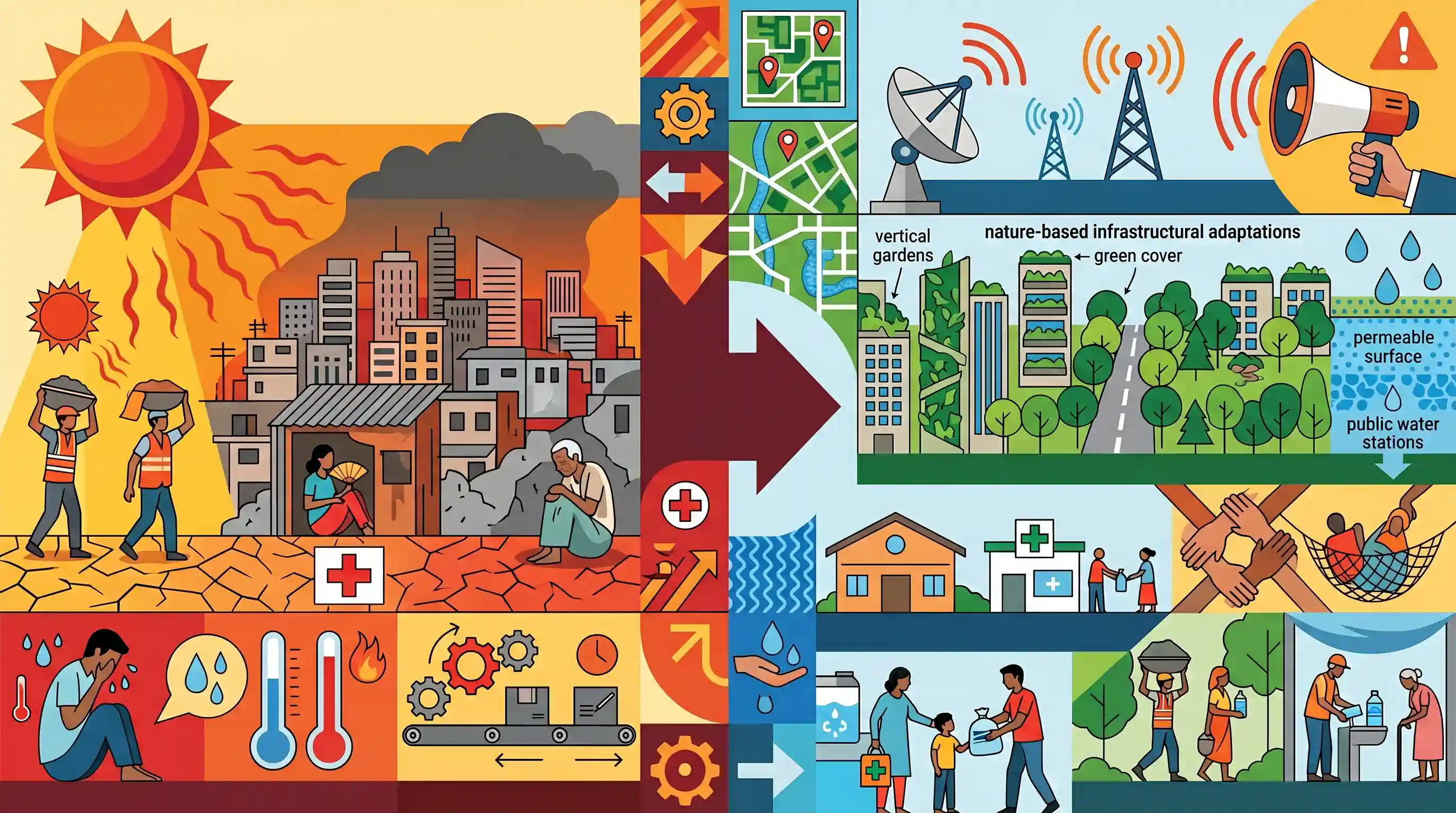
The escalating heat crisis in India, driven by climate change and the urban heat island effect, poses severe threats to public health, economic productivity, and urban livability. Vulnerable populations, particularly outdoor workers, the urban poor, and the elderly, bear a disproportionate burden due to extreme temperatures and hazardous wet-bulb conditions. Addressing this crisis necessitates a paradigm shift in urban planning and disaster management. It requires the implementation of localized, proactive Heat Action Plans (HAPs) that integrate early warning systems, nature-based infrastructural adaptations like increased green cover, and enhanced social safety nets to ensure equitable access to cooling and healthcare.
Key Points
- The Urban Heat Island (UHI) effect significantly magnifies temperatures in Indian cities due to rampant concretization, high population density, and loss of green cover.
- Rising wet-bulb temperatures, which combine heat and humidity, are dangerously approaching the critical 35°C physiological limit beyond which human survival is compromised even in the shade.
- The informal workforce, slum dwellers, and gig economy workers face heightened vulnerability due to prolonged outdoor exposure, poor housing conditions, and a lack of access to active cooling solutions.
- Effective urban governance requires transitioning from generic advisories to comprehensive, proactive Heat Action Plans (HAPs) that include localized early warning systems, cool roofs, and urban greening.
- There is a growing policy imperative to integrate heat-resilient design into building codes and to formally recognize severe heat waves as notified national disasters to mobilize adequate relief funds.
Important Terms
Heat Action Plans (HAPs)

Localized strategies to reduce health and economic impacts of extreme heat through early warning systems, inter-departmental coordination, and long-term cooling infrastructure like cool roofs.
UPSC context
GS-3: Disaster Management; tests understanding of mitigation strategies and institutional responses to climate-induced hazards.
Wet-bulb Temperature
A combined measure of temperature and humidity reflecting the lowest temperature reachable by evaporative cooling; it is a critical threshold for human survivability during extreme heat.
UPSC context
GS-3: Environment/Public Health; tests knowledge of human survivability limits and climate adaptation metrics.
Urban Heat Island (UHI) Effect
A phenomenon where urban areas experience significantly higher temperatures than surrounding rural areas due to heat-absorbing concrete surfaces, building density, and lack of green cover.
UPSC context
GS-1: Geography/Urbanization; tests understanding of human-induced microclimate changes and urban planning challenges.
National Disaster Management Authority (NDMA)
India’s apex statutory body for disaster management, chaired by the Prime Minister, responsible for framing policies, plans, and guidelines for disaster resilience and response.
UPSC context
GS-3: Disaster Management; tests knowledge of the institutional framework and administrative response to natural disasters.
India Meteorological Department (IMD)
The principal government agency for meteorological observations and forecasting, responsible for monitoring weather events and declaring heatwaves based on regional temperature and departure thresholds.
UPSC context
GS-1: Geography; tests awareness of technical criteria for geophysical phenomena and the role of scientific institutions.
National Action Plan on Climate Change (NAPCC)
A 2008 policy framework comprising eight national missions designed to address climate change through sustainable development, mitigation, and adaptation across sectors like energy, water, and habitat.
UPSC context
GS-3: Environment; tests understanding of India’s national strategies and commitments to global climate goals.
Prelims Trap
Heat waves are officially notified national disasters under the Disaster Management Act, 2005, allowing states full access to the NDRF.
Despite their severity, heatwaves are NOT centrally notified national disasters. States cannot automatically access the NDRF for them and can only use up to 10% of their SDRF.
Static Concepts Connected
What is Wet-Bulb Temperature and why is the 35°C threshold biologically critical?
- Dry-bulb temperature: It measures actual air temperature without factoring in relative humidity.
- Wet-bulb temperature: It measures the lowest temperature achievable by water evaporation. It represents the combined effect of ambient heat and humidity.
- 35°C Limit: At 35°C wet-bulb, the air is too hot and humid for sweat to evaporate, leading to fatal hyperthermia even for healthy, resting adults in the shade.
How are the SDRF and NDRF funded and utilized under the DMA 2005?
- SDRF (State Fund): The primary fund with State Governments, financed 75:25 by Centre and States (90:10 for special category states).
- NDRF (National Fund): Used for disasters of a "severe nature" when SDRF is inadequate. Financed through the National Calamity Contingent Duty (NCCD).
- Local Disasters Cap: States can use up to 10% of their SDRF allocation for local disasters (like heatwaves or lightning) not on the central notified list.
Cross-Topic Patterns
Heat stress and gig worker rights
The disproportionate impact on informal and gig workers links climate adaptation directly to the Code on Social Security, 2020, and the urgent need for mandated occupational safety standards for outdoor labor.
Urban Heat Islands vs Smart Cities Mission
Rampant concretization and the loss of urban water bodies (exacerbating UHI) directly challenge the sustainable infrastructure and climate resilience goals mandated under the Smart Cities Mission and AMRUT.

Expect a 2026 Prelims question testing the physiological 35°C wet-bulb limit alongside India's criteria for notified national disasters.
Linked PYQs · 4
Linked PYQs · 4
- 2013MainsGS1
Bring out the causes for the formation of heat islands in the urban habitat of the world.
- 2025PrelimsGS1
The World Bank warned that India could become one of the first places where wet-bulb temperatures routinely exceed 35 °C. Which of the following statements best reflect(s) the implication of the above-said report? I. Peninsular India will most likely suffer from flooding, tropical cyclones and droughts. II. The survival of animals including humans will be affected as shedding of their body heat through perspiration becomes difficult. Select the correct answer using the code given below.
- 2019MainsGS3
Vulnerability is an essential element for defining disaster impacts and its threat to people. How and in what ways can vulnerability to disasters be characterized? Discuss different types of vulnerability with reference to disasters.
- 2020MainsGS3
Discuss the recent measures initiated in disaster management by the Government of India departing from the earlier reactive approach.
