Green ammonia deployment for clean energy transitions in India
Source:The Hindu ↗
Why It Matters
Green ammonia and green hydrogen are central to India's climate commitments (Panchamrit) and energy security strategy. Understanding their applications, production processes, and related government missions is highly relevant for GS3 S&T, Environment, and Economy.
Summary
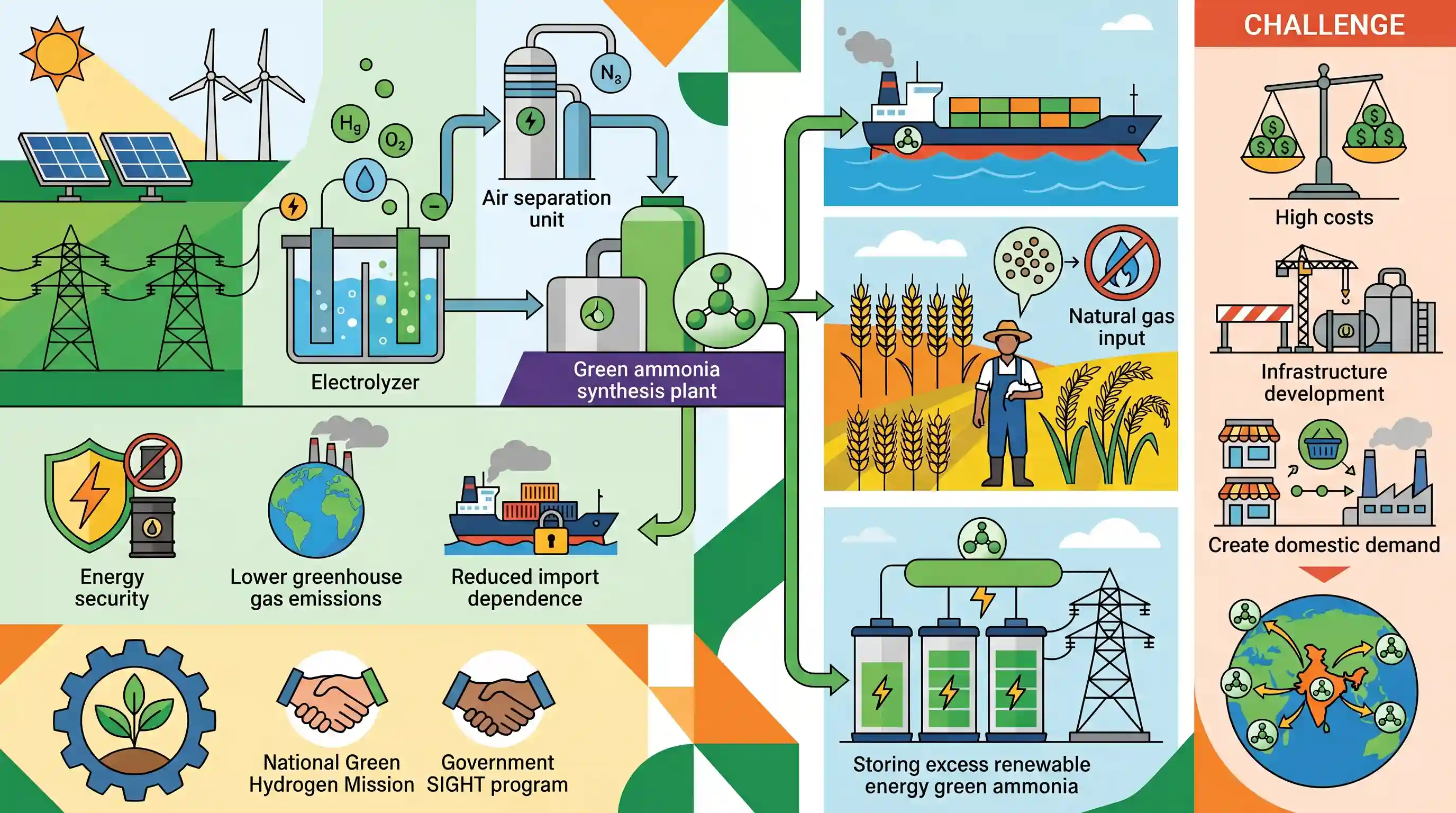
India is strategically positioning green ammonia as a linchpin in its transition from fossil fuels to renewable energy. Produced by combining nitrogen with green hydrogen—derived from water electrolysis powered by renewable sources—green ammonia offers a practical solution for energy storage, clean maritime fuel, and decarbonizing the fertilizer sector. Supported by the National Green Hydrogen Mission and the SIGHT programme, the push towards green ammonia aims to enhance energy security, reduce import dependence on natural gas, and lower greenhouse gas emissions. However, realizing this potential requires addressing high production costs, building necessary infrastructure, and creating a sustainable domestic demand ecosystem to make India a global hub for green ammonia.
Key Points
- Green ammonia is emerging as a critical vector in India's clean energy transition, acting as both a clean fuel and a sustainable fertilizer substitute.
- The National Green Hydrogen Mission aims to establish a capacity of 5 million metric tonnes (MMT) of green hydrogen per annum by 2030, with green ammonia being a major end-use application.
- Transitioning to green ammonia can significantly decarbonize 'hard-to-abate' sectors like agriculture (fertilizers), maritime shipping, and heavy industries, while reducing reliance on imported natural gas.
- The strategic shift requires overcoming challenges such as high production costs, inadequate storage and transportation infrastructure, and the necessity of robust demand-side incentives.
Important Terms
National Green Hydrogen Mission

A flagship initiative launched in 2023 to make India a global hub for green hydrogen production, usage, and export, targeting 5 MMT annual capacity by 2030.
UPSC context
GS Paper III: Energy, Environment. Tests understanding of India’s renewable energy targets, import reduction, and climate commitments (Net Zero 2070).
Strategic Interventions for Green Hydrogen Transition (SIGHT) Programme
A financial sub-component of the National Green Hydrogen Mission providing incentives for domestic electrolyser manufacturing and green hydrogen production to enhance cost-competitiveness.
UPSC context
GS Paper III: Economy, Infrastructure. Relevant for questions on industrial policy, fiscal incentives, and indigenization of green technologies.
Green Ammonia
Ammonia produced by combining nitrogen with hydrogen derived from water electrolysis powered by renewable energy, serving as a carbon-neutral fertilizer and maritime fuel.
UPSC context
GS Paper III: Science & Tech, Environment. Crucial for decarbonizing "hard-to-abate" sectors like agriculture and shipping.
Ministry of New and Renewable Energy (MNRE)
The nodal ministry responsible for India's renewable energy transition, specifically overseeing the coordination, implementation, and financial guidelines of the National Green Hydrogen Mission.
UPSC context
GS Paper II/III: Governance, Energy. Tests knowledge of institutional frameworks driving India’s shift toward sustainable development.
Electrolyser
A device that uses electricity to split water into hydrogen and oxygen; it is the core technology for producing green hydrogen from renewable sources.
UPSC context
GS Paper III: Science & Tech. Tests technical understanding of green energy production and manufacturing challenges in India.
Prelims Trap
Green hydrogen has a higher energy density and is easier to liquefy for transport compared to green ammonia.
Green ammonia actually liquefies at just -33°C and has higher volumetric energy density, making it significantly easier and cheaper to store and transport than hydrogen (which requires -253°C).
Static Concepts Connected
How do the 'colours' of Hydrogen production differ?
- Grey Hydrogen: Produced from natural gas (methane) via steam methane reforming, with resultant greenhouse gases released into the atmosphere.
- Blue Hydrogen: Extracted from fossil fuels similarly to grey hydrogen, but the carbon emissions are captured and stored (CCS).
- Green Hydrogen: Produced by splitting water via electrolysis, powered entirely by renewable energy sources like solar or wind.
What is the Haber-Bosch process and its modern significance?
- Mechanism: An artificial nitrogen fixation process combining atmospheric nitrogen with hydrogen under high temperature and pressure.
- Output: Produces ammonia (NH3), which is the critical foundational precursor for nitrogenous fertilizers like Urea and DAP.
- Carbon Footprint: Traditionally highly carbon-intensive due to its reliance on natural gas. Substituting green hydrogen decarbonizes the entire output.
Cross-Topic Patterns
Fertilizer Subsidies & Import Bills
Replacing natural gas with domestic green ammonia for urea production simultaneously shrinks India's massive energy import bill and directly reduces the agricultural sector's carbon footprint.
Net-Zero Maritime Shipping via IMO
Green ammonia is emerging as the premier zero-carbon bunker fuel to help global shipping meet the International Maritime Organization's (IMO) 2050 net-zero targets.

Expect a Prelims S&T question comparing energy density, storage, and transport viability of green hydrogen versus green ammonia in 2026.
Linked PYQs · 3
Linked PYQs · 3
- 2023PrelimsGS1
With reference to green hydrogen, consider the following statements: 1. It can be used directly as a fuel for internal combustion. 2. It can be blended with natural gas and used as fuel for heat or power generation. 3. It can be used in the hydrogen fuel cell to run vehicles. How many of the above statements are correct?
- 2023PrelimsGS1
Consider the following heavy industries: 1. Fertilizer plants 2. Oil refineries 3. Steel plants Green hydrogen is expected to play a significant role in decarbonizing how many of the above industries?
- 2022MainsGS3
Do you think India will meet 50 percent of its energy needs from renewable energy by 2030 ? Justify your answer. How will the shift of subsidies from fossil fuels to renewables help achieve the above objective ? Explain.
