UN ESCAP Projects Indian Economic Growth and FDI Performance
Source:The Hindu ↗
Why It Matters
Provides crucial data points and international validation (UN ESCAP) of India's macroeconomic stability, FDI attractiveness, and the success of its green industrial policies (PLI scheme). It also highlights external vulnerabilities, such as the impact of US tariffs and remittance taxes on the Indian economy, which are highly relevant for GS3 answers on trade and economic growth.
Summary
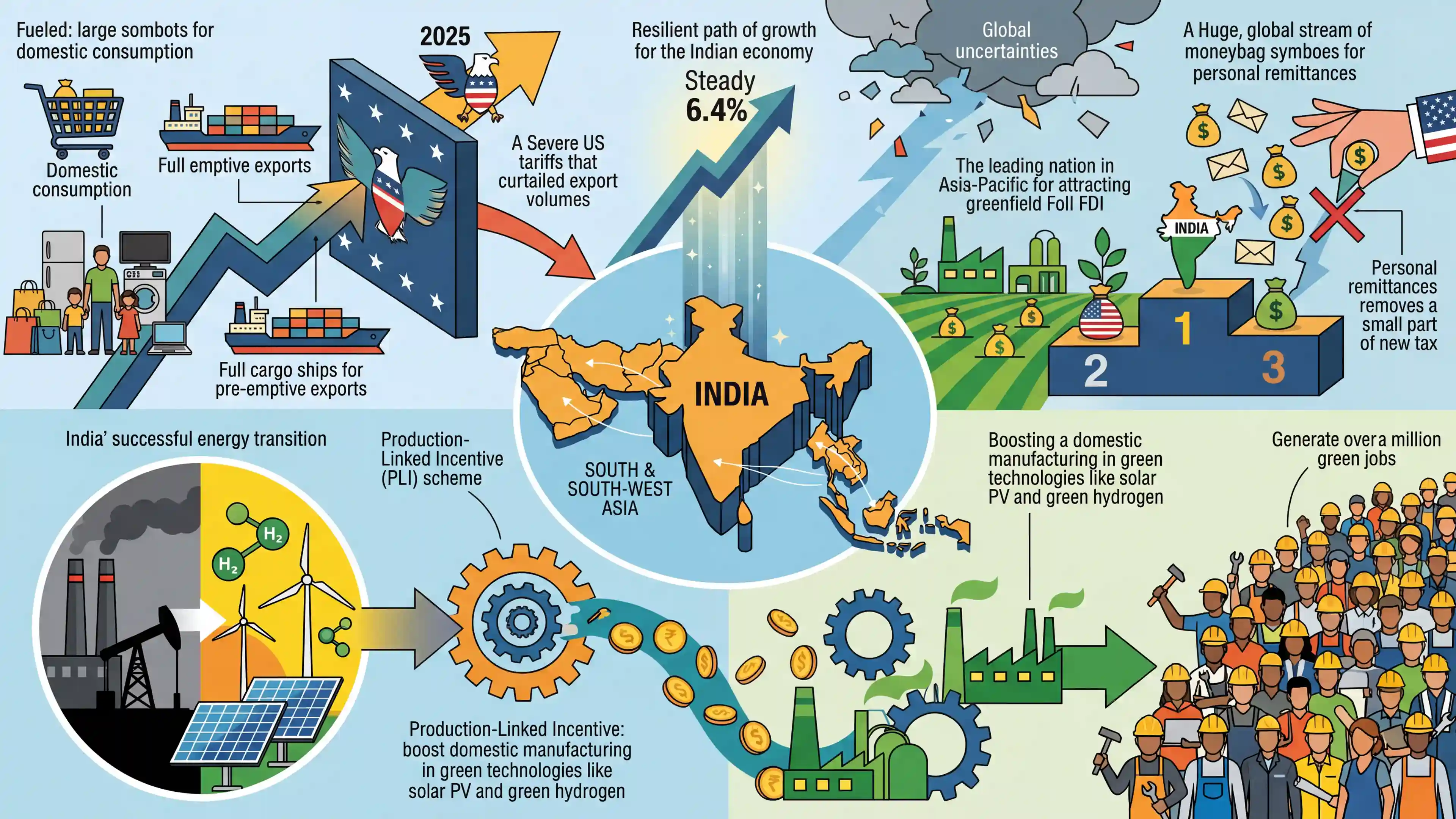
A recent United Nations ESCAP report projects India's economy to grow at a resilient 6.4% in 2026, anchoring growth in the broader South and South-West Asia region. While India saw high growth of 7.4% in 2025 fueled by domestic consumption and pre-emptive exports, it faced headwinds later in the year due to severe US tariffs that curtailed export volumes. Despite global uncertainties, India led the Asia-Pacific in attracting greenfield Foreign Direct Investment (FDI) and retained its position as the top destination for personal remittances globally, though a newly levied US tax poses a challenge. Crucially, the UN report highlights India's successful energy transition, praising the Production-Linked Incentive (PLI) scheme for boosting domestic manufacturing in green technologies like solar PV and green hydrogen, and generating over a million green jobs.
Key Points
- The UN ESCAP report projects India's economic growth at 6.4% for 2026 and 6.6% for 2027, alongside a cooling inflation rate of 4.4%.
- In 2025, India's growth peaked at 7.4% driven by domestic consumption, GST cuts, and export frontloading, though momentum slowed after a 25% drop in exports to the US due to new tariffs.
- India secured the highest greenfield FDI in the Asia-Pacific region ($50 billion) and remained the top global recipient of remittances ($137 billion in 2024), despite a new 1% US tax on remittances.
- The report lauds India's Production-Linked Incentive (PLI) scheme for successfully driving green industrial development, noting it has helped generate 1.3 million green jobs in sectors like solar PV, batteries, and green hydrogen.
Important Terms
Production-Linked Incentive (PLI) Scheme

A government scheme providing financial incentives to companies based on incremental sales of products manufactured in India, aiming to boost domestic manufacturing and reduce import reliance.
UPSC context
GS Paper III: Economy/Industry. Tests knowledge of industrial policy, 'Make in India,' and self-reliance initiatives.
UN ESCAP
The regional arm of the UN for the Asia-Pacific, providing policy analysis and regional cooperation to promote sustainable economic growth and social development.
UPSC context
GS Paper II: International Relations. Tests understanding of international organizations and reports affecting India’s regional standing.
Greenfield FDI
A form of Foreign Direct Investment (FDI) where a parent company starts a new venture in a foreign country by constructing new operational facilities from the ground up.
UPSC context
GS Paper III: Investment Models. Tests understanding of long-term capital inflows and their role in infrastructure/job creation.
Remittances
Money sent by migrants to their home country. India is the global leader in these inflows, which are crucial for foreign exchange reserves and rural consumption.
UPSC context
GS Paper III: External Sector. Tests understanding of Balance of Payments and the economic contribution of the diaspora.
Green Hydrogen
Hydrogen produced via water electrolysis using renewable energy. It is a clean fuel critical for India’s energy transition and National Green Hydrogen Mission targets.
UPSC context
GS Paper III: Science & Tech/Environment/Energy. Tests knowledge of decarbonization technologies and climate commitments.
Goods and Services Tax (GST)
A comprehensive, destination-based indirect tax that replaced multiple central and state taxes to create a unified national market for goods and services.
UPSC context
GS Paper III: Economy (Fiscal Policy). Tests knowledge of tax reforms and cooperative federalism.
Prelims Trap
"Remittances to India represent a major, non-debt creating inflow that strengthens the Capital Account surplus in the Balance of Payments."
Remittances are classified as private transfers under the 'Invisibles' component of the Current Account, not the Capital Account, because they do not create liabilities.
Static Concepts Connected
What distinguishes Greenfield FDI from Brownfield FDI?
- Greenfield FDI: Involves building new operational facilities from the ground up, actively creating new production capacity and generating direct employment.
- Brownfield FDI: Involves purchasing, leasing, or merging with existing facilities and companies, which changes ownership but does not immediately add new production capacity.
How are personal remittances classified within India's Balance of Payments?
- Current Account Invisibles: They are recorded under the 'Invisibles' section of the Current Account, specifically as private unilateral transfers (receipts without anything given in return).
- No Liability Creation: Remittances are purely non-debt-creating foreign exchange inflows; they support household consumption and forex reserves without imposing future repayment obligations.
Cross-Topic Patterns
PLI scaling green technologies
The PLI scheme bridges GS3 Industrial Policy with GS3 Environment, serving as a dual-purpose tool to boost domestic manufacturing while simultaneously accelerating India's Net-Zero energy transition.
Western protectionism vs Export growth
Escalating tariff barriers and protectionism by developed economies highlight the vulnerability of India's export-reliant growth, reinforcing the need for strong domestic consumption anchors.

A multi-statement Prelims question merging FDI types (greenfield/brownfield) and BoP classification of remittances is highly probable.
Linked PYQs · 5
Linked PYQs · 5
- 2016MainsGS3
Justify the need for FDI for the development of the Indian economy. Why there is gap between MOUs signed and actual FDIs? Suggest remedial steps to be taken for increasing actual FDIs in India.
- 2019MainsGS3
Do you agree with the view that steady GDP growth and low inflation have left the Indian economy in good shape? Give reasons in support of your arguments.
- 2025MainsGS3
Discuss the rationale of the Production Linked Incentive (PLI) scheme. What are its achievements? In what way can the functioning and outcomes of the scheme be improved?
- 2020PrelimsGS1
With reference to Foreign Direct Investment in India, which one of the following is considered its major characteristic?
- 2021PrelimsGS1
Consider the following : 1. Foreign currency convertible bonds 2. Foreign institutional investment with certain conditions 3. Global depository receipts 4. Non-resident external deposits Which of the above can be included in Foreign Direct Investments?
