UN Economic Growth Projections and External Trade Impacts
Source:The Hindu ↗
Why It Matters
Provides authoritative economic projections and assesses the impact of external shocks (U.S. tariffs and remittance taxes) on India's macroeconomic stability. It also offers crucial international validation of India's PLI scheme in transitioning toward a green economy, making it highly relevant for GS3 answers on industrial policy, trade, and sustainable development.
Summary
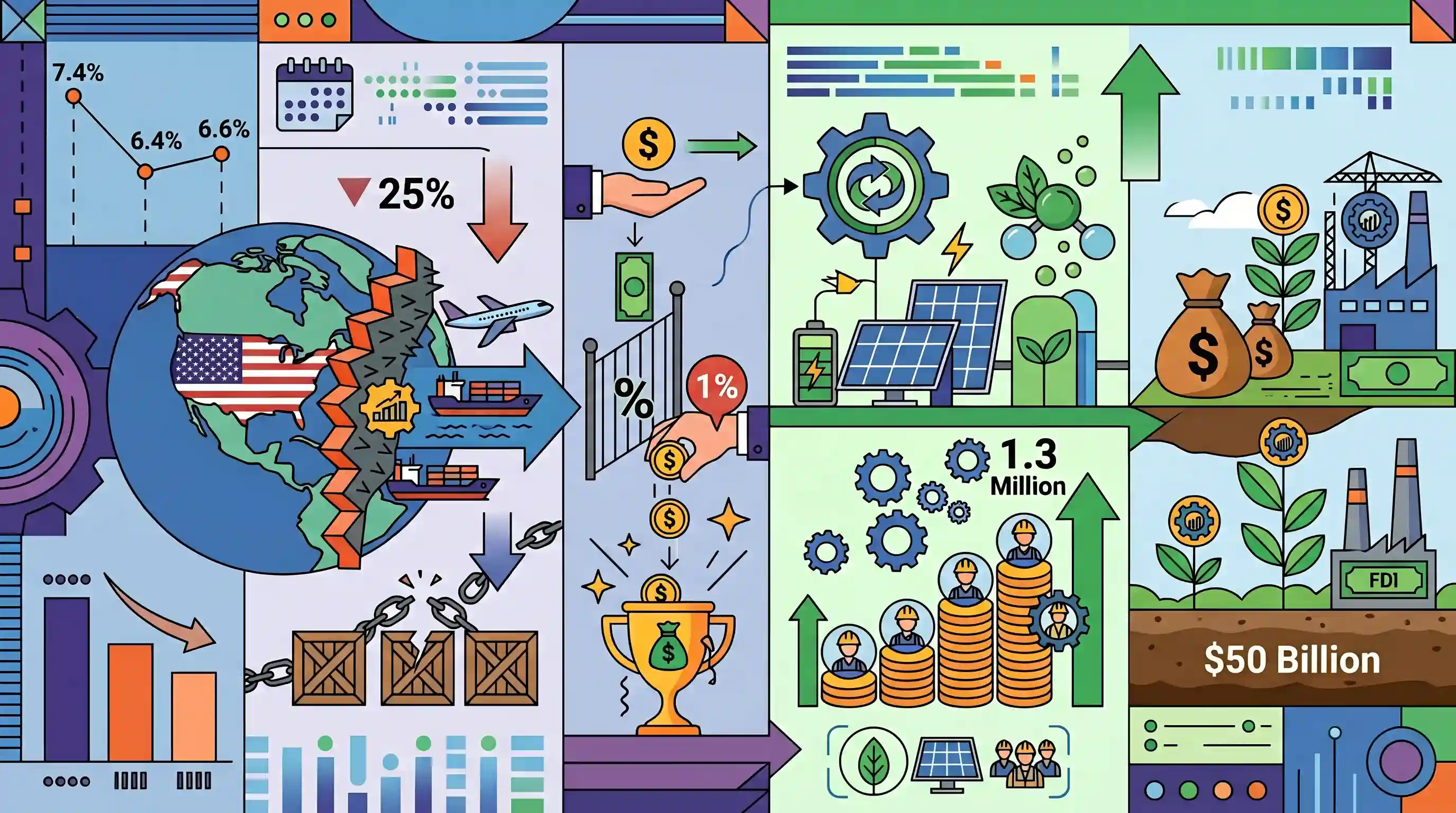
A recent report by the United Nations Economic and Social Commission for Asia and the Pacific (UN ESCAP) projects India's economy to grow at 6.4% in 2026 and 6.6% in 2027. While growth in 2025 stood at 7.4%, the momentum slowed in the latter half of the year due to a 25% drop in exports to the U.S. following hefty U.S. tariffs. India's status as the top recipient of personal remittances is also threatened by a new 1% U.S. tax on remittances. On the positive side, India continued to attract significant greenfield FDI ($50 billion in the first three quarters of 2025). Furthermore, the report commended India's Production-Linked Incentive (PLI) scheme for driving green industrial development in solar modules, batteries, and green hydrogen, contributing to 1.3 million green jobs in the country.
Key Points
- The UN ESCAP 'Economic and Social Survey of Asia and the Pacific 2026' report projects India's GDP to grow at 6.4% in 2026 and 6.6% in 2027.
- India's economic activities moderated in the second half of 2025 as exports to the U.S. fell by 25% following the imposition of 50% U.S. tariffs.
- India remains the world's largest recipient of personal remittances ($137 billion in 2024) but faces potential losses due to a new 1% U.S. tax on all remittances initiated in January 2026.
- Despite global declines in FDI amid geopolitical uncertainties, India attracted $50 billion in greenfield FDI during the first three quarters of 2025.
- The report highlights India's Production-Linked Incentive (PLI) scheme as an effective macroeconomic policy fostering green industrial development, noting it has helped create 1.3 million green jobs.
Important Terms
Production-Linked Incentive (PLI) scheme

A performance-based incentive program launched in 2020 to boost domestic manufacturing. It provides financial incentives to companies based on incremental sales across 14 strategic sectors.
UPSC context
GS Paper III (Economy/Industrial Policy); tests understanding of 'Atmanirbhar Bharat' and manufacturing competitiveness.
United Nations Economic and Social Commission for Asia and the Pacific (UN ESCAP)
Established in 1947, this UN regional commission promotes economic and social cooperation in the Asia-Pacific. It provides policy guidance on SDGs and regional connectivity.
UPSC context
GS Paper II (International Relations); tests knowledge of regional multilateral platforms and UN's role in Asia-Pacific development.
Greenfield FDI
A type of Foreign Direct Investment (FDI) where a parent company builds new operational facilities in a foreign country from the ground up.
UPSC context
GS Paper III (Economy/External Sector); tests the ability to distinguish investment types and their impact on employment.
Personal Remittances
Funds sent by migrants to their home country. India is the world's top recipient, with these inflows critical for external financial stability and BoP.
UPSC context
GS Paper III (Economy/External Sector); tests understanding of non-debt capital inflows and the socio-economic role of the diaspora.
International Renewable Energy Agency (IRENA)
An intergovernmental organization founded in 2009 to support the global energy transition. It provides policy and technology knowledge on renewable energy.
UPSC context
GS Paper III (Environment/Economy); tests knowledge of global climate governance and India’s net-zero commitments.
Prelims Trap
India is the world's largest recipient of personal remittances as a percentage of its GDP.
While India is the undisputed top recipient of remittances in absolute dollar terms, remittances constitute a small percentage of its GDP (~3%) compared to smaller nations like Nepal or Tajikistan.
Static Concepts Connected
What distinguishes Greenfield FDI from Brownfield FDI in macroeconomic terms?
- Greenfield FDI: A parent company builds new operational facilities from the ground up, generating direct employment, new production capacity, and technology transfer.
- Brownfield FDI: Involves purchasing, leasing, or merging with existing production facilities (M&As). It brings foreign ownership but not necessarily new immediate capacity.
How do personal remittances impact India's Balance of Payments (BoP) accounting?
- Current Account Location: Remittances are categorized as unrequited transfers and are recorded under 'Invisibles' in the Current Account, not the Capital Account.
- Deficit Financing: They provide a massive, non-debt-creating foreign exchange buffer that helps finance India's structural merchandise trade deficit and stabilizes the Rupee.
Cross-Topic Patterns
Protectionism hitting both trade and current accounts
Tariffs on exports plus a new tax on remittances represent a structural shift where Western protectionism directly targets both India's trade and non-debt external flows simultaneously.
PLI shifting from industrial to climate policy
Extending PLI to solar modules, batteries, and green hydrogen blends Make in India with the Panchamrit climate targets, showing how domestic manufacturing incentives now double as carbon-reduction tools.

Expect a 2026 Prelims statement testing whether remittances fall under capital or current account invisibles, alongside FDI types.
Linked PYQs · 3
Linked PYQs · 3
- 2025MainsGS3
Discuss the rationale of the Production Linked Incentive (PLI) scheme. What are its achievements? In what way can the functioning and outcomes of the scheme be improved?
- 2018PrelimsGS1
The Partnership for Action on Green Economy (PAGE), a UN mechanism to assist countries transition towards greener and more inclusive economies, emerged at
- 2023MainsGS3
Faster economic growth requires increased share of the manufacturing sector in GDP, particularly of MSMEs. Comment on the present policies of the Government in this regard.
