UN projects India economy to grow at 6.4 percent in 2026
Source:The Hindu ↗
Why It Matters
Provides key authoritative data points (UN ESCAP, IRENA, World Bank) on macroeconomic resilience, inflation cooling, and green job creation. It offers excellent fodder for Mains answers evaluating the success of the PLI scheme, India's energy transition, and the economic benefits (and risks) linked to the Indian diaspora.
Summary
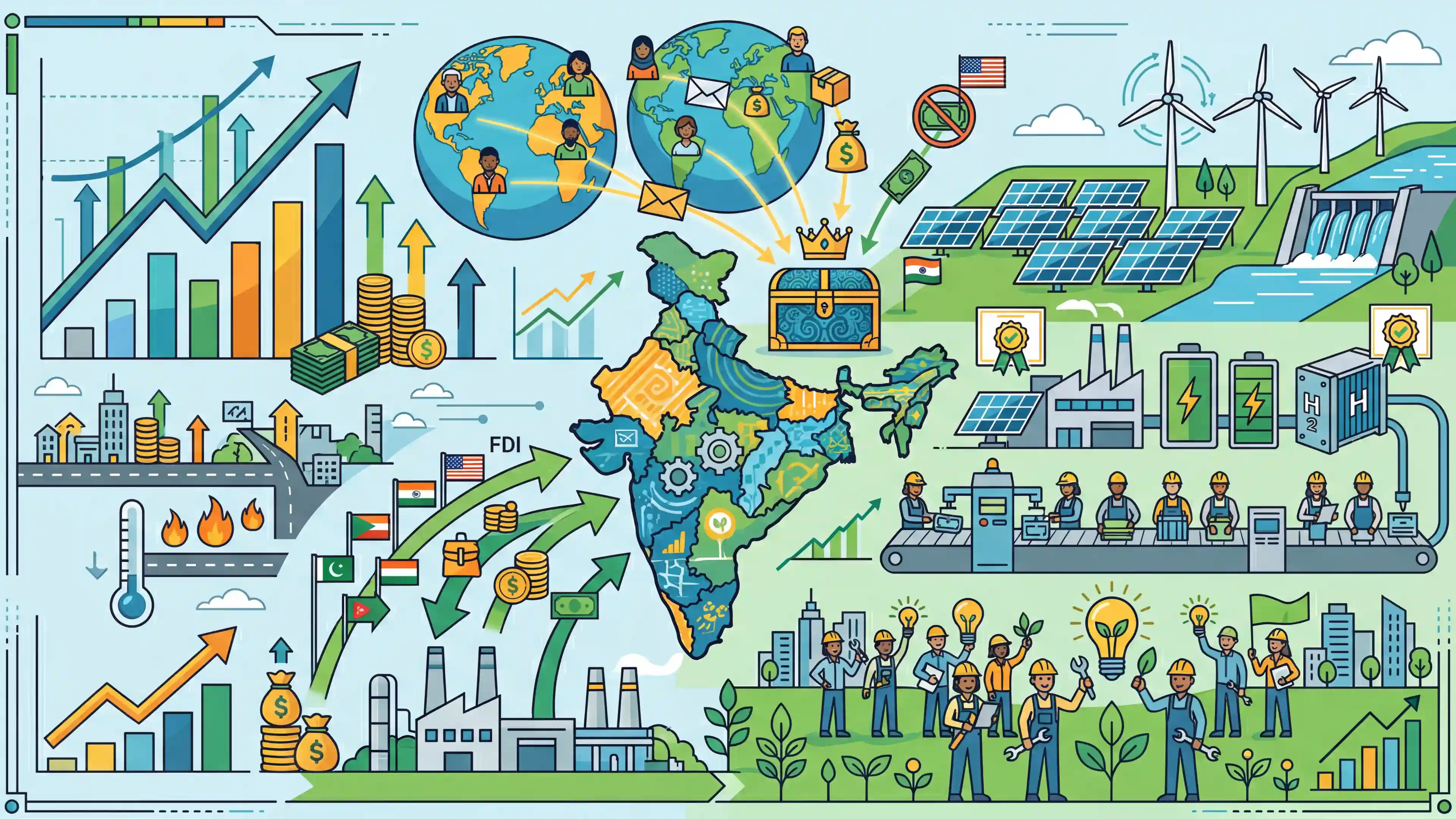
The UN ESCAP’s ‘Economic and Social Survey of Asia and the Pacific 2026’ projects India’s economy to grow at a robust 6.4% in 2026, supported by strong greenfield FDI, stable macroeconomic conditions, and cooling inflation. The report highlights India's global leadership as the top recipient of personal remittances ($137 billion), though a recent 1% US tax on outbound transfers could constrain future growth. Furthermore, India’s focused energy transition initiatives—most notably the Production Linked Incentive (PLI) schemes for solar modules, batteries, and green hydrogen—are praised for scaling domestic manufacturing and significantly contributing to global green job creation (1.3 million jobs according to IRENA).
Key Points
- The UN ESCAP forecasts India's economy to grow at 6.4% in 2026 and 6.6% in 2027, maintaining its position as one of the fastest-growing major economies.
- Retail inflation in India is projected to cool down to 4.4% in 2026 due to prudent monetary policies and stabilized food prices.
- Despite global FDI slowdowns, India remains in the top five global destinations for greenfield FDI.
- India is the largest global recipient of personal remittances ($137 billion in 2024), but future growth may be challenged by a 1% US tax on outgoing remittances enacted in 2026.
- India is heavily prioritizing its energy transition, leveraging the PLI scheme to boost domestic manufacturing of solar PVs, advanced chemistry cell batteries, and green hydrogen.
- IRENA data shows India contributing approximately 1.3 million green jobs, establishing it alongside China and Brazil as top markets for renewable energy employment.
Important Terms
Production Linked Incentive (PLI) Scheme

A central government initiative providing financial incentives to companies based on incremental sales of products manufactured in India, aiming to boost domestic manufacturing, exports, and global competitiveness.
UPSC context
GS Paper 3: Industrial Policy and Growth. Tests understanding of 'Make in India' and sectoral manufacturing incentives.
UN Economic and Social Commission for Asia and the Pacific (UN ESCAP)
One of the five regional commissions of the United Nations, serving as an intergovernmental platform for cooperation on socio-economic issues across the Asia-Pacific region.
UPSC context
GS Paper 2: International Organizations. Tests knowledge of regional bodies and their socio-economic reports.
International Renewable Energy Agency (IRENA)
An intergovernmental organization that supports countries in their transition to a sustainable energy future, serving as a principal platform for international cooperation on renewable energy.
UPSC context
GS Paper 3: Energy and Environment. Tests understanding of global energy transition and renewable job statistics.
National Green Hydrogen Mission
A flagship Indian initiative aimed at making India a global hub for the production, usage, and export of Green Hydrogen and its derivatives.
UPSC context
GS Paper 3: Energy and Infrastructure. Tests knowledge of decarbonization strategies and clean energy targets.
Remittances
Funds transferred by foreign workers to their home countries; India is currently the world's largest recipient, receiving approximately $137 billion in 2024.
UPSC context
GS Paper 3: External Sector and Indian Diaspora. Tests understanding of Balance of Payments and economic stability.
Greenfield FDI
A form of Foreign Direct Investment (FDI) where a parent company starts a new venture or builds new facilities in a foreign country from the ground up.
UPSC context
GS Paper 3: Investment Models. Tests distinction between types of FDI and their impact on capital formation.
Green Jobs
Employment in sectors that contribute to preserving or restoring the environment, such as renewable energy, energy efficiency, and waste management.
UPSC context
GS Paper 3: Employment and Environment. Tests understanding of the socio-economic benefits of the energy transition.
Prelims Trap
"The majority of India's inward remittances originate from low-skilled workers in Gulf Cooperation Council (GCC) nations."
The primary source of remittances has structurally shifted to Advanced Economies (like the USA) due to high-skilled migration, surpassing the GCC.
Static Concepts Connected
What distinguishes Greenfield FDI from Brownfield FDI?
- Greenfield FDI: Involves building new operational facilities from the ground up, directly expanding long-term productive capacity and creating fresh employment.
- Brownfield FDI: Involves acquiring, leasing, or merging with existing facilities or companies, transferring ownership rather than immediately creating new production capacity.
How does the Production Linked Incentive (PLI) scheme function?
- Core Objective: To scale domestic manufacturing, reduce import dependence in critical sectors, and create global manufacturing champions.
- Incentive Structure: Offers a direct financial subsidy calculated as a percentage of incremental sales of goods manufactured in India over a base year.
- Green Components: Heavily targets the energy transition, covering high-efficiency solar PV modules, advanced chemistry cell (ACC) batteries, and green hydrogen components.
Cross-Topic Patterns
Remittances cushioning India's CAD
High inward remittances ($137B) act as a crucial invisible receipt in the Current Account, consistently offsetting India's persistent merchandise trade deficit and stabilizing the Rupee against external shocks.
IRENA data meets 'Just Transition'
India's creation of 1.3 million green jobs aligns with the UNFCCC 'Just Transition' framework, shifting the workforce from fossil-fuel dependency to renewable sectors via PLI-backed domestic manufacturing.

Expect a 2026 multi-statement question linking the structural shift in remittance sources (US vs GCC) to the new US outbound transfer tax.
Linked PYQs · 5
Linked PYQs · 5
- 2019MainsGS3
Do you agree with the view that steady GDP growth and low inflation have left the Indian economy in good shape? Give reasons in support of your arguments.
- 2025MainsGS3
Discuss the rationale of the Production Linked Incentive (PLI) scheme. What are its achievements? In what way can the functioning and outcomes of the scheme be improved?
- 2022MainsGS3
Do you think India will meet 50 percent of its energy needs from renewable energy by 2030 ? Justify your answer. How will the shift of subsidies from fossil fuels to renewables help achieve the above objective ? Explain.
- 2023MainsGS2
Indian diaspora has scaled new heights in the West. Describe its economic and political benefits for India.
- 2020MainsGS3
Describe the benefits of deriving electric energy from sunlight in contrast to the conventional energy generation. What are the initiatives offered by our Government for this purpose?
