UN economic growth projections and macroeconomic trends for India
Source:The Hindu ↗
Why It Matters
Macroeconomic projections by UN agencies highlight India's fundamental growth drivers and vulnerabilities (like US tariffs and remittance taxes). The overlap between industrial policy (PLI) and green energy targets provides a crucial template for answering Mains questions on sustainable development, manufacturing sector growth, and employment generation.
Summary
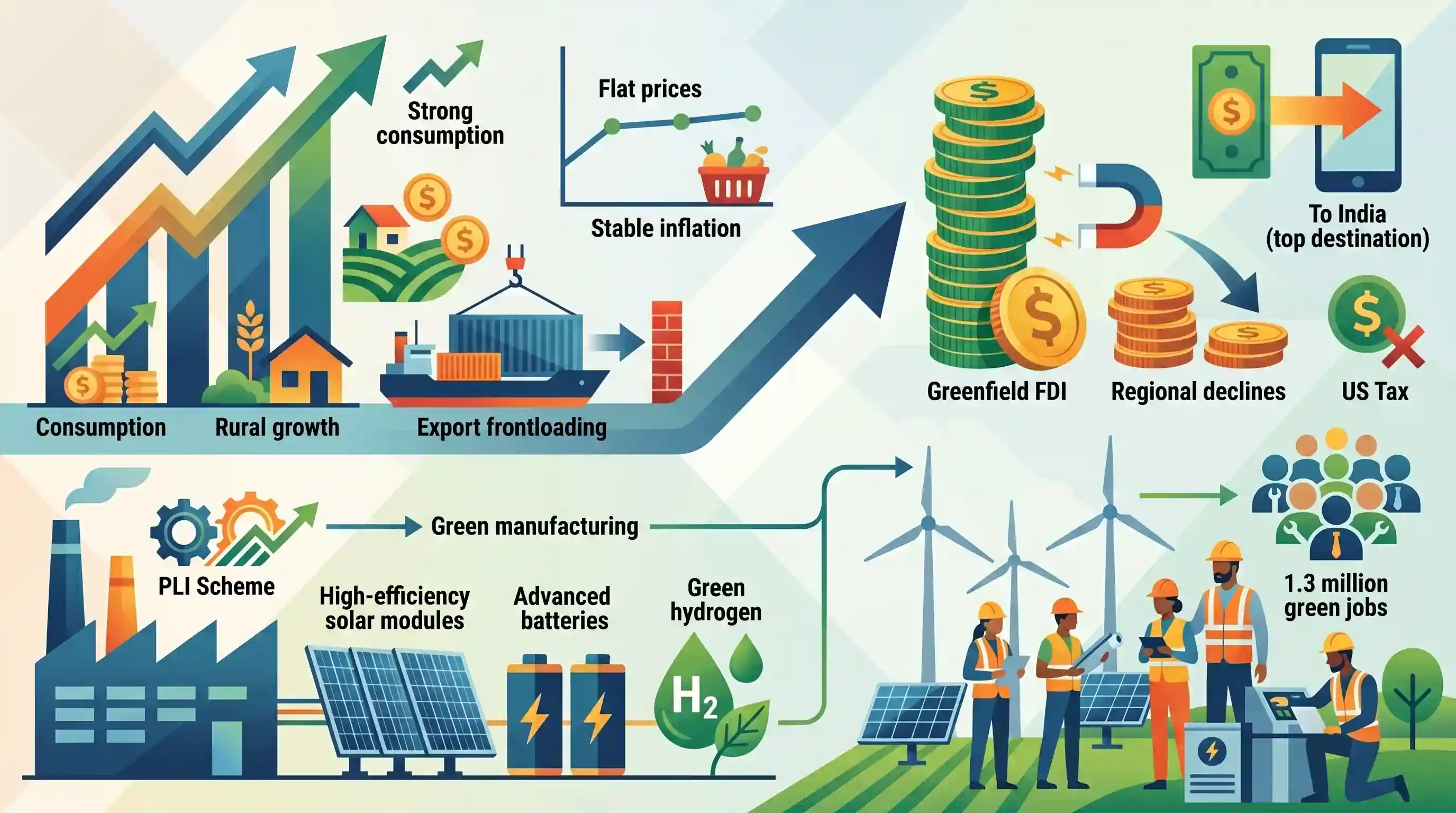
The UN Economic and Social Commission for Asia and the Pacific (ESCAP) has projected India's economy to grow at 6.4% in 2026 and 6.6% in 2027, driven by strong consumption, rural growth, and export frontloading amid looming US tariffs. Inflation is expected to remain stable at around 4.4%. India continues to secure a large share of greenfield Foreign Direct Investment (FDI) despite regional declines, and remains the top destination for remittances, although a new US tax on remittances could affect future flows. Additionally, the transition to a green economy is yielding results, with India generating 1.3 million green jobs. This transition is actively supported by the Production-Linked Incentive (PLI) scheme, which is boosting domestic manufacturing capacity in high-efficiency solar modules, advanced batteries, and green hydrogen.
Key Points
- UN ESCAP projects India's GDP to grow at 6.4% in 2026 and 6.6% in 2027, with inflation hovering around 4.4%.
- Growth is supported by strong domestic consumption, a robust rural economy, GST rate cuts, and export frontloading prior to impending US tariffs.
- Despite a regional decline in FDI, India successfully attracted a substantial share of greenfield FDI.
- India remains the largest global recipient of remittances (USD 137 billion in 2024), but faces potential headwinds from a new 1% US tax on outward remittances.
- The energy transition is creating green jobs (1.3 million in India) and is boosted by the PLI scheme targeting solar modules, batteries, and green hydrogen manufacturing.
Important Terms
Economic and Social Commission for Asia and the Pacific (ESCAP)

One of five UN regional commissions, established in 1947 and based in Bangkok. It fosters inclusive, sustainable development in the Asia-Pacific through policy dialogue and regional cooperation.
UPSC context
GS Paper 2: International Organizations. Important for reports on regional economic integration and sustainable development goals.
Production-Linked Incentive (PLI) Scheme
A performance-linked government initiative offering financial incentives to companies based on incremental sales from domestic manufacturing. It aims to reduce import dependence and boost local production.
UPSC context
GS Paper 3: Indian Economy and Industrial Policy. Tests knowledge of 'Make in India' strategies and sectoral manufacturing growth.
Greenfield Foreign Direct Investment (FDI)
A form of Foreign Direct Investment (FDI) where a parent company establishes new operations and facilities in a foreign country from scratch, rather than acquiring existing ones.
UPSC context
GS Paper 3: External Sector and Investment Models. Crucial for understanding capital inflows and infrastructure development.
Remittances
Funds transferred by migrant workers to their home country. India is the world's largest recipient, and these inflows are vital for balancing the current account deficit.
UPSC context
GS Paper 3: Indian Economy (External Sector). Highlights the role of the Indian diaspora in national economic stability.
Green Jobs
Decent work that significantly contributes to preserving or restoring the environment, such as in renewable energy, resource conservation, and energy efficiency sectors.
UPSC context
GS Paper 3: Economy and Environment. Relevant for climate change mitigation, sustainable development, and Skill India initiatives.
Green Hydrogen
Hydrogen produced through the electrolysis of water using renewable energy sources. It is a key focus area under India’s National Green Hydrogen Mission and PLI schemes.
UPSC context
GS Paper 3: Energy and Science & Technology. Crucial for India’s net-zero targets and decarbonization of heavy industries.
Prelims Trap
"Remittances sent by the Indian diaspora are recorded under the Capital Account."
Remittances are unilateral transfers (secondary income) with no future repayment obligations. They are strictly recorded under the Current Account (Invisibles), not the Capital Account.
Static Concepts Connected
What is the fundamental difference between Greenfield and Brownfield FDI?
- Greenfield FDI: Involves building new operational facilities from scratch, directly adding to the host country's productive capacity and creating fresh employment.
- Brownfield FDI: Involves acquiring or leasing existing facilities (e.g., mergers and acquisitions). It transfers ownership but does not immediately create new physical production capacity.
Where do private remittances figure in India's Balance of Payments (BoP)?
- Current Account: Remittances are classified under the Current Account, specifically within the 'Invisibles' category alongside services and income.
- Unilateral Transfers: They represent one-way financial flows (secondary income) with no future repayment obligation, playing a vital role in balancing the overall BoP.
Cross-Topic Patterns
Remittance taxation and CAD resilience
A US tax on outward remittances directly impacts India's Current Account Deficit (CAD), as these diaspora transfers are crucial for offsetting India's persistent merchandise trade deficit.
PLI intersecting with Climate targets
Expanding PLI to solar modules and green hydrogen merges industrial policy with climate targets, strategically reducing dependency on Chinese green-tech imports while generating local green jobs.

A multi-statement prelims question combining Current Account components (remittances) and Greenfield FDI trends is highly probable.
Linked PYQs · 5
Linked PYQs · 5
- 2021PrelimsGS1
Consider the following : 1. Foreign currency convertible bonds 2. Foreign institutional investment with certain conditions 3. Global depository receipts 4. Non-resident external deposits Which of the above can be included in Foreign Direct Investments?
- 2013PrelimsGS1
The balance of payments of a country is a systematic record of
- 2023MainsGS3
Faster economic growth requires increased share of the manufacturing sector in GDP, particularly of MSMEs. Comment on the present policies of the Government in this regard.
- 2021MainsGS3
Explain the difference between computing methodology of India's Gross Domestic Product (GDP) before the year 2015 and after the year 2015.
- 2025MainsGS3
Discuss the rationale of the Production Linked Incentive (PLI) scheme. What are its achievements? In what way can the functioning and outcomes of the scheme be improved?
