Macroeconomic Growth Projections and External Shocks for India
Source:The Hindu ↗
Why It Matters
This article provides a comprehensive snapshot of the vulnerability of India's macroeconomic indicators to external and environmental shocks (geopolitics in West Asia and El Niño). Understanding these linkages—specifically how currency depreciation, crude oil volatility, and monsoon deviations influence inflation, fiscal targets, and overall GDP growth—is essential for answering core economic and agricultural questions in both Prelims and Mains.
Summary
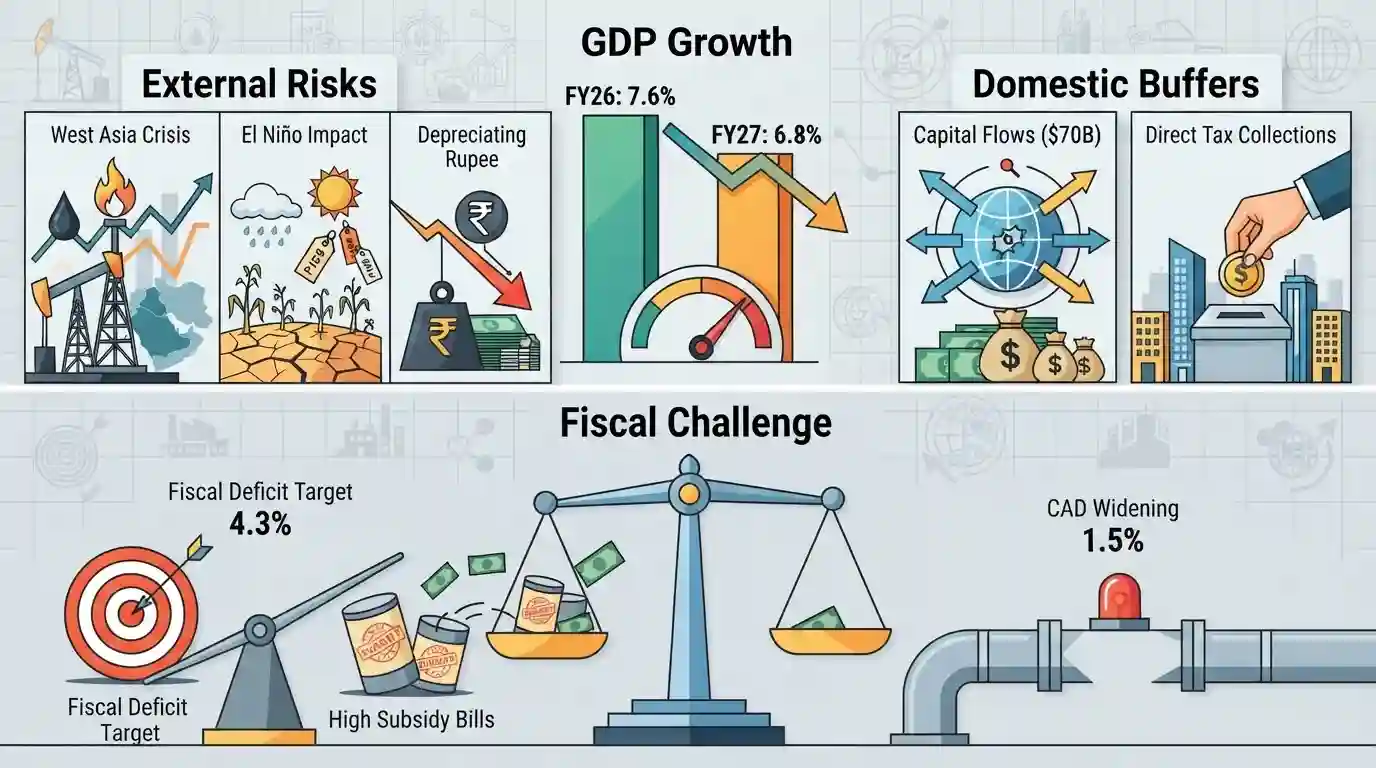
India Ratings & Research (Ind-Ra) has projected India’s GDP growth to slow down to 6.8% in FY27 from 7.6% in the previous fiscal year. The deceleration is primarily driven by external risks such as the West Asia crisis leading to fuel price volatility, the adverse impact of El Niño on agriculture causing food inflation, and a depreciating rupee. While the current account deficit (CAD) is expected to widen to 1.5% of GDP, domestic buffers like steady capital flows ($70 billion) and resilient direct tax collections are expected to provide some support, though meeting the fiscal deficit target of 4.3% remains challenging due to high subsidy bills.
Key Points
- GDP Growth Moderation: India Ratings & Research (Ind-Ra) projects India’s GDP growth to slow down to 6.8% in FY27 from 7.6% in FY26, marginally higher than its previous projection of 6.7% and the RBI's revised forecast of 6.7%.
- Key Risk Factors: The projected slowdown is attributed to fuel and food inflation driven by the West Asia conflict, potential agricultural disruption due to El Niño, and a depreciating rupee.
- Currency and Crude Oil: The rupee-dollar exchange rate is expected to average ₹93.98/USD in FY27 (a 6.4% YoY depreciation). Average Indian basket crude oil is assumed at $85 per barrel for FY27, down from previous projections of $95/barrel.
- Inflation and CAD Projections: Retail inflation is estimated to average 4.9% in FY27 (compared to 2% in FY26), while the Current Account Deficit (CAD) is projected to rise to 1.5% of GDP in FY27 from 0.6% in FY26. Capital inflows from FCNR(B) and ECBs are estimated at $70 billion.
- Fiscal Deficit Vulnerabilities: Meeting the FY27 fiscal deficit target of 4.3% remains challenging due to high subsidy expenditures on LPG and fertilisers, with sluggish indirect tax collections posing further headwinds despite strong direct tax and non-tax revenues.
Important Terms
India Ratings & Research (Ind-Ra)

A leading SEBI-registered credit rating agency in India and a wholly-owned subsidiary of the Fitch Group, providing credit ratings, research, and economic forecasts.
UPSC context
GS Paper III (Indian Economy); tests domestic credit rating mechanisms, macro-growth projections, and financial sector health.
Fitch Group
One of the "Big Three" global credit rating agencies alongside S&P and Moody's, providing sovereign, corporate, and structured finance credit assessments globally.
UPSC context
GS Paper III (Indian Economy); tests global financial institutions, credit rating dynamics, and their impact on international capital flows.
Reserve Bank of India (RBI)
India's central bank and apex monetary authority, established in 1935, responsible for regulating banking, issuing currency, and formulating monetary policy to maintain price stability.
UPSC context
GS Paper III (Indian Economy); tests monetary policy, inflation targeting, banking regulation, and external sector management.
Current Account Deficit (CAD)
An economic metric representing the excess of a nation's foreign spending on imports of goods, services, and transfers over its foreign earnings from exports.
UPSC context
GS Paper III (Indian Economy); tests Balance of Payments, trade competitiveness, and foreign exchange reserves management.
Fiscal Deficit
The excess of a government's total expenditure over its total non-borrowed receipts, reflecting the total borrowing requirements of the government in a financial year.
UPSC context
GS Paper III (Indian Economy/Budgeting); tests public debt management, fiscal policy framework, and macroeconomic stability.
El Niño
The warm phase of the El Niño-Southern Oscillation cycle, characterized by anomalous warming of sea surface temperatures in the equatorial Pacific, often disrupting global monsoons.
UPSC context
GS Paper I (Climatology) & GS Paper III (Agriculture); tests monsoon variability, food inflation, and agricultural policy.
Prelims Trap
"A depreciating rupee automatically reduces the Current Account Deficit by boosting export competitiveness."
India's major imports (crude oil, fertilizers) are price-inelastic. Rupee depreciation usually inflates the import bill (imported inflation) faster than it boosts export volumes, often widening the CAD.
Static Concepts Connected
How does currency depreciation lead to 'imported inflation' in India?
- Exchange Rate Mechanism: A weaker Rupee means more domestic currency is required to purchase the same volume of dollar-denominated foreign goods.
- Inelastic Demand: Because India imports around 85% of its crude oil, currency depreciation directly raises domestic fuel costs even if global crude prices remain flat.
- Cost-Push Effect: Higher fuel and raw material costs cascade into transportation and agricultural prices, causing generalized cost-push inflation across the economy.
What is the macroeconomic chain reaction of an El Niño year in India?
- Ocean Warming Mechanism: It involves abnormal sea surface warming in the central and eastern Pacific, weakening trade winds and disrupting the Walker circulation.
- Monsoon Suppression: It generally suppresses India's Southwest monsoon, leading to spatial rainfall deficits and drought-like conditions in key agricultural zones.
- Economic Spillover: Poor rainfall lowers Kharif crop yields, creates supply-side shortages, spikes food inflation, and depresses rural consumption demand, thereby slowing GDP growth.
Cross-Topic Patterns
Climate patterns & Fiscal Policy
El Niño reduces agricultural yields, forcing the government to increase fertilizer and food security subsidies. This non-discretionary spending directly challenges statutory fiscal deficit targets.
Geopolitics & Domestic Monetary Stance
West Asia conflicts hike crude prices, causing imported inflation and a widening CAD. This forces the RBI into a hawkish monetary stance (delaying rate cuts), which dampens overall GDP growth.

Expect a question linking El Nino-driven food inflation, imported inflation via a weaker rupee, and their impact on RBI's monetary stance.
Linked PYQs · 4
Linked PYQs · 4
- 2024MainsGS3
What are the causes of persistent high food inflation in India? Comment on the effectiveness of the monetary policy of the RBI to control this type of inflation.
- 2022PrelimsGS1
With reference to the Indian economy, consider the following statements: 1. An increase in Nominal Effective Exchange Rate (NEER) indicates the appreciation of rupee. 2. An increase in the Real Effective Exchange Rate (REER) indicates an improvement in trade competitiveness. 3. An increasing trend in domestic inflation relative to inflation in other countries is likely to cause an increasing divergence between NEER and REER. Which of the above statements are correct?
- 2017PrelimsGS1
With reference to 'Indian Ocean Dipole (IOD)' sometimes mentioned in the news while forecasting Indian monsoon, which of the following statements is/are correct? 1. IOD phenomenon is characterised by a difference in sea surface temperature between tropical Western Indian Ocean and tropical Eastern Pacific Ocean. 2. An IOD phenomenon can influence an El Nino's impact on the monsoon. Select the correct answer using the code given below:
- 2025MainsGS2
"Energy security constitutes the dominant kingpin of India's foreign policy, and is linked with India's overarching influence in Middle Eastern countries.” How would you integrate energy security with India's foreign policy trajectories in the coming years?
