BMI projects moderation in India economic growth rate for FY27
Source:The Hindu ↗
Why It Matters
The article provides a comprehensive overview of how domestic monetary policy shifts (RBI rate hikes to fight inflation) and global geopolitical bottlenecks (Strait of Hormuz tensions) interact to influence India's growth trajectory, currency valuation, and export competitiveness. It is highly relevant for GS-3 Economy questions on macroeconomic stability, inflation targeting, and external sector dynamics.
Summary
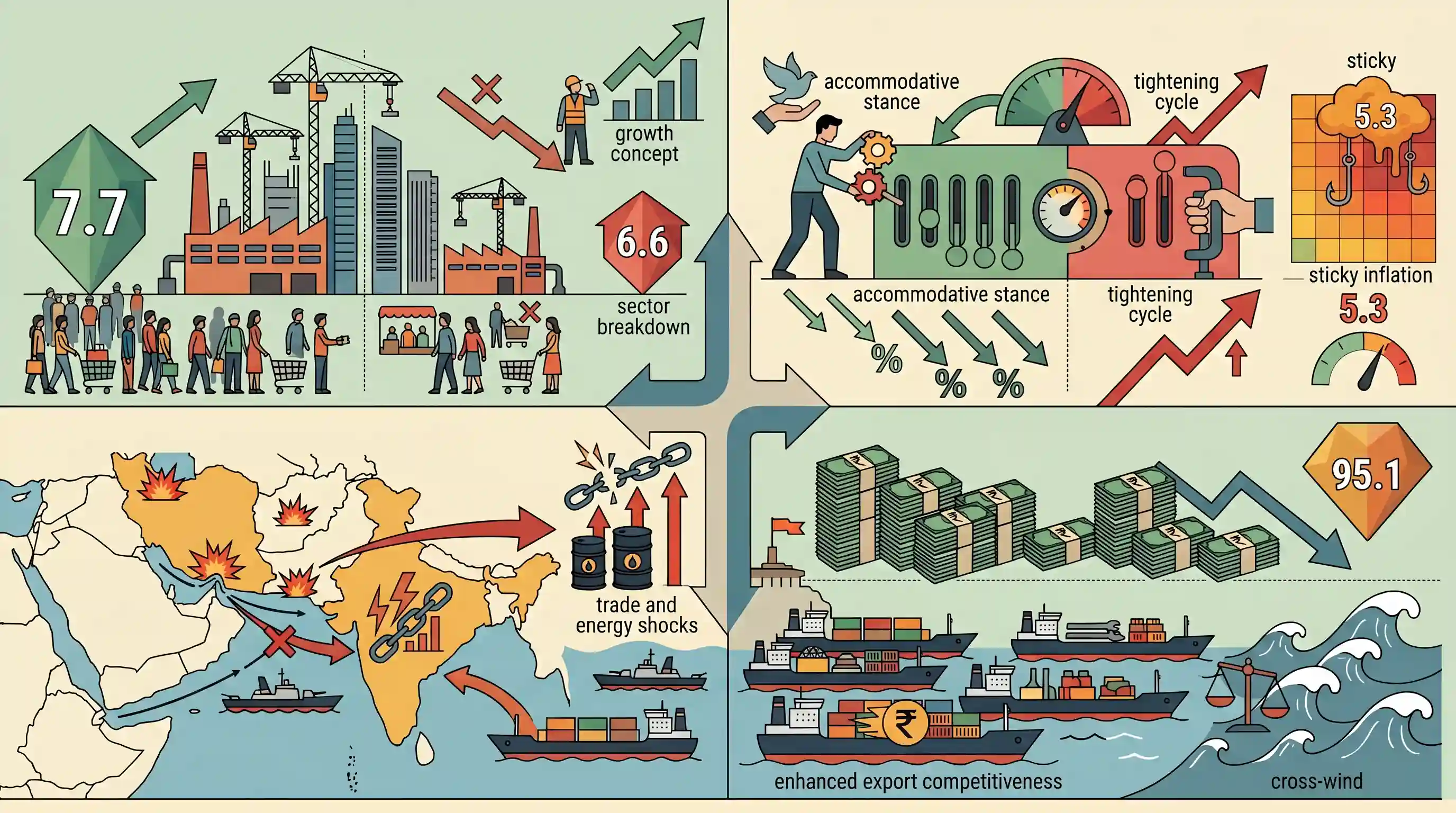
According to BMI, India's economic growth is forecast to moderate to 6.6% in FY27 from a projected 7.7% in FY26, largely due to slower investments and a waning consumption boom following GST reforms. The slowdown will be exacerbated by a shift in RBI's monetary policy from an accommodative stance (125 bps cuts in 2025) to a tightening cycle with an expected 50 bps hike to control sticky inflation around 5.3%. External pressures, including trade and energy shocks stemming from West Asia conflicts (Iran/Strait of Hormuz), further weigh on the outlook. However, a projected depreciation of the rupee to 95.1 against the USD is expected to enhance export competitiveness, partially offsetting these terms-of-trade challenges.
Key Points
- India's GDP growth is projected by BMI to decelerate to 6.6% in FY27 from 7.7% in FY26.
- The slowdown is primarily driven by weakening consumption growth and slower investments.
- Past RBI rate cuts (125 bps in 2025) are losing their stimulus effect, and an impending 50 bps rate hike cycle in FY26-27 is expected to address sticky inflation (projected at 5.3%).
- Geopolitical tensions involving Iran and the Strait of Hormuz present external trade and supply chain shocks.
- The Indian rupee is expected to depreciate to 95.1 against the US dollar by FY27, which could cushion the terms-of-trade shock by boosting export competitiveness.
Important Terms
Goods and Services Tax (GST)

A unified, destination-based indirect tax levied on the supply of goods and services. Introduced via the 101st Constitutional Amendment Act (2017) to create a single national market by subsuming multiple taxes.
UPSC context
GS Paper III (Indian Economy); tests understanding of indirect tax reforms, cooperative federalism (GST Council), and fiscal policy impacts on growth.
Reserve Bank of India (RBI)
India's central bank and regulatory body responsible for regulating the banking system, issuing currency, and formulating monetary policy to maintain price stability while supporting economic growth.
UPSC context
GS Paper III (Indian Economy); core to questions on monetary authority, inflation targeting, and financial sector stability.
Monetary Policy Stance
The orientation of a central bank's policy; 'Accommodative' indicates willingness to cut rates to boost growth, while 'Tightening' (or Hawkish) focuses on raising rates to curb inflation.
UPSC context
GS Paper III (Indian Economy); tests technical knowledge of how the MPC manages liquidity and responds to macroeconomic cycles.
Strait of Hormuz
A critical maritime chokepoint between Iran and Oman connecting the Persian Gulf to the Gulf of Oman. It handles roughly 20% of global petroleum consumption and 35% of LNG trade.
UPSC context
GS Paper II (International Relations) & GS Paper III (Energy Security); vital for questions on West Asia geopolitics and India's energy vulnerability.
Terms of Trade (ToT)
The ratio between the index of export prices and the index of import prices. An improvement (favorable) means a country can purchase more imports for a given level of exports.
UPSC context
GS Paper III (External Sector); relevant for analyzing export competitiveness, exchange rate impacts, and the balance of payments.
Inflation Targeting
A monetary policy framework where the central bank uses interest rates to keep inflation within a specific target range (4% ± 2% for India) to ensure price stability.
UPSC context
GS Paper III (Indian Economy); fundamental concept for the Monetary Policy Committee's (MPC) mandate and its effectiveness in controlling sticky inflation.
Prelims Trap
Depreciation of the rupee automatically improves India's Terms of Trade.
Depreciation generally worsens the Terms of Trade index since imports become comparatively costlier. It improves export competitiveness and potentially the Balance of Trade, but not necessarily the Terms of Trade ratio.
Static Concepts Connected
What do 'accommodative' and 'tightening' monetary policy stances mean?
- Accommodative Stance: The central bank is prepared to expand money supply and cut interest rates to boost economic growth.
- Tightening/Hawkish Stance: The central bank prioritizes inflation control over growth by raising policy rates to absorb excess liquidity.
What is the geographical significance of the Strait of Hormuz?
- Connecting Bodies: It links the Persian Gulf to the Gulf of Oman and the broader Arabian Sea.
- Bordering Nations: It is bordered by Iran to the north, and Oman and the UAE to the south.
- Economic Chokepoint: It is a critical global maritime chokepoint, vulnerable to disruptions that cause energy supply shocks.
Cross-Topic Patterns
Geopolitics + Imported Inflation
West Asian conflicts disrupting the Strait of Hormuz directly transmit into India as imported inflation, forcing the RBI into a tightening cycle despite slowing domestic economic growth.
Currency Depreciation + Trade Shocks
A depreciating rupee acts as an automatic macroeconomic stabilizer. It cushions external terms-of-trade shocks by artificially lowering the foreign-currency price of Indian exports to maintain global competitiveness.

Expect a 2026 Prelims multi-statement question linking Middle East chokepoints (Hormuz) directly to imported inflation and RBI policy.
Linked PYQs · 4
Linked PYQs · 4
- 2023MainsGS3
Faster economic growth requires increased share of the manufacturing sector in GDP, particularly of MSMEs. Comment on the present policies of the Government in this regard.
- 2022PrelimsGS1
With reference to the Indian economy, consider the following statements: 1. If the inflation is too high, Reserve Bank of India (RBI) is likely to buy government securities. 2. If the rupee is rapidly depreciating, RBI is likely to sell dollars in the market. 3. If interest rates in the USA or European Union were to fall, that is likely to induce RBI to buy dollars. Which of the statements given above are correct?
- 2021PrelimsGS1
Consider the following statements : The effect of devaluation of a currency is that it necessarily 1. improves the competitiveness of the domestic exports in the foreign markets 2. increases the foreign value of domestic currency 3. improves the trade balance Which of the above statements is/are correct?
- 2022PrelimsGS1
With reference to the Indian economy, consider the following statements: 1. An increase in Nominal Effective Exchange Rate (NEER) indicates the appreciation of rupee. 2. An increase in the Real Effective Exchange Rate (REER) indicates an improvement in trade competitiveness. 3. An increasing trend in domestic inflation relative to inflation in other countries is likely to cause an increasing divergence between NEER and REER. Which of the above statements are correct?
