BMI Forecasts Moderate India GDP Growth Due to Investment Slowdown
Source:The Hindu ↗
Why It Matters
This forecast illustrates the complex interplay between domestic macroeconomic indicators (consumption, investment, inflation) and external geopolitical shocks (energy crises, terms-of-trade). It offers critical insights into how the RBI's monetary policy and exchange rate depreciation can act as stabilizers, which is highly relevant for GS-3 topics on Indian Economy and planning.
Summary
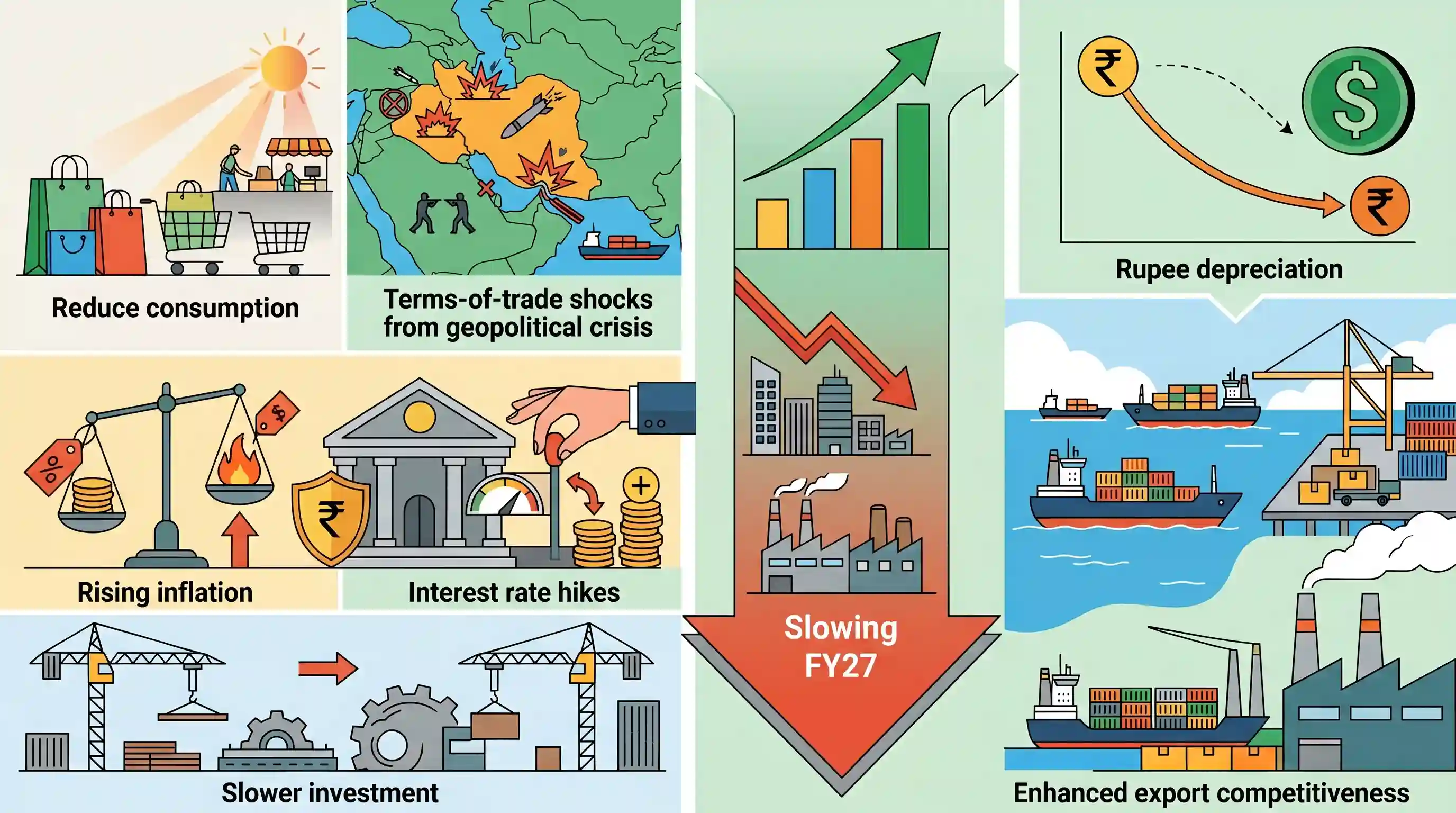
According to Business Monitor International (BMI), India's economic growth is projected to slow to 6.6% in FY27 from 7.7% in FY26. This moderation is driven by fading consumption boosts from previous GST reforms, a projected rise in inflation to 5.3%, and slower investment growth. External headwinds include terms-of-trade shocks stemming from the West Asia crisis and disruptions at the Strait of Hormuz. However, BMI notes that an expected depreciation of the Rupee against the US dollar will enhance export competitiveness, partially offsetting these shocks. To address inflationary pressures, the RBI is anticipated to raise interest rates by 50 basis points cumulatively in FY27.
Key Points
- Business Monitor International (BMI) projects India's GDP growth to moderate to 6.6% in FY27, down from an estimated 7.7% in FY26, aligning with the RBI's forecasts.
- The slowdown is attributed to the waning impact of past GST reforms on consumption, sticky inflation expected to reach 5.3%, and moderating investment growth.
- Geopolitical tensions in West Asia (Iran conflict, Strait of Hormuz disruptions) pose trade and energy shocks, though a depreciating Rupee (forecast at 95.1/USD) could buffer this by boosting export competitiveness.
- BMI expects the RBI to implement cumulative rate hikes of 50 basis points in FY27 to manage inflation, though past rate cuts provide current economic support amidst the energy crisis.
Important Terms
Goods and Services Tax (GST)

A comprehensive destination-based indirect tax on the supply of goods and services. It replaced multiple central and state taxes to create a unified national market.
UPSC context
GS Paper 3: Indian Economy. Key for questions on fiscal policy, tax reforms, and cooperative federalism (GST Council).
Reserve Bank of India (RBI)
India's central bank and monetary authority. It manages inflation via the Monetary Policy Committee (MPC) and regulates the banking system and foreign exchange reserves.
UPSC context
GS Paper 3: Indian Economy. Essential for understanding monetary policy instruments like repo rate and inflation targeting.
Strait of Hormuz
A strategic maritime chokepoint between Iran and Oman. It is vital for global energy trade, carrying roughly 20% of the world's oil supply.
UPSC context
GS Paper 3/2: Energy Security and International Relations. Critical for India's energy imports (40% crude oil).
Terms-of-Trade (ToT)
The ratio between a country’s export prices and its import prices. A "shock" occurs when prices fluctuate sharply, affecting trade balance and growth.
UPSC context
GS Paper 3: Indian Economy. Relates to external sector stability, current account deficits, and macroeconomic resilience.
Basis Points (BPS)
A unit of measure used in finance to describe interest rate changes. One basis point equals 0.01% (or 1/100th of a percentage point).
UPSC context
GS Paper 3: Indian Economy. Technical term used in monetary policy discussions and interest rate movements.
Business Monitor International (BMI)
A subsidiary of Fitch Solutions providing macroeconomic, industry, and financial market analysis across global markets.
UPSC context
Contextual: Source of macroeconomic forecasts and country risk analysis used to gauge economic sentiment.
Prelims Trap
"Currency depreciation strictly worsens economic shocks for import-dependent nations."
While depreciation inflates the oil import bill, it simultaneously makes domestic exports cheaper abroad, acting as a partial macroeconomic buffer by enhancing export competitiveness.
Static Concepts Connected
What constitutes 'sticky inflation' and how does the RBI respond?
- Definition: A macroeconomic condition where prices for goods and services resist downward movement despite cooling demand.
- Core Drivers: Often driven by entrenched wage-price spirals, structural bottlenecks, or persistent supply-side energy shocks.
- Policy Response: The RBI employs contractionary monetary policy, raising the repo rate to curb aggregate demand and anchor inflation expectations.
What is the geographical and economic significance of the Strait of Hormuz?
- Location: A critical maritime chokepoint connecting the Persian Gulf to the Gulf of Oman and Arabian Sea.
- Bordering Nations: Flanked by Iran to the north and Oman (Musandam Peninsula) and the UAE to the south.
- Economic Impact: Transits roughly 20% of global oil consumption; disruptions here trigger immediate terms-of-trade shocks for import-dependent economies like India.
Cross-Topic Patterns
Energy chokepoints & imported inflation
Disruptions in the Strait of Hormuz directly link physical geography to macroeconomics, causing 'imported inflation' that forces the RBI into hawkish monetary policy despite slowing domestic growth.
Currency depreciation as a buffer
UPSC frequently tests exchange rate dynamics; here, a floating exchange rate (rupee depreciation) acts as an automatic stabilizer, partially offsetting external shocks by boosting export competitiveness.

Expect a 2026 multi-statement prelims question linking geopolitical chokepoints (Strait of Hormuz) to imported inflation and RBI rate hikes.
Linked PYQs · 4
Linked PYQs · 4
- 2024MainsGS3
What are the causes of persistent high food inflation in India? Comment on the effectiveness of the monetary policy of the RBI to control this type of inflation.
- 2023MainsGS3
Faster economic growth requires increased share of the manufacturing sector in GDP, particularly of MSMEs. Comment on the present policies of the Government in this regard.
- 2022PrelimsGS1
With reference to the Indian economy, consider the following statements: 1. An increase in Nominal Effective Exchange Rate (NEER) indicates the appreciation of rupee. 2. An increase in the Real Effective Exchange Rate (REER) indicates an improvement in trade competitiveness. 3. An increasing trend in domestic inflation relative to inflation in other countries is likely to cause an increasing divergence between NEER and REER. Which of the above statements are correct?
- 2022PrelimsGS1
With reference to the Indian economy, consider the following statements: 1. If the inflation is too high, Reserve Bank of India (RBI) is likely to buy government securities. 2. If the rupee is rapidly depreciating, RBI is likely to sell dollars in the market. 3. If interest rates in the USA or European Union were to fall, that is likely to induce RBI to buy dollars. Which of the statements given above are correct?
