India Economic Dependence on China and Border Disengagement Concerns
Source:Indian Express ↗
Why It Matters
The India-China relationship is a highly critical topic for UPSC, covering both GS2 (International Relations) and GS3 (Border Security). Understanding the specific geography of friction points (Depsang, Pangong Tso, Galwan) and the nuances of the disengagement agreements provides necessary factual backing for Mains answers. Furthermore, the dichotomy of rising bilateral trade despite geopolitical hostility highlights India's supply-chain vulnerabilities and the challenges facing 'Atmanirbhar Bharat'.
Summary
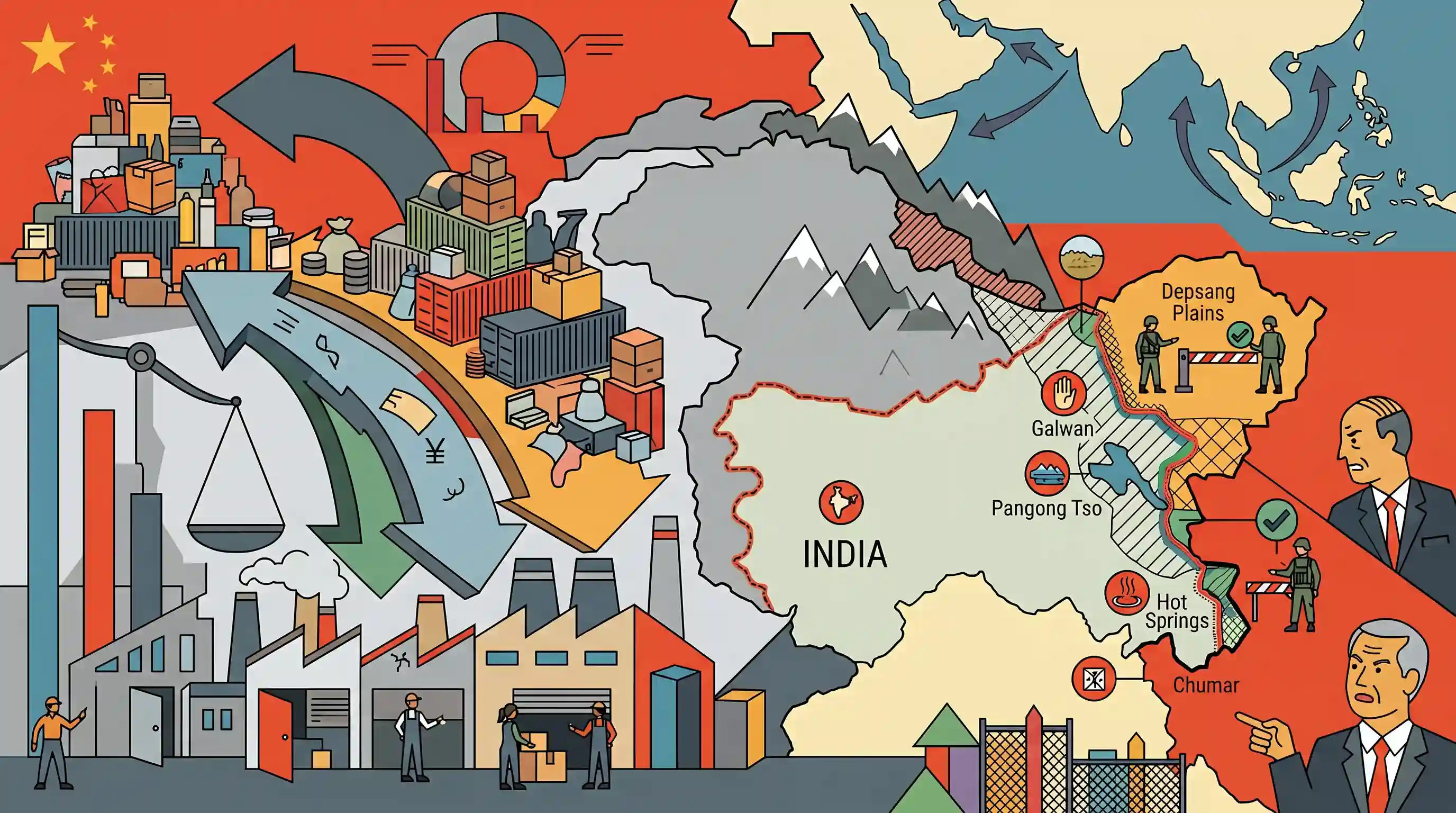
The Indian National Congress has criticized the Union government over India's increasing economic dependence on China and unresolved issues along the Line of Actual Control (LAC). Despite border tensions, Chinese imports have crossed $100 billion, widening the trade deficit and impacting MSMEs. Additionally, the opposition claims the recent October 2024 disengagement agreement effectively formalizes the loss of 2,000 sq km of land in Ladakh. The creation of buffer zones in Galwan, Hot Springs, and Pangong Tso, along with the requirement of Chinese concurrence to patrol strategic points in the Depsang Plains, Demchok, and Chumar, signifies a shift from the pre-2020 status quo.
Key Points
- The Congress party has raised concerns over India's growing economic dependence on China, highlighting that Chinese imports have exceeded $100 billion, severely impacting domestic MSMEs.
- Congress alleges that the border disengagement agreement of October 21, 2024, has led to the loss of around 2,000 sq km of Indian territory in Ladakh.
- The creation of 'buffer zones' has restricted Indian troops from patrolling up to their previous limits in Galwan, Hot Spring, and Pangong Tso (e.g., restricted to Finger 3 instead of Finger 8).
- Indian patrols reportedly now require Chinese concurrence to access strategic locations in the Depsang Plains (Patrolling Points 10, 11, 11A, 12, 13), Demchok, and Chumar.
Important Terms
Line of Actual Control (LAC)

The de facto boundary separating Indian-controlled territory from Chinese-controlled territory. It is not officially demarcated, leading to differing perceptions and periodic military standoffs in its Western, Middle, and Eastern sectors.
UPSC context
GS-II (International Relations) and GS-III (Internal Security); essential for understanding border management, sovereignty, and the 1962 conflict's legacy.
Disengagement Agreement (October 2024)
A bilateral pact reached on October 21, 2024, to restore patrolling and grazing rights in Depsang and Demchok to the pre-2020 status quo, marking the completion of disengagement at all major friction points.
UPSC context
GS-II (Bilateral Relations); tests knowledge of contemporary diplomatic breakthroughs and current affairs related to India's northern neighborhood.
Buffer Zones
Temporary demilitarized areas created between opposing forces along the LAC where patrolling is restricted to prevent physical clashes. Critics argue they may inadvertently formalize loss of access to previously controlled territory.
UPSC context
GS-III (Internal Security/Border Management); relevant for discussing conflict resolution tactics and tactical disadvantages in mountain warfare.
Depsang Plains
A strategic high-altitude plateau in eastern Ladakh near the Karakoram Pass. It is a critical friction point due to its proximity to the Daulat Beg Oldie (DBO) airstrip and vital supply lines.
UPSC context
GS-I (Geography) and GS-III (Internal Security); tests map-based knowledge of strategic locations and their geopolitical significance.
Trade Deficit
The negative balance in international trade where a country's imports exceed its exports. India's deficit with China reached approximately $100 billion in FY 2024-25, highlighting heavy industrial dependence.
UPSC context
GS-III (Economy); central to discussions on 'Atmanirbhar Bharat', domestic manufacturing vulnerabilities, and bilateral economic leverage.
MSMEs (Micro, Small and Medium Enterprises)
Enterprises defined by specific investment and turnover limits. In Indo-China relations, these sectors are vulnerable to 'dumping' of cheap Chinese goods, which can erode domestic manufacturing capacity.
UPSC context
GS-III (Economy); vital for questions on industrial growth, employment, and the impact of global trade on the grassroots economy.
Prelims Trap
India's trade deficit with China has steadily declined over the last five years due to import substitution and PLI schemes.
Despite PLI schemes and Atmanirbhar Bharat, structural dependence on Chinese APIs, electronics, and capital goods has actually caused the bilateral trade deficit to widen, not shrink.
Static Concepts Connected
What is the North-to-South alignment of key Eastern Ladakh friction points?
- Depsang Plains: Northernmost friction point near the strategic Daulat Beg Oldie (DBO) airstrip and the Karakoram Pass.
- Galwan Valley: Located south of Depsang, marking the strategic junction where the Galwan river meets the Shyok river.
- Pangong Tso: An endorheic lake further south, whose northern bank is divided by mountain spurs known as 'Fingers'.
- Demchok: The southernmost major friction point in eastern Ladakh, centered around the Charding Ninglung Nullah junction.
Why is India structurally dependent on Chinese imports?
- Pharma APIs: China supplies roughly 70% of the Active Pharmaceutical Ingredients (APIs) required by India's massive generic pharmaceutical industry.
- Electronics & Renewables: India heavily relies on Chinese supply chains for integrated circuits, semiconductors, telecom hardware, and solar photovoltaic cells.
- Capital Goods: Affordable Chinese industrial machinery and intermediate goods remain crucial for the survival and scaling of Indian MSMEs.
Cross-Topic Patterns
Green energy targets vs. import reliance
India's push for 500 GW non-fossil capacity by 2030 deepens its reliance on China for solar modules and critical mineral processing, complicating strategic decoupling efforts.
Border infrastructure and Vibrant Villages
The prolonged Ladakh standoff has accelerated BRO projects like the DS-DBO road and prompted the Vibrant Villages Programme to counter China's dual-use Xiaokang border villages.

North-South mapping of Ladakh friction points (Depsang to Demchok) paired with the paradox of rising trade deficits is a prime 2026 target.
Linked PYQs · 3
Linked PYQs · 3
- 2024MainsGS3
India has a long and troubled border with China and Pakistan fraught with contentious issues. Examine the conflicting issues and security challenges along the border. Also give out the development being undertaken in these areas under the Border Area Development Programme (BADP) and Border Infrastructure and Management (BIM) Scheme.
- 2024MainsGS2
‘The West is fostering India as an alternative to reduce dependence on China's supply chain and as a strategic ally to counter China's political and economic dominance.’ Explain this statement with examples.
- 2012MainsGS2
Do you think that China's emergence as one of the largest trading partners of India has adversely affected the settlement of the outstanding border problem?
