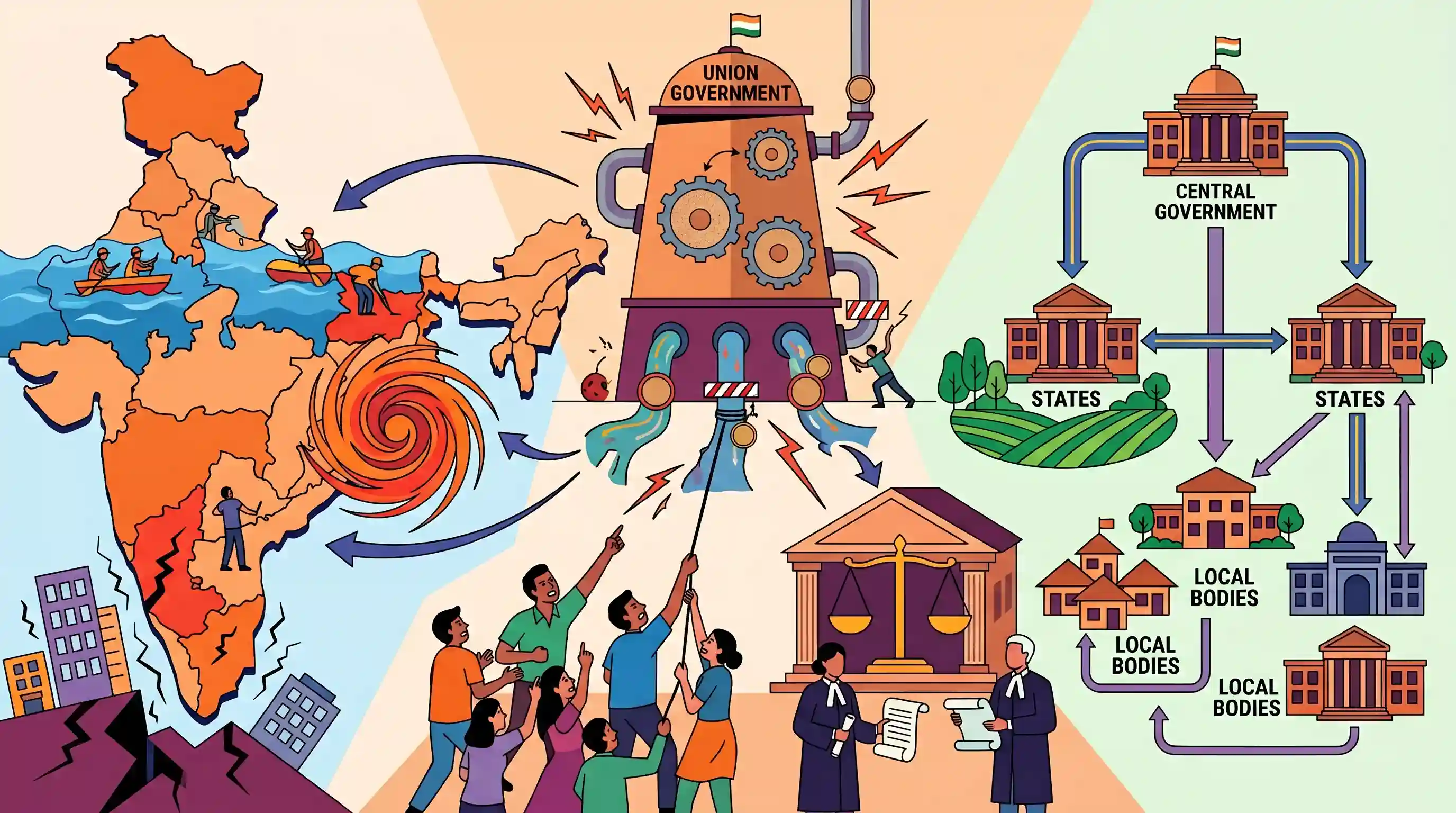
Disaster management funds friction and cooperative federalism
Source:The Hindu ↗
Why It Matters
The intersection of disaster management and federalism is a critical, recurring theme in UPSC. Recent Supreme Court cases filed by states against the Centre for disaster funds make this a highly probable case study for GS2 (Federalism/Centre-State relations) and GS3 (Disaster Management).
Summary
The article highlights how India's disaster response framework, primarily governed by the Disaster Management Act of 2005, has become a point of friction in Centre-State relations. With states bearing the immediate brunt of natural disasters, the delayed and inadequate release of disaster relief funds from the Centre has forced several states to seek judicial intervention. This dynamic underscores a centralising tendency that undermines cooperative federalism. The piece advocates for structural reforms in fiscal federalism and disaster funding to empower states with timely resources and operational autonomy, ensuring a more effective and decentralized disaster management system.
Key Points
- The Disaster Management Act, 2005, gives sweeping powers to the Union government, often reflecting centralising tendencies that bypass state autonomy.
- States have increasingly faced challenges with delayed or inadequate release of funds from the National Disaster Response Fund (NDRF), prompting states like Karnataka and Tamil Nadu to approach the Supreme Court.
- The financial dependency of states on the Centre for disaster relief creates significant friction, putting strain on India's fiscal federalism.
- There is a growing need to transition from a top-down approach to cooperative federalism in disaster management, ensuring states have timely access to resources and greater operational autonomy.
Important Terms
Disaster Management Act, 2005

The 2005 legislation providing India's legal-institutional framework for disaster response. it mandates the creation of authorities at National, State, and District levels to oversee mitigation and relief.
UPSC context
GS Paper II/III; tests understanding of executive powers and legislative framework for Centre-State cooperation during emergencies.
National Disaster Management Authority (NDMA)
India's apex statutory body for disaster management, chaired by the Prime Minister. It formulates national policies, plans, and guidelines to ensure timely and effective responses to calamities.
UPSC context
GS Paper III; essential for understanding the institutional hierarchy and governance structures for national-level planning.
National Disaster Response Fund (NDRF)
A central fund managed by the Union Government to provide immediate relief during "severe" disasters. It supplements state funds when local resources are insufficient for emergency response.
UPSC context
GS Paper III; relevant for questions on disaster financing, relief mechanisms, and financial interdependence in federalism.
State Disaster Response Fund (SDRF)
The primary statutory fund available to State Governments for immediate response to notified disasters. The Centre typically contributes 75% (90% for Himalayan and NE states).
UPSC context
GS Paper II/III; critical for analyzing fiscal federalism and the operational autonomy of states during crises.
Finance Commission
A constitutional body (Article 280) that recommends the distribution of financial resources between the Union and States, including the specific allocations for disaster relief and mitigation.
UPSC context
GS Paper II; central to debates on fiscal federalism, revenue devolution, and Centre-State financial relations.
Supreme Court of India
The highest judicial body in India, acting as the final arbiter in legal disputes between States and the Centre over relief fund delays or legislative implementation.
UPSC context
GS Paper II; tests the judiciary's role in adjudicating federal friction and enforcing constitutional obligations.
Prelims Trap
"The NDRF is the primary fund for disaster relief and is maintained under the Consolidated Fund of India."
SDRF is the primary fund for state-level relief. NDRF only supplements it for 'severe' disasters. Crucially, both funds are maintained in the Public Account of India, not the Consolidated Fund.
Static Concepts Connected
How do the SDRF and NDRF differ in their funding structure and purpose?
- Primary vs Supplementary: SDRF is the primary fund available to states. NDRF is supplementary, triggered only for disasters of a 'severe nature' when state resources run out.
- Funding Ratio: SDRF is shared 75:25 (General) or 90:10 (Special Category) between Centre and States. NDRF is 100% centrally funded through specialized cesses and levies.
- Public Account Status: Both NDRF and SDRF are placed in the 'Public Account of India' under the sub-head 'Reserve Funds not bearing interest'.
What are the parameters of the Supreme Court's Original Jurisdiction under Article 131?
- Exclusive Scope: It covers disputes between the Centre and States, or between two or more States, acting as an exclusive forum for federal disputes.
- Legal Right Requirement: The dispute must involve a question of law or fact on which the existence or extent of a legal right depends. Political disputes are excluded.
- Key Exclusions: It does not extend to disputes arising from pre-Constitution treaties or inter-state river water disputes (which fall under Article 262).
Cross-Topic Patterns
Finance Commission & Disaster Mitigation
The Finance Commission sets the allocation logic for SDRF and NDRF. Integrating climate vulnerability into these fiscal devolution formulas is a critical GS2/GS3 intersection for Mains.
Judicialization of Fiscal Federalism
States are increasingly invoking Article 131 to resolve financial conflicts (borrowing limits, NDRF delays), bypassing political avenues like the Inter-State Council. This highlights a shift in Centre-State dispute resolution.

Expect a Prelims question comparing NDRF/SDRF funding sources, Public Account status, and the PM's role in NDMA vs MHA's role.
Linked PYQs · 5
Linked PYQs · 5
- 2024MainsGS2
What changes has the Union Government recently introduced in the domain of Centre-State relations ? Suggest measures to be adopted to build the trust between the Centre and the States and for strengthening federalism.
- 2020MainsGS2
Indian Constitution exhibits centralising tendencies to maintain unity and integrity of the nation. Elucidate in the perspective of the Epidemic Diseases Act, 1897; The Disaster Management Act, 2005 and recently passed Farm Acts.
- 2025MainsGS2
Examine the evolving pattern of Centre-State financial relations in the context of planned development in India. How far have the recent reforms impacted the fiscal federalism in India?
- 2015MainsGS2
The concept of cooperative federalism has been increasingly emphasized in recent years. Highlight the drawbacks in the existing structure and the extent to which cooperative federalism would answer the shortcomings.
- 2024MainsGS3
What is disaster resilience? How is it determined? Describe various elements of a resilience framework. Also mention the global targets of Sendai Framework for Disaster Risk Reduction (2015–2030).
