Telecom provider liability in SIM swap cyber fraud cases
Source:Indian Express ↗
Why It Matters
This ruling establishes significant civil accountability for telecom service providers regarding cyber frauds caused by negligent SIM issuance. It highlights the systemic vulnerability of India's OTP-dependent digital economy and bridges GS3 (Cyber Security/Digital Economy) with GS2 (Lok Adalat jurisdiction/Telecom regulation).
Summary
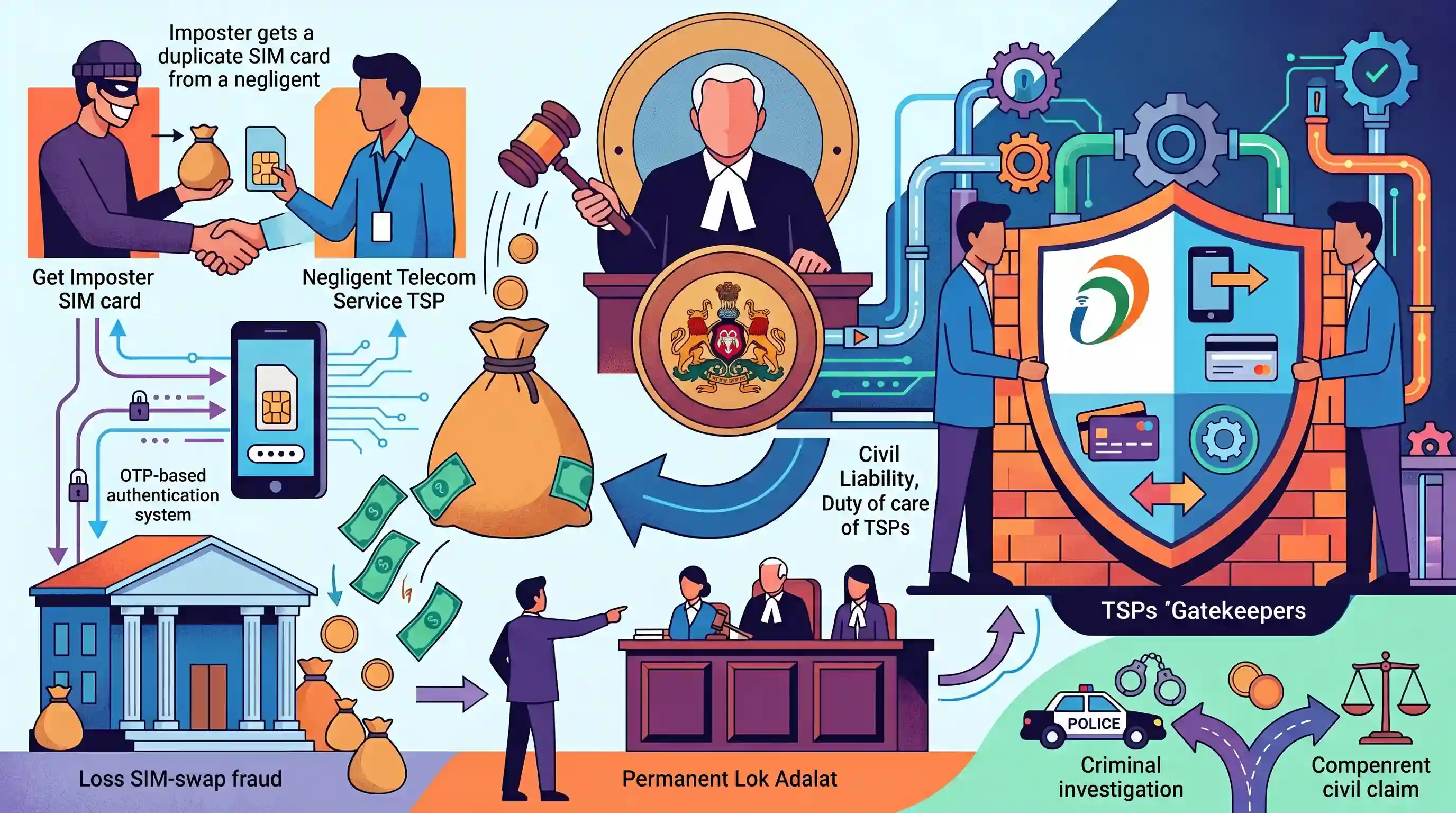
The Karnataka High Court has ordered BSNL to pay Rs 55 lakh in compensation to a cooperative bank that lost funds due to a SIM-swap fraud, which was enabled by BSNL's negligent issuance of a duplicate SIM card to an imposter. The ruling emphasized that telecom operators serve as the essential "gatekeepers" of India’s OTP-based authentication architecture, which acts as the last line of defense for the Digital India programme, UPI, NEFT, and RTGS systems. The court declared that telecom providers will face civil liability for failing their duty of care, as such negligence introduces a systemic vulnerability into the country's digital financial infrastructure. Crucially, the court also upheld the Permanent Lok Adalat’s jurisdiction to award civil compensation for this deficiency in service under the Legal Services Authorities Act, 1987, explicitly noting that concurrent criminal investigations do not preclude civil claims.
Key Points
- The Karnataka High Court directed BSNL to pay Rs 55 lakh to a cooperative bank to compensate for losses incurred through a SIM-swap cyber fraud.
- BSNL was held liable for 'deficiency in service' due to issuing a duplicate SIM to an imposter without adhering to the strict KYC and identity verification guidelines mandated by DoT and TRAI.
- Justice Suraj Govindaraj highlighted that India’s digital economy—spanning UPI, NEFT, and RTGS—critically relies on the integrity of OTP-based authentication, positioning telecom providers as essential 'gatekeepers'.
- The court affirmed that the Permanent Lok Adalat possesses the jurisdiction to award civil compensation for deficiency in telephone services, even when concurrent criminal proceedings for fraud are ongoing.
- The ruling sets a precedent that telecom operators will face civil accountability if their negligence creates systemic vulnerabilities in the digital financial architecture.
- The High Court suggested additional safety layers, such as multi-channel OTP delivery, time delays for large transactions after SIM swaps, and better alternate communication alerts.
Important Terms
Permanent Lok Adalat

Statutory bodies established under the Legal Services Authorities Act for pre-litigative conciliation of public utility disputes. Their awards are final, binding, and carry the weight of a civil court decree.
UPSC context
GS Paper II: Statutory bodies and Alternative Dispute Resolution (ADR); tested for judicial reforms and access to justice.
Legal Services Authorities Act, 1987
A 1987 law fulfilling the constitutional mandate of Article 39A to provide free legal services to marginalized groups and establish a multi-tiered legal aid framework.
UPSC context
GS Paper II: Social Justice and Governance; crucial for questions on legal aid and the NALSA framework.
Digital India programme
A flagship initiative launched in 2015 to transform India into a digitally empowered society and knowledge economy through enhanced infrastructure, e-governance, and digital literacy.
UPSC context
GS Paper III: IT and Economy; tests knowledge of digital infrastructure and governance-delivery mechanisms.
Telecom Regulatory Authority of India (TRAI)
The independent statutory regulator of the Indian telecommunications sector, responsible for setting tariffs, ensuring service quality, protecting consumer interests, and advising the government on policy.
UPSC context
GS Paper II/III: Regulatory bodies; important for understanding telecom governance and market competition.
Department of Telecommunications (DoT)
The nodal department under the Ministry of Communications responsible for formulating telecom policies, granting licenses, and managing radio frequency spectrum in India.
UPSC context
GS Paper II: Governance; relevant for policy-making in the telecom sector and executive functions.
Bharat Sanchar Nigam Limited (BSNL)
An Indian central public sector undertaking and the nation's largest government-owned wireless telecommunications service provider, managed by the Department of Telecommunications.
UPSC context
GS Paper III: Public Sector Undertakings (PSUs); relevant for infrastructure and accountability in public service.
Prelims Trap
"Permanent Lok Adalats only have conciliation powers and cannot decide disputes on merits."
Unlike regular Lok Adalats, Permanent Lok Adalats (established under Chapter VI-A of the LSA Act) possess adjudicatory powers to decide disputes on merits if conciliation fails for public utilities.
Static Concepts Connected
What are the key powers and features of Permanent Lok Adalats (PLAs)?
- Public Utilities: Established under the Legal Services Authorities Act, 1987 (Chapter VI-A) specifically for disputes regarding 'Public Utility Services' (telecom, transport, power, insurance).
- Adjudicatory Power: Unlike regular Lok Adalats, if conciliation fails, PLAs can adjudicate and decide the dispute on its merits.
- Final and Binding: The award passed by a PLA is final, binding on all parties, and deemed to be a decree of a civil court.
- Pecuniary Jurisdiction: They can entertain disputes where the value of the property or claim does not exceed ₹1 crore.
How does a SIM-Swap attack compromise digital security architectures?
- Impersonation: Fraudsters impersonate a victim to procure a duplicate SIM card, deactivating the victim's original SIM in the process.
- Bypassing 2FA: It bypasses Two-Factor Authentication (2FA) by allowing hackers to intercept One-Time Passwords (OTPs) and financial alerts directly.
- Systemic Risk: It highlights systemic vulnerabilities in digital financial architectures (like UPI and NEFT) that rely heavily on mobile-number integrity for validation.
Cross-Topic Patterns
DPI's reliance on telecom architecture
India's Digital Public Infrastructure (UPI, Aadhaar authentication) treats telecom service providers as de facto 'gatekeepers', merging macroeconomic digital economy risks with traditional telecom KYC compliance.
Public Utilities + Cyber Accountability
Using statutory civil forums like Permanent Lok Adalats to hold essential infrastructure providers financially liable for cybersecurity negligence introduces a new accountability mechanism outside of standard criminal cyber laws.

Permanent Lok Adalats' adjudicatory powers over public utilities, mixed with cyber-fraud liability, is a prime 2026 Polity-Tech crossover question.
Linked PYQs · 3
Linked PYQs · 3
- 2020MainsGS3
Discuss different types of cyber crimes and measures required to be taken to fight the menace.
- 2023MainsGS3
What is the status of digitalization in the Indian economy? Examine the problems faced in this regard and suggest improvements.
- 2024MainsGS2
Explain and distinguish between Lok Adalats and Arbitration Tribunals. Whether they entertain civil as well as criminal cases ?
