Diaspora diplomacy and limits of cultural nationalism abroad
Source:The Hindu ↗
Why It Matters
The Indian diaspora is explicitly mentioned in the GS Paper 2 syllabus. Understanding the nuances, benefits, and potential liabilities of diaspora mobilization—especially the impact of domestic politics on overseas communities—is crucial for answering analytical questions on foreign policy.
Summary
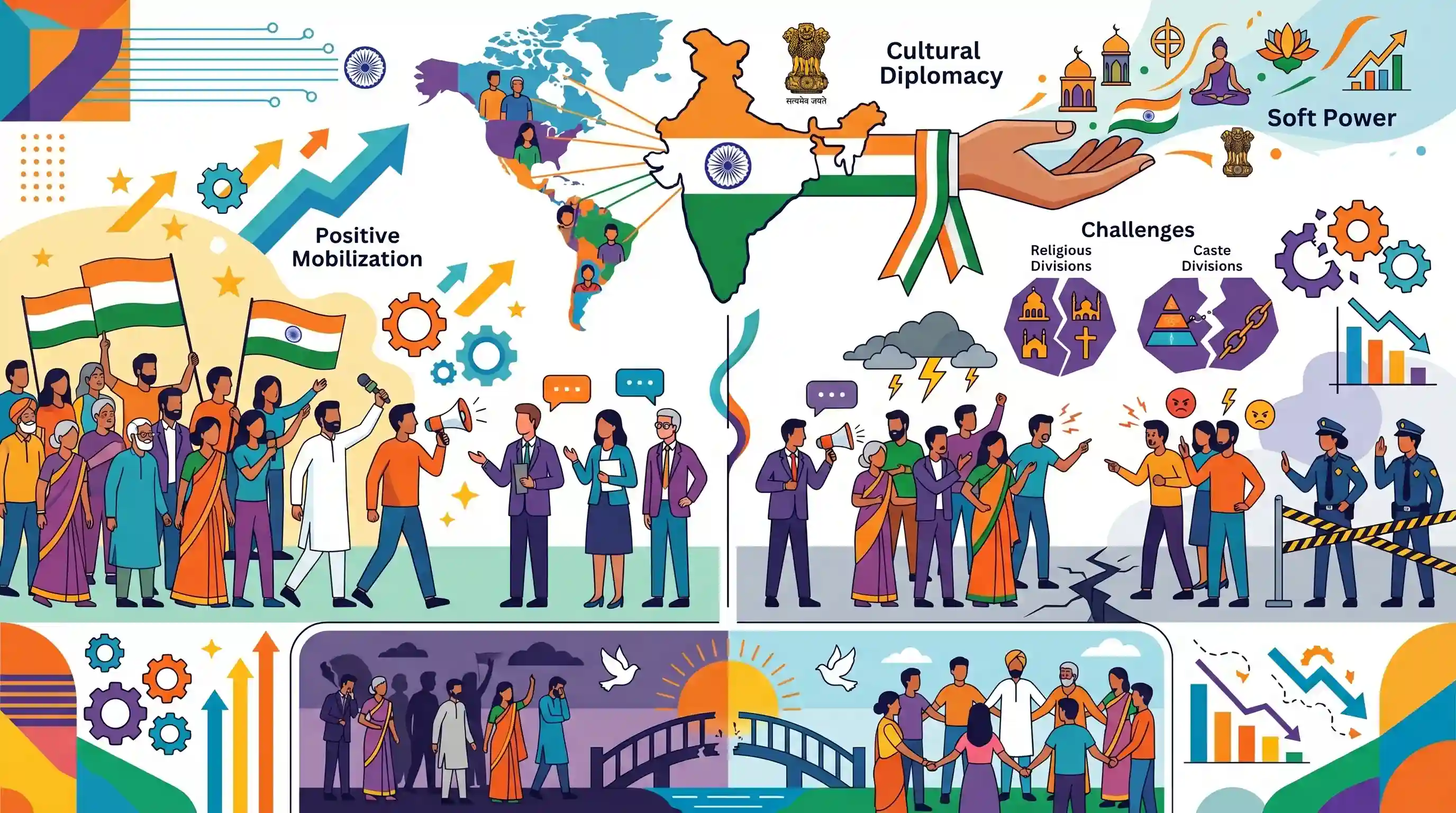
The article analyzes India's evolving diaspora diplomacy, highlighting the increasing use of cultural nationalism as a tool to engage and mobilize overseas Indians. While this approach has successfully galvanized large segments of the diaspora, turning them into vocal advocates for Indian interests, it also presents significant challenges. The overt projection of cultural nationalism risks exporting India's domestic political and social fault lines—such as religious and caste divisions—abroad. This polarization within the diaspora can erode its cohesive influence and invite backlash from host countries, as evidenced by recent inter-community tensions in western nations. Ultimately, the piece cautions that for the diaspora to remain an effective asset in India's foreign policy, engagement must remain inclusive and avoid entangling expatriate communities in divisive domestic politics.
Key Points
- The Indian diaspora has evolved into a central pillar of India’s soft power and a strategic tool in its foreign policy arsenal.
- Recent diplomatic strategies have heavily utilized cultural nationalism to mobilize the diaspora, creating a shared identity centered around civilizational and cultural motifs.
- Exporting domestic cultural nationalism has limits, as it risks polarizing the diaspora along religious, regional, and caste lines, fracturing their unified lobbying power.
- Diaspora-related tensions and the manifestation of domestic fault lines abroad (e.g., in the UK, Canada, and Australia) can lead to pushback from host governments and affect bilateral ties.
- A sustainable diaspora diplomacy requires a broad-based, inclusive approach that refrains from drawing overseas communities into divisive domestic political narratives.
Important Terms
Overseas Citizen of India (OCI)

A form of permanent residency granted to foreign nationals of Indian origin. It offers a lifelong, multiple-entry visa and parity with NRIs in economic and educational fields, excluding political rights.
UPSC context
GS Paper II (International Relations/Polity); tested under Indian Diaspora and Citizenship. Crucial for understanding legal frameworks governing the overseas community.
Soft Power
The ability of a country to influence global behavior through attraction and persuasion—using culture, values, and policies—rather than coercion or economic force.
UPSC context
GS Paper II (International Relations); evaluates India’s global influence and the strategic role of its civilizational heritage.
Pravasi Bharatiya Divas (PBD)
A biennial flagship convention of the Ministry of External Affairs held on January 9 to commemorate Mahatma Gandhi's return to India and recognize the diaspora's contribution to national development.
UPSC context
GS Paper II; important for questions on diaspora engagement strategies and the institutional history of India’s foreign outreach.
Cultural Diplomacy
The use of cultural exchanges—such as Yoga, cinema, and heritage—to foster mutual understanding and strengthen foreign relations, often leveraging the diaspora as 'informal ambassadors.'
UPSC context
GS Paper II; tests the application of soft power in bilateral ties and regional cooperation (e.g., Buddhist or Yoga diplomacy).
Ministry of External Affairs (MEA)
The central government agency responsible for formulating and executing India's foreign policy, managing diplomatic missions, and leading engagement with the 35-million-strong Indian diaspora.
UPSC context
GS Paper II; the primary institutional actor in International Relations. Tests knowledge of India’s diplomatic machinery and consular responsibilities.
Cultural Nationalism (Abroad)
A strategic shift in diaspora engagement emphasizing pride in Indian identity and heritage to mobilize overseas communities as vocal advocates for India’s domestic and global interests.
UPSC context
GS Paper II; analyzes emerging challenges in foreign policy, including the export of domestic fault lines and host-country backlash.
Prelims Trap
"Overseas Citizens of India (OCI) cardholders enjoy full political rights, including the right to vote in Lok Sabha elections."
OCI is not dual citizenship. OCI cardholders do not have voting rights, cannot contest elections, hold constitutional posts, or buy agricultural land in India.
Static Concepts Connected
How does India's policy toward its diaspora evolve over time?
- Nehruvian Era: Indians settling abroad were actively advised to integrate completely into their host nations, minimizing ties.
- 1990s Shift: Post-1991 reforms led to economic engagement, recognizing the financial potential of NRIs.
- Post-2000s: Proactive integration via Pravasi Bharatiya Divas and the OCI scheme, leveraging the diaspora as strategic soft power.
What are the distinctions between NRI, PIO, and OCI?
- NRI: Indian citizens residing abroad for over 182 days in a financial year; they retain full voting rights.
- PIO: Foreign citizens of Indian origin. The PIO scheme was merged into the OCI scheme in 2015.
- OCI: Provides lifelong visa-free travel to India but grants no political rights or rights to purchase agricultural land.
Cross-Topic Patterns
Diaspora lobbying vs. Foreign Interference
Host nations (e.g., Canada, Australia) increasingly frame aggressive diaspora mobilization as "foreign interference," blurring the lines between soft-power cultural diplomacy and national security breaches.
Transnational caste and religious divides
Exported domestic fault lines are prompting host nations to intervene legally and administratively, seen in Seattle's caste discrimination ban and the UK's response to the Leicester communal clashes.

Expect a GS-2 Mains question analyzing the 'double-edged sword' of diaspora mobilization and how exported fault lines impact bilateral ties.
Linked PYQs · 4
Linked PYQs · 4
- 2023MainsGS2
Indian diaspora has scaled new heights in the West. Describe its economic and political benefits for India.
- 2020MainsGS2
Indian diaspora has a decisive role to play in the politics and economy of America and European Countries'. Comment with examples.
- 2017MainsGS2
Indian diaspora has an important role to play in South-East Asian countries' economy and society. Appraise the role of Indian diaspora in South-East Asia in this context.
- 2012MainsGS2
Write a short analytical note on Indian Diaspora. How is the "New Diaspora" different from the "Old Diaspora"?
