Defence Budget Allocation and Military Modernization Needs
Source:The Hindu ↗
Why It Matters
Understanding the structure and constraints of the defence budget is vital for addressing UPSC questions on military modernization, border security challenges, and the financial hurdles in achieving self-reliance in defense production. It integrates concepts from both the economy (budgeting, capital vs. revenue) and internal/external security syllabi of GS Paper 3.
Summary
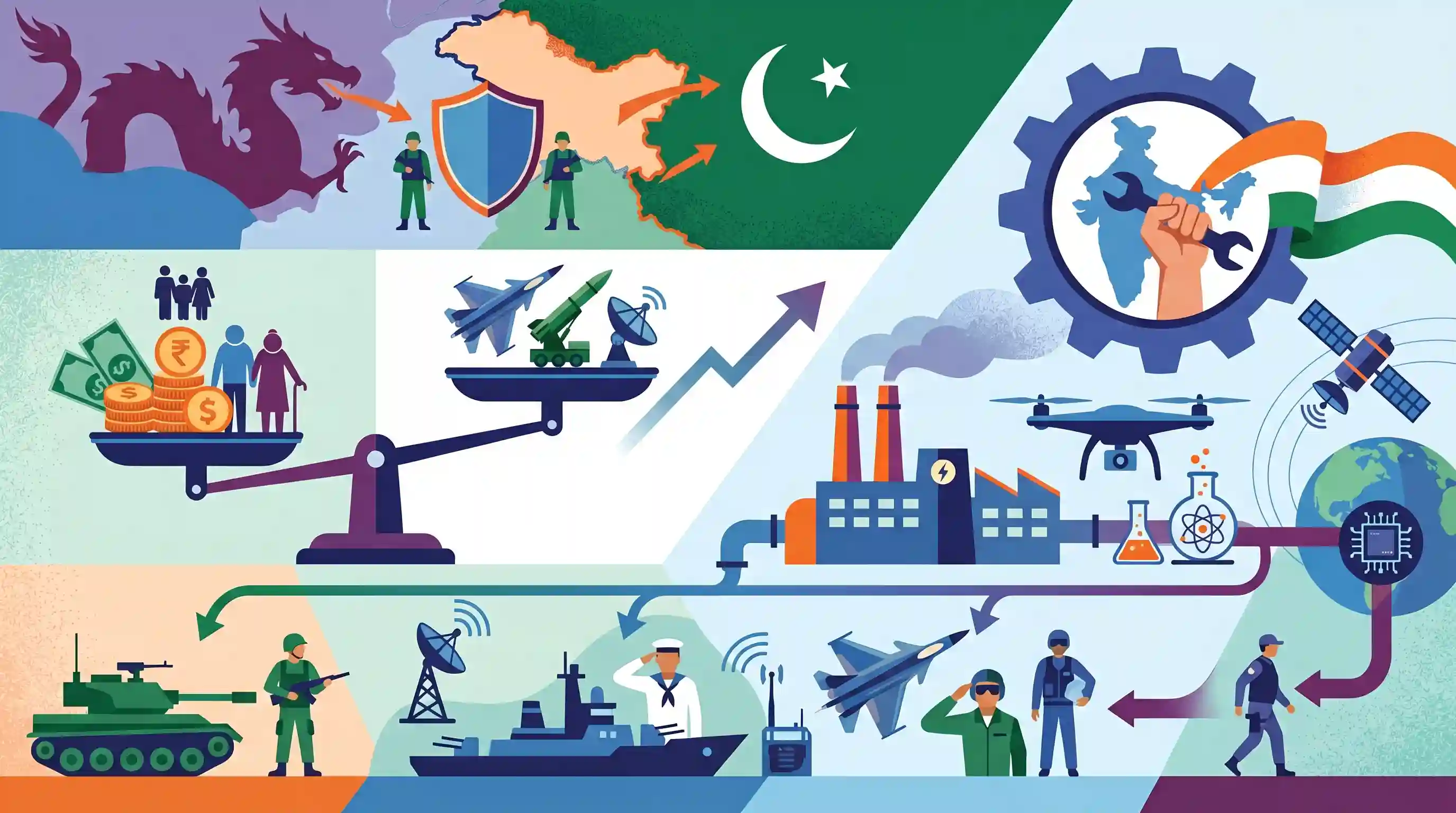
The article makes a robust case for increasing India’s defence budget allocation to address persistent capability gaps and mitigate the rising twin-threat from China and Pakistan. It points out that defence spending, when measured as a proportion of GDP, remains suboptimal for a military tasked with comprehensive modernization and multi-front operational readiness. A significant challenge lies in the skewed ratio between revenue expenditure—heavily dominated by salaries and pensions—and the capital expenditure required for acquiring advanced weaponry, platforms, and next-generation technology. The analysis advocates for a strategic and sustained hike in capital outlay to boost the technological edge of the Indian Armed Forces while concurrently supporting the domestic defence manufacturing ecosystem under the 'Atmanirbhar Bharat' vision.
Key Points
- Evaluates the current state of India's defence budget allocation against the backdrop of an evolving national security environment, particularly the two-front threat from China and Pakistan.
- Argues that current defence expenditure as a percentage of GDP is inadequate to ensure robust military modernization and sustained capital acquisition programs.
- Highlights the persistent dichotomy between revenue expenditure (salaries, pensions, and maintenance) and capital expenditure, emphasizing the urgent need to boost capital outlay for advanced technologies.
- Stresses that higher defence allocation is essential not only for operational readiness but also for catalyzing the domestic defence manufacturing ecosystem and reducing import dependency.
Important Terms
Atmanirbhar Bharat (Defence)

The government's 'Self-Reliant India' vision aiming to reduce import dependency in strategic sectors like defence through domestic design, development, and manufacturing.
UPSC context
GS Paper 3: Security, Indigenization of Technology. Tests understanding of strategic autonomy and domestic manufacturing.
Agnipath Scheme
A recruitment model for the Indian Armed Forces where youth (Agniveers) serve on four-year contracts, aimed at lowering the average age of personnel and reducing long-term pension liabilities.
UPSC context
GS Paper 3: Security/Budgeting. Focuses on balancing human resource management with modernization costs.
Capital Expenditure (CapEx) in Defence
Budgetary allocation for acquiring long-term assets such as advanced weaponry, aircraft, naval platforms, and modern technology required for military modernization.
UPSC context
GS Paper 3: Budgeting. Essential for analyzing the state of military readiness and technological edge.
Revenue Expenditure in Defence
Recurring expenditure on day-to-day operations, including salaries, pensions, and maintenance of existing equipment, which often consumes the largest share of the defence budget.
UPSC context
GS Paper 3: Government Budgeting. Tests ability to critique fiscal imbalances in national security spending.
Make in India (Defence)
A flagship initiative launched in 2014 to transform India into a global manufacturing hub, focusing on indigenizing the production of high-tech military hardware.
UPSC context
GS Paper 2 & 3: Government Policies, Security. Key for questions on economic growth and strategic manufacturing.
Indigenization of Technology
The process of developing and manufacturing military hardware within the country to ensure strategic autonomy and reduce vulnerability to global supply chain disruptions.
UPSC context
GS Paper 3: Science & Technology, Security. Core topic regarding India's defense R&D and self-sufficiency.
Prelims Trap
Capital expenditure currently holds the largest share of India's defence budget due to modernization drives.
Revenue expenditure (salaries, pensions, and daily maintenance) consistently dominates the defence budget, forming a 'revenue bias' that significantly restricts capital outlays.
Static Concepts Connected
How are Revenue and Capital expenditures classified in India's Defence Budget?
- Revenue Expenditure: Covers daily running costs, salaries, and maintenance of existing equipment, traditionally consuming the largest budget share.
- Capital Expenditure: Allocated specifically for purchasing new weapons, platforms, and technological modernization of the armed forces.
- Defence Pensions: Paid from a distinct budget head but grouped under overall MoD allocation, heavily skewing total defence spending.
What is the top priority procurement category under DAP 2020?
- Buy (Indian-IDDM): Indigenously Designed, Developed and Manufactured; it is the absolute most preferred category to promote self-reliance.
- Indigenous Content Requirement: Mandates a minimum of 50% Indigenous Content (IC) to qualify for this highest-tier procurement category.
Cross-Topic Patterns
Agnipath's core economic rationale
The Agnipath scheme directly tackles the defence budget's 'revenue bias' by curbing long-term pension liabilities, structurally freeing up funds for capital-intensive military modernization.
Defence capital as MSME catalyst
Ring-fencing 75% of the capital acquisition budget for domestic procurement bridges GS3 Security and Economy, utilizing military spending to scale up Indian manufacturing MSMEs.

Expect a 2026 GS3 question linking India's defence 'revenue bias' to the Agnipath scheme's economic rationale for modernization.
Linked PYQs · 4
Linked PYQs · 4
- 2024MainsGS3
India has a long and troubled border with China and Pakistan fraught with contentious issues. Examine the conflicting issues and security challenges along the border. Also give out the development being undertaken in these areas under the Border Area Development Programme (BADP) and Border Infrastructure and Management (BIM) Scheme.
- 2021MainsGS3
Distinguish between Capital Budget and Revenue Budget. Explain the components of both these Budgets.
- 2019MainsGS3
The public expenditure management is a challenge to the Government of India in the context of budget making during the post-liberalization period. Clarify it.
- 2016MainsGS3
Border management is a complex task due to difficult terrain and hostile relations with some countries. Elucidate the challenges and strategies for effective border management.
