India Crude Import Bill Surges Amid West Asia Crisis
Source:The Hindu ↗
Why It Matters
This article is highly relevant for GS Paper 2 (International Relations) and GS Paper 3 (Economy and Energy Security) as it highlights the intersection of foreign policy in West Asia and India's critical dependence on imported energy, affecting macroeconomic stability (current account deficit).
Summary
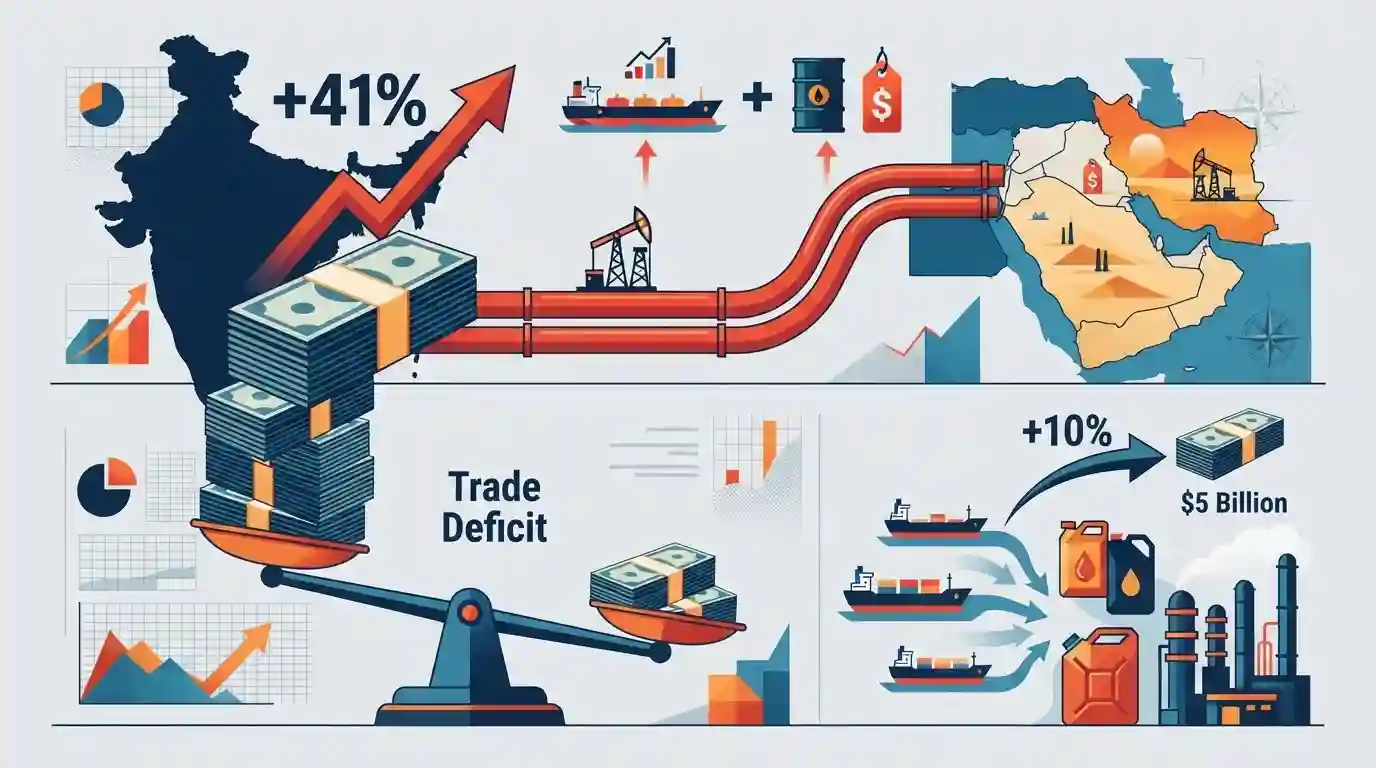
India’s crude oil import bill experienced a sharp 41% year-on-year increase in July, reaching $13.7 billion. This surge is attributed to a combination of higher import volumes and elevated global oil prices fueled by geopolitical instability in West Asia. Importing nearly 89% of its crude needs, India's extreme dependency underscores its vulnerability to external energy shocks, negatively impacting its trade deficit. Conversely, India demonstrated resilience in its downstream sector, recording a 10% increase in the export of refined petroleum products, which generated $5 billion in revenue.
Key Points
- India's crude oil import bill surged by 41% in July to $13.7 billion, driven by both a 13.3% rise in import volumes and elevated global oil prices.
- The West Asia crisis and subsequent geopolitical tensions kept benchmark Brent crude prices highly volatile.
- India remains highly dependent on external sources, importing nearly 89% of its domestic crude oil requirements.
- Despite being a major crude importer, India is a significant exporter of refined petroleum products, with exports rising 10% to generate $5 billion in July.
- The overall net import bill for oil and gas increased by 19% to $11.2 billion, widening the trade deficit and impacting macroeconomic stability.
Important Terms
Petroleum Planning and Analysis Cell (PPAC)

A nodal agency under the Ministry of Petroleum and Natural Gas, established in 2002. It collects and analyzes oil/gas data, administers subsidy schemes, and monitors domestic and global price trends.
UPSC context
GS Paper 3 (Energy/Economy). Relevant for understanding energy data governance, fuel subsidies, and strategic sector monitoring in India.
Trade Deficit
An economic condition that occurs when the value of a country's imported goods and services exceeds the value of its exported goods and services over a given period.
UPSC context
GS Paper 3 (Economy). Crucial for understanding Balance of Payments, macroeconomic stability, currency valuation, and India's external trade health.
Downstream Sector
The final phase of the oil and gas industry, involving the refining of raw crude oil into marketable products like petrol and petrochemicals, along with their distribution and sale.
UPSC context
GS Paper 3 (Economy/Infrastructure). Tests knowledge of India's petroleum value chain, refining capacities, and its resilience in exporting refined products.
Energy Security
The continuous, affordable availability of energy sources. For India, this critically involves managing a massive crude oil import dependency (nearly 89%) and mitigating supply disruption risks from geopolitical conflicts.
UPSC context
GS Paper 2 & 3 (IR & Economy). Central to questions on strategic reserves, import diversification, and India's geopolitical vulnerabilities in West Asia.
Prelims Trap
India is a net importer of all categories of petroleum, including refined products, due to its 89% domestic crude dependency.
India is actually a net exporter of refined petroleum products (its largest export commodity by value), despite importing ~89% of its raw crude oil.
Static Concepts Connected
How do global crude oil price shocks impact India's macroeconomic stability?
- Inelastic demand: India's crude demand is highly price-inelastic, meaning global price spikes directly inflate the trade deficit without reducing domestic consumption.
- Currency depreciation: Massive USD outflows to settle oil bills increase dollar demand, depreciating the Indian Rupee against the dollar.
- Imported inflation: Elevated fuel costs increase transport and manufacturing input costs, triggering cascading retail inflation across the domestic economy.
What is India's Strategic Petroleum Reserve (SPR) framework?
- Institutional custodian: Managed by Indian Strategic Petroleum Reserves Limited (ISPRL), a Special Purpose Vehicle under the Ministry of Petroleum and Natural Gas.
- Phase I caverns: Completed underground rock cavern facilities at Visakhapatnam (Andhra Pradesh), Mangaluru (Karnataka), and Padur (Karnataka) storing 5.33 MMT.
- Phase II expansion: Approved commercial-cum-strategic storage facilities at Chandikhol (Odisha) and Padur (Karnataka) to add 6.5 MMT capacity.
Cross-Topic Patterns
Energy diplomacy and strategic autonomy
Balancing discounted Russian Urals with traditional West Asian ties illustrates how domestic energy security imperatives drive India's strategic pragmatism in global forums like the Quad and BRICS.
Refining footprint and trade policy
India's massive refining capacity transforms raw import vulnerabilities into export strengths, serving as a critical macroeconomic buffer for the country's balance of payments.

UPSC is likely to test the structural duality of India being a top crude importer but a leading global exporter of refined petroleum.
Linked PYQs · 4
Linked PYQs · 4
- 2025MainsGS2
"Energy security constitutes the dominant kingpin of India's foreign policy, and is linked with India's overarching influence in Middle Eastern countries.” How would you integrate energy security with India's foreign policy trajectories in the coming years?
- 2017MainsGS2
The question of India's Energy Security constitutes the most important part of India's economic progress. Analyze India's energy policy cooperation with West Asian countries.
- 2018MainsGS3
“Access to affordable, reliable, sustainable and modern energy is the sine qua non to achieve Sustainable Development Goals (SDGs).” Comment on the progress made in India in this regard.
- 2025PrelimsGS1
Consider the following activities : I. Production of crude oil II. Refining, storage and distribution of petroleum III. Marketing and sale of petroleum products IV. Production of natural gas How many of the above activities are regulated by the Petroleum and Natural Gas Regulatory Board in our country?
