Macroeconomic Impact of Rising Crude Import Bill on India
Source:The Hindu ↗
हे का महत्त्वाचे आहे
India's extreme dependence (88.5%) on crude oil imports makes its economy highly vulnerable to external geopolitical shocks, particularly in West Asia. Spikes in the import bill directly impact India's current account deficit (CAD), domestic inflation, and currency value, emphasizing the urgent need for strategic oil reserves, fuel diversification, domestic production enhancement, and transition to renewable energy.
सारांश
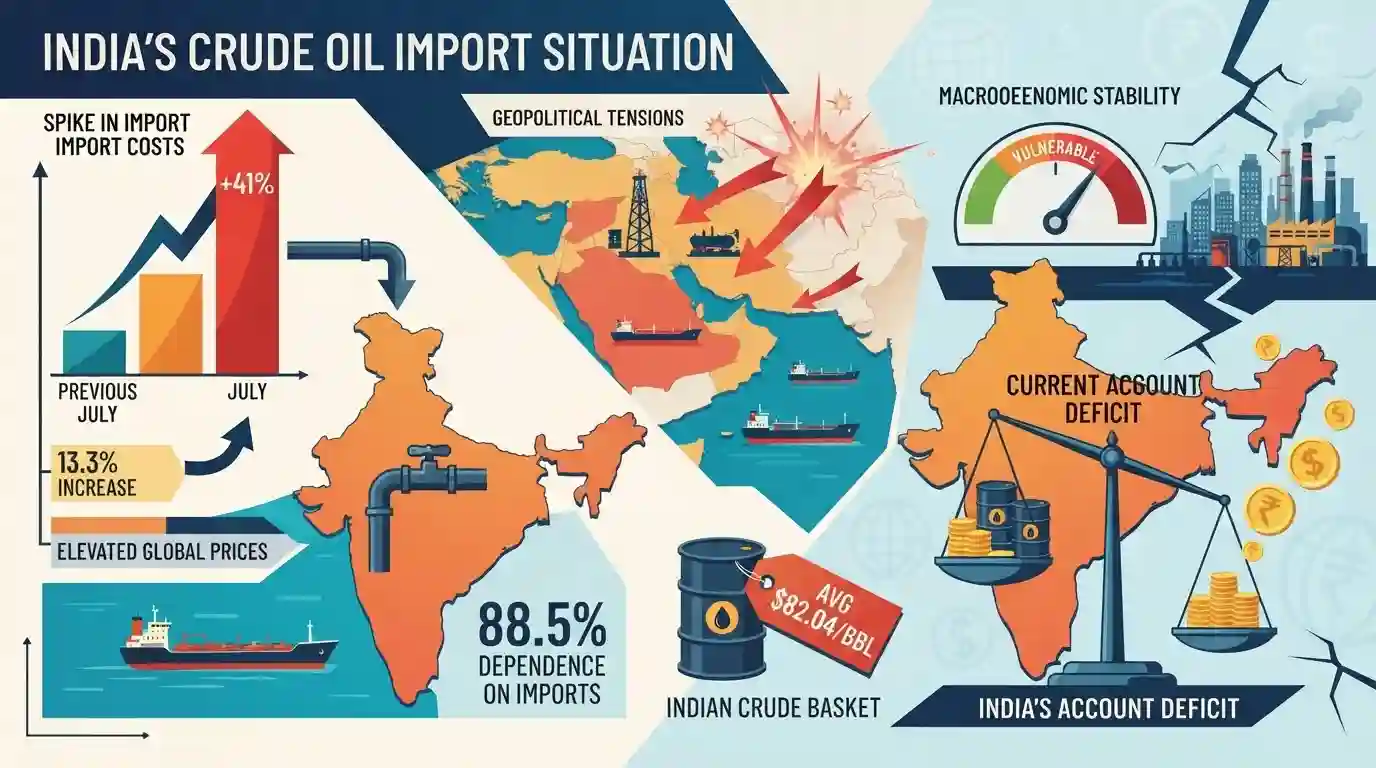
India's crude oil import bill spiked by over 41% year-on-year to $13.7 billion in July, driven by a combination of a 13.3% increase in import volume and elevated global oil prices resulting from geopolitical tensions in West Asia. With India relying on imports for 88.5% of its crude oil requirements, the rising price of the Indian crude basket (averaging $82.04 per barrel) has significantly increased the country's net oil and gas import bill to $11.2 billion, highlighting the ongoing vulnerability of India's macroeconomic stability to global geopolitical shocks.
मुख्य मुद्दे
- India's crude oil import bill surged by over 41% year-on-year to $13.7 billion in July, driven by elevated global oil prices and persistent geopolitical tension in West Asia.
- In volume terms, crude oil imports grew by 13.3% year-on-year to 21.4 million metric tonnes (MMT) compared to 18.9 MMT in the same month of the previous year.
- India's crude oil import reliance remains high, with imports accounting for 88.5% of the country's total crude oil consumption.
- The average cost of the Indian crude basket rose to $82.04 a barrel in July, up from $70.95 a barrel a year earlier, while Brent crude benchmark prices fluctuated due to episodic conflicts in West Asia.
- The country's net import bill for oil and gas (accounting for imports minus exports of petroleum products) increased by more than 19% year-on-year to $11.2 billion.
- On the export front, Indian oil-marketing companies increased petroleum product exports by 10% year-on-year to 5.5 MMT, generating $5 billion in revenue.
महत्त्वाच्या संज्ञा
Petroleum Planning and Analysis Cell (PPAC)

An attached office under the Ministry of Petroleum and Natural Gas created in 2002. It collects hydrocarbon data, monitors global and domestic price trends, and administers petroleum subsidy schemes.
UPSC context
GS Paper 3 (Economy). Relevant for understanding energy sector governance, data monitoring, and government subsidy administration.
Indian Crude Basket
A weighted average index of sour (Dubai and Oman) and sweet (Brent) crude oil grades. It acts as the benchmark price indicator for India's imported crude oil requirements.
UPSC context
GS Paper 3 (Economy). Crucial for evaluating how global oil price fluctuations translate into domestic inflation and rising import bills.
Current Account Deficit (CAD)
A situation where the total value of a country's imported goods, services, and transfers exceeds its exports. India's CAD is structurally driven by its massive crude oil import bill.
UPSC context
GS Paper 3 (Economy). Fundamental for Balance of Payments topics, assessing macroeconomic stability, and understanding currency depreciation pressures.
Energy Security
The uninterrupted and affordable availability of energy sources. For India, it primarily involves mitigating economic vulnerabilities stemming from importing nearly 89% of its crude oil amid global geopolitical tensions.
UPSC context
GS Paper 3 (Infrastructure) & GS 2 (IR). Tests knowledge of India's strategic petroleum reserves, import diversification, and renewable transitions.
Strait of Hormuz
A vital maritime chokepoint connecting the Persian Gulf to the Gulf of Oman. A significant portion of India's crude oil and LNG imports from West Asia passes through this route.
UPSC context
GS Paper 1 (Geography) & GS 2 (IR). Frequently tested in map-based questions and discussions on geopolitical supply-chain vulnerabilities.
पूर्वपरीक्षा सापळा
Due to its 88.5% crude import dependency, India remains a net importer of both raw crude and refined petroleum products.
India has world-class domestic refining capacity (e.g., Jamnagar), making refined petroleum products one of its largest export earners despite importing ~88.5% of raw crude.
संबंधित स्थिर संकल्पना
What is the Indian Crude Basket and how is it structured?
- Definition: It is a derived pricing index used by the government to monitor the cost of crude imported into India.
- Composition: It consists of a weighted average of Sour grades (Oman and Dubai average) and Sweet grade (Brent).
- Weightage: The ratio is dynamically updated by the Petroleum Planning and Analysis Cell (PPAC) to reflect actual refinery processing patterns.
How does crude oil price volatility transmit to India's macroeconomy?
- CAD Expansion: As India's largest import item, price hikes immediately expand the trade deficit, widening the overall Current Account Deficit (CAD).
- Currency Depreciation: Increased demand for US Dollars to settle higher oil import bills depreciates the Indian Rupee (INR).
- Imported Inflation: Higher fuel costs increase domestic logistics and transport expenses, driving structural cost-push CPI inflation.
आंतर-विषय नमुने
Energy Security & Strategic Reserves
Volatile import bills expose the urgency of expanding India's Phase-II Strategic Petroleum Reserves (SPR) to buffer against prolonged maritime chokepoint disruptions.
Geopolitics & Balance of Payments
West Asian instability directly impacts India's capital account through remittance variations and trade deficit expansion, testing the RBI's foreign exchange reserve management.

Exam may link India's crude dependency to imported inflation transmission channels and the composition of the Indian Crude Basket.
संबंधित PYQ · 2
संबंधित PYQ · 2
- 2025MainsGS2
"Energy security constitutes the dominant kingpin of India's foreign policy, and is linked with India's overarching influence in Middle Eastern countries.” How would you integrate energy security with India's foreign policy trajectories in the coming years?
- 2017MainsGS2
The question of India's Energy Security constitutes the most important part of India's economic progress. Analyze India's energy policy cooperation with West Asian countries.
