India Cold Desert Biosphere Reserve enters UNESCO network list
Source:The Hindu ↗
Why It Matters
Biosphere reserves, Ramsar sites, and high-altitude national parks are highly recurrent themes in UPSC Prelims and Mains (GS3 Biodiversity). The addition of the Cold Desert Biosphere Reserve to the WNBR makes it a prime candidate for map-based geography questions and environment-related policy questions regarding UNESCO's MAB programme and community-led conservation.
Summary
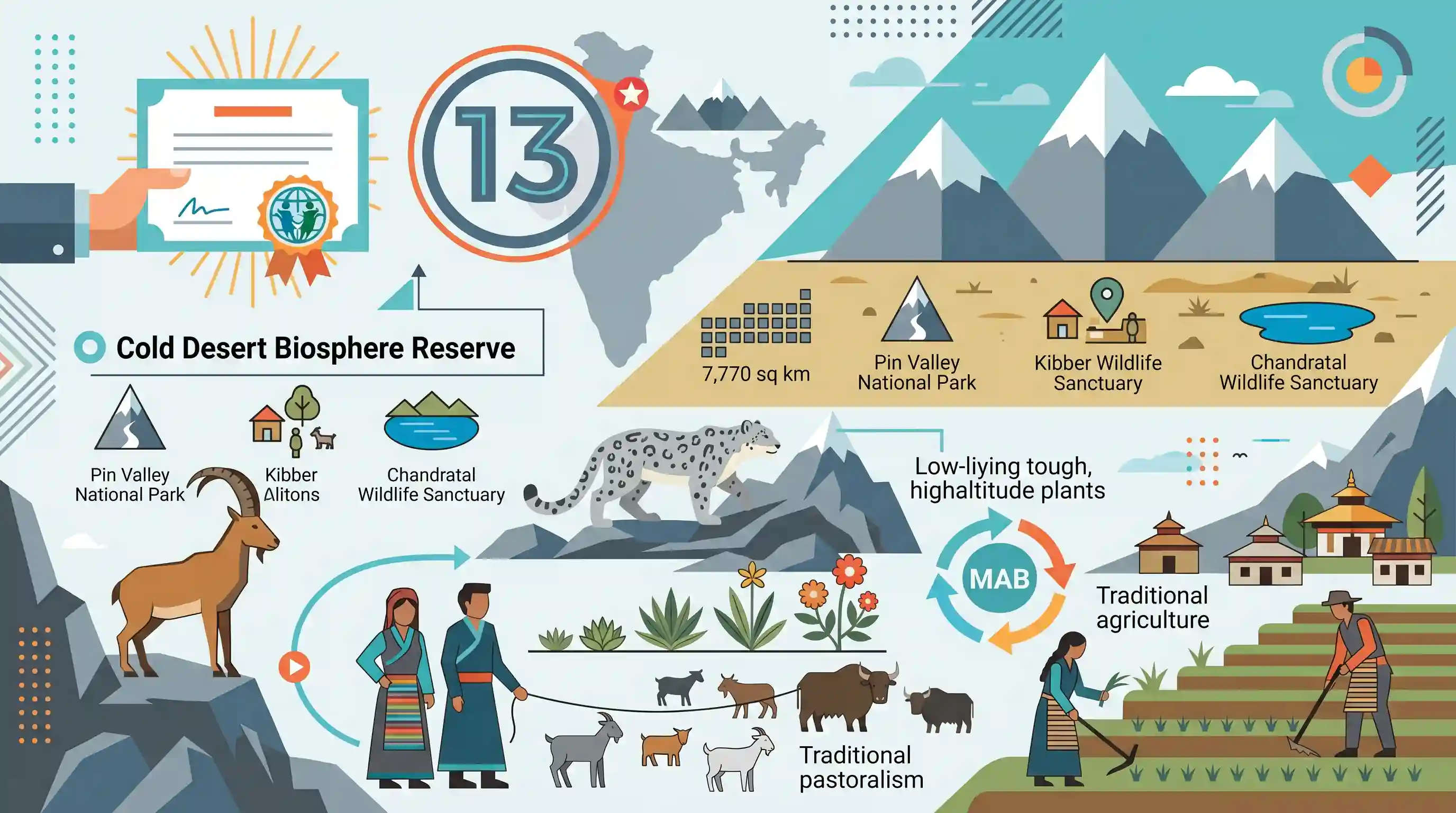
India's Cold Desert Biosphere Reserve (CDBR) in Himachal Pradesh has been officially added to UNESCO's World Network of Biosphere Reserves (WNBR). Encompassing the Pin Valley National Park and the Kibber and Chandratal Wildlife Sanctuaries, the 7,770 sq. km reserve in the Lahaul-Spiti district is recognized for its unique high-altitude cold desert ecosystem. It harbors rare flora and fauna, including the snow leopard and Himalayan ibex, and supports approximately 12,000 local inhabitants engaged in traditional pastoralism and agriculture. This designation brings India's total number of internationally recognized biosphere reserves to 13, highlighting successful conservation efforts integrated with sustainable local livelihoods under the Man and the Biosphere (MAB) programme.
Key Points
- India's Cold Desert Biosphere Reserve (CDBR) in Himachal Pradesh has been designated by UNESCO into the World Network of Biosphere Reserves (WNBR).
- With this addition, India now has 13 biosphere reserves recognized under UNESCO's MAB programme, out of 18 nationally designated reserves.
- The reserve covers 7,770 sq. km across the Lahaul-Spiti district, featuring one of the coldest and driest environments in the WNBR, encompassing Pin Valley National Park and Kibber and Chandratal Wildlife Sanctuaries.
- It is a critical habitat for rare high-altitude fauna like the snow leopard, Himalayan ibex, and blue sheep, along with endemic flora such as the Willow-leaved sea-buckthorn and Himalayan birch.
- The reserve is home to about 12,000 inhabitants who practice traditional pastoralism (yak and goat herding) and Tibetan herbal medicine, underscoring the MAB programme's focus on harmonious human-nature coexistence.
Important Terms
Man and the Biosphere (MAB) Programme

A UNESCO-led intergovernmental scientific initiative launched in 1971. It aims to establish a scientific basis for enhancing the relationship between people and their environments through conservation and sustainable development.
UPSC context
GS Paper III (Environment); frequently tested for conservation strategies and international environmental frameworks.
World Network of Biosphere Reserves (WNBR)
A global collection of UNESCO-designated sites (Biosphere Reserves) that promote sustainable development. These sites integrate biodiversity conservation with sustainable human activities across terrestrial, coastal, and marine ecosystems.
UPSC context
GS Paper III; relevant for biodiversity conservation and international cooperation in environmental management.
International Coordinating Council (ICC) of MAB
The main governing body of the MAB Programme, consisting of 34 elected Member States. It reviews progress, assesses priorities, and designates new sites to the WNBR.
UPSC context
GS Paper III; tests knowledge of international environmental governance and decision-making bodies.
Cold Desert Biosphere Reserve (CDBR)
India’s 13th site in the UNESCO WNBR, located in Himachal Pradesh. It encompasses high-altitude ecosystems like Pin Valley National Park and supports rare species like the snow leopard.
UPSC context
GS Paper III (Biodiversity); important for specific protected areas in news and Himalayan ecosystem conservation.
Biosphere Reserve (Zonation)
A multi-purpose protected area categorized into three zones: Core (strict protection), Buffer (limited human activity/research), and Transition (sustainable development and human settlements).
UPSC context
GS Paper III; essential for understanding the management structure of protected areas in Prelims and Mains.
Prelims Trap
"All Biosphere Reserves designated by India are included in UNESCO's World Network of Biosphere Reserves."
India has 18 nationally notified Biosphere Reserves, but only 13 of them (now including the Cold Desert BR) are officially recognized under UNESCO's WNBR.
Static Concepts Connected
What are the three structural zones of a UNESCO Biosphere Reserve?
- Core Zone: Strictly protected ecosystem dedicated solely to conservation, monitoring, and non-destructive research. Human interference is prohibited.
- Buffer Zone: Adjoins the core and accommodates activities compatible with sound ecological practices, including environmental education, recreation, and ecotourism.
- Transition Zone: The outermost area fostering harmonious human-nature coexistence, allowing sustainable resource management, agriculture, and traditional pastoralism.
How does the regional river system interact with the Cold Desert Biosphere Reserve?
- Pin River: It drains the Pin Valley National Park, acting as a crucial life-source for the extremely arid, cold desert ecosystem.
- Spiti Basin: The Pin River is a right-bank tributary of the Spiti River, which itself flows into the Sutlej river system.
- Chandratal Wetland: Located within the BR, this high-altitude wetland is situated near the Chandra River, a primary headwater of the Chenab.
Cross-Topic Patterns
Nested Protected Areas and Ramsar Sites
UPSC frequently tests overlapping conservation tags. Chandratal's dual status as both a Ramsar Wetland of International Importance and a component of the Cold Desert BR makes it highly testable.
High-Altitude Predator Conservation
This highlights the shift in focus towards high-altitude predators, linking the BR to Project Snow Leopard, the GSLEP program, and its downlisted IUCN status (Vulnerable).
Trans-Himalayan Ecology vs. Border Infrastructure
The ecological fragility of the Lahaul-Spiti cold desert must now be balanced with strategic border infrastructure initiatives like the Vibrant Villages Programme and the Atal Tunnel.

Expect a 2026 Prelims pairs question mapping India's newest UNESCO Biosphere Reserves against their constituent national parks or rivers.
Linked PYQs · 4
Linked PYQs · 4
- 2014PrelimsGS1
The most important strategy for the conservation of biodiversity together with traditional human life is the establishment of
- 2022PrelimsGS1
Consider the following pairs: Peak Mountains 1. Namcha Barwa: Garhwal Himalaya 2. Nanda Devi: Kumaon Himalaya 3. Nokrek: Sikkim Himalaya Which of the pairs given above is/are correctly matched?
- 2019PrelimsGS1
Consider the following statements: 1. Under Ramsar Convention, it is mandatory on the part of the Government of India to protect and conserve all the wetlands in the territory of India. 2. The Wetlands (Conservation and Management) Rules, 2010 were framed by the Government of India based on the recommendations of Ramsar Convention. 3. The Wetlands (Conservation and Management) Rules, 2010 also encompass the drainage area or catchment regions of the wetlands as determined by the authority. Which of the statements given above is/are correct?
- 2023MainsGS3
Comment on the National Wetland Conservation Programme initiated by the Government of India and name a few India's wetlands of international importance included in the Ramsar Sites.
