India Climate Change Mitigation Strategy and Development Balance
Source:The Hindu ↗
Why It Matters
Understanding India's climate strategy is essential for UPSC aspirants as it bridges environmental conservation with developmental economics and international diplomacy. It forms the core of GS-3 (Environment and Disaster Management) and GS-2 (International Treaties) syllabi, frequently appearing in Mains questions regarding NDCs, COP summits, and extreme weather resilience.
Summary
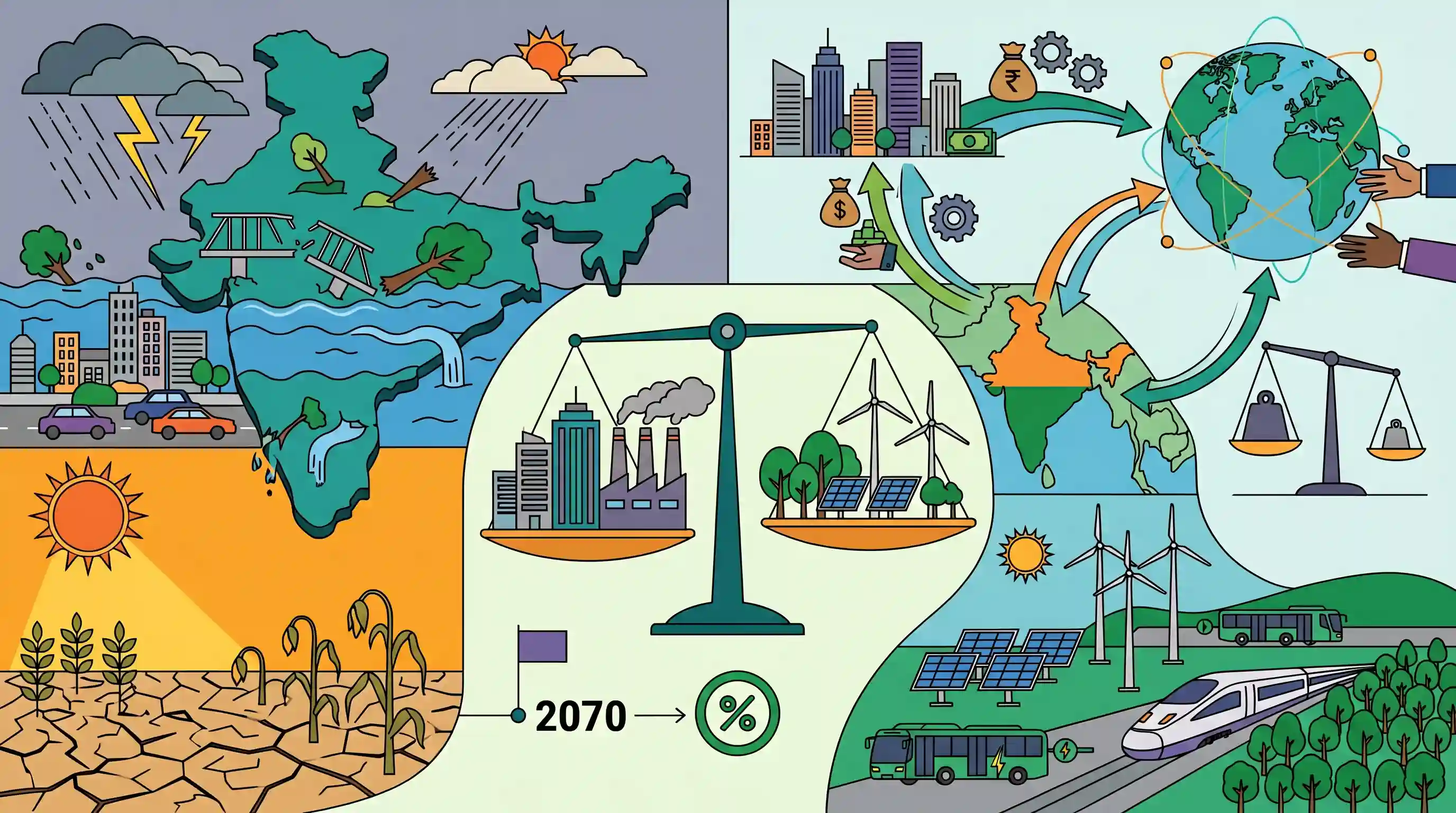
The article underscores India's multifaceted climate challenge, highlighting the tension between necessary economic development and the pressing need for climate action. As one of the countries most vulnerable to extreme weather events, India faces significant risks to its agriculture and infrastructure. To address these, the nation has committed to ambitious climate goals, notably the Panchamrit targets and updated Nationally Determined Contributions (NDCs), culminating in a net-zero pledge for 2070. However, achieving these targets hinges on global cooperation, particularly regarding the provision of accessible climate finance and clean technology transfers from the developed world, in alignment with the principle of Common But Differentiated Responsibilities.
Key Points
- India navigates a critical dual challenge of pursuing rapid economic growth and poverty alleviation while undertaking aggressive decarbonization to combat climate change.
- The structural necessity of securing adequate climate finance and technology transfer from developed nations, anchoring on the principle of Common But Differentiated Responsibilities (CBDR).
- India remains highly vulnerable to climate-induced disasters, with rising instances of extreme weather events, erratic monsoons, and urban flooding threatening agricultural security and infrastructure.
- Despite developmental pressures, India has outlined strong commitments through its updated Nationally Determined Contributions (NDCs) and the Panchamrit strategy, which targets net-zero emissions by 2070 and massive renewable energy capacity addition.
Important Terms
Panchamrit

A five-point action plan announced by India at COP26 (2021) to combat climate change, including targets like 500 GW non-fossil energy capacity and reaching net-zero emissions by 2070.
UPSC context
GS Paper 3 (Environment); critical for understanding India’s specific climate commitments and its leadership role in global climate negotiations.
Nationally Determined Contributions (NDCs)
Self-defined, non-binding climate action plans submitted by countries under the Paris Agreement every five years, outlining targets for emission reductions and adaptation to climate impacts.
UPSC context
GS Paper 3 (Environment); tests knowledge of the "bottom-up" climate governance model and India's updated domestic policy targets.
Paris Agreement
A legally binding 2015 international treaty under the UNFCCC aiming to limit global warming to well below 2°C, preferably 1.5°C, compared to pre-industrial levels.
UPSC context
GS Paper 2 (International Agreements) & 3 (Environment); foundational topic for global environmental governance and multilateral climate diplomacy.
Common But Differentiated Responsibilities (CBDR)
A principle within the UNFCCC acknowledging that while all nations must address climate change, developed countries bear greater historical responsibility and should provide finance and technology.
UPSC context
GS Paper 3 (Environment); central to India’s stance on "climate justice" and equity in international negotiations.
IPCC (Intergovernmental Panel on Climate Change)
A UN body (WMO and UNEP) that synthesizes global scientific research on climate change to provide policymakers with regular assessments on risks, impacts, and mitigation strategies.
UPSC context
GS Paper 3 (Environment/Disaster Management); provides the scientific evidence base for vulnerability assessments and policy-making.
UNFCCC
The 1992 international environmental treaty that established the primary framework for global climate cooperation to stabilize greenhouse gas concentrations in the atmosphere.
UPSC context
GS Paper 2 (International Groupings); the umbrella convention for all climate COPs and major treaties like the Paris Agreement.
Prelims Trap
"India’s updated NDCs legally bind it to achieve Net-Zero emissions by 2050."
India’s Net-Zero target is 2070, announced as part of the 'Panchamrit' at COP26. 2050 is the Net-Zero timeline adopted by many developed nations.
Static Concepts Connected
What are the core targets of India's Panchamrit climate pledge?
- Non-Fossil Capacity: Reach 500 GW of non-fossil energy capacity by the year 2030.
- Renewable Share: Meet 50% of the country's energy requirements from renewable energy sources by 2030.
- Emission Reduction: Reduce total projected carbon emissions by one billion tonnes from now onwards till 2030.
- Net Zero: Achieve the target of Net-Zero emissions by the year 2070.
What is Common But Differentiated Responsibilities (CBDR-RC)?
- Origin: Formalized at the 1992 Earth Summit in Rio; it is a cornerstone principle of the UNFCCC framework.
- Historical Responsibility: Acknowledges all states must protect the environment, but developed nations bear a heavier burden due to historical industrial emissions.
- Finance & Tech: Mandates that developed nations provide financial resources and clean technology transfers to developing nations to support mitigation and adaptation.
Cross-Topic Patterns
Climate Finance + Sovereign Debt
The push for CBDR climate finance intersects with global sovereign debt crises. Mechanisms like 'debt-for-nature' swaps are emerging as critical developmental tools for the Global South.
Erratic Monsoons + Urban Flooding
Rising climate-induced extreme weather exposes poor urban planning. Mains questions frequently link changing monsoon patterns with the encroachment of urban wetlands and inadequate drainage systems.

Expect a 2026 question mixing India's exact Panchamrit targets with UNFCCC's New Collective Quantified Goal (NCQG) on climate finance.
Linked PYQs · 4
Linked PYQs · 4
- 2025MainsGS3
Write a review on India's climate commitments under the Paris Agreement (2015) and mention how these have been further strengthened in COP26 (2021). In this direction, how has the first Nationally Determined Contribution intended by India been updated in 2022?
- 2021MainsGS3
Describe the major outcomes of the 26th session of the Conference of the Parties (COP) to the United Nations Framework Convention on Climate Change (UNFCCC). What are the commitments made by India in this conference?
- 2016PrelimsGS1
The term 'Intended Nationally Determined Contributions' is sometimes seen in the news in the context of
- 2024MainsGS3
Flooding in urban areas is an emerging climate-induced disaster. Discuss the causes of this disaster. Mention the features of two such major floods in the last two decades in India. Describe the policies and frameworks in India that aim at tackling such floods.
