Inclusive Climate Action and Adaptation Strategies in India
Source:The Hindu ↗
Why It Matters
The article provides critical insights into the qualitative aspects of climate action, emphasizing the intersection of environmental sustainability with socio-economic vulnerabilities. It underscores the importance of multi-stakeholder governance and inclusive adaptation, themes that are highly relevant for GS Paper 1 (Urbanization & Society), GS Paper 2 (Role of NGOs/Stakeholders), and GS Paper 3 (Environment & Conservation).
Summary
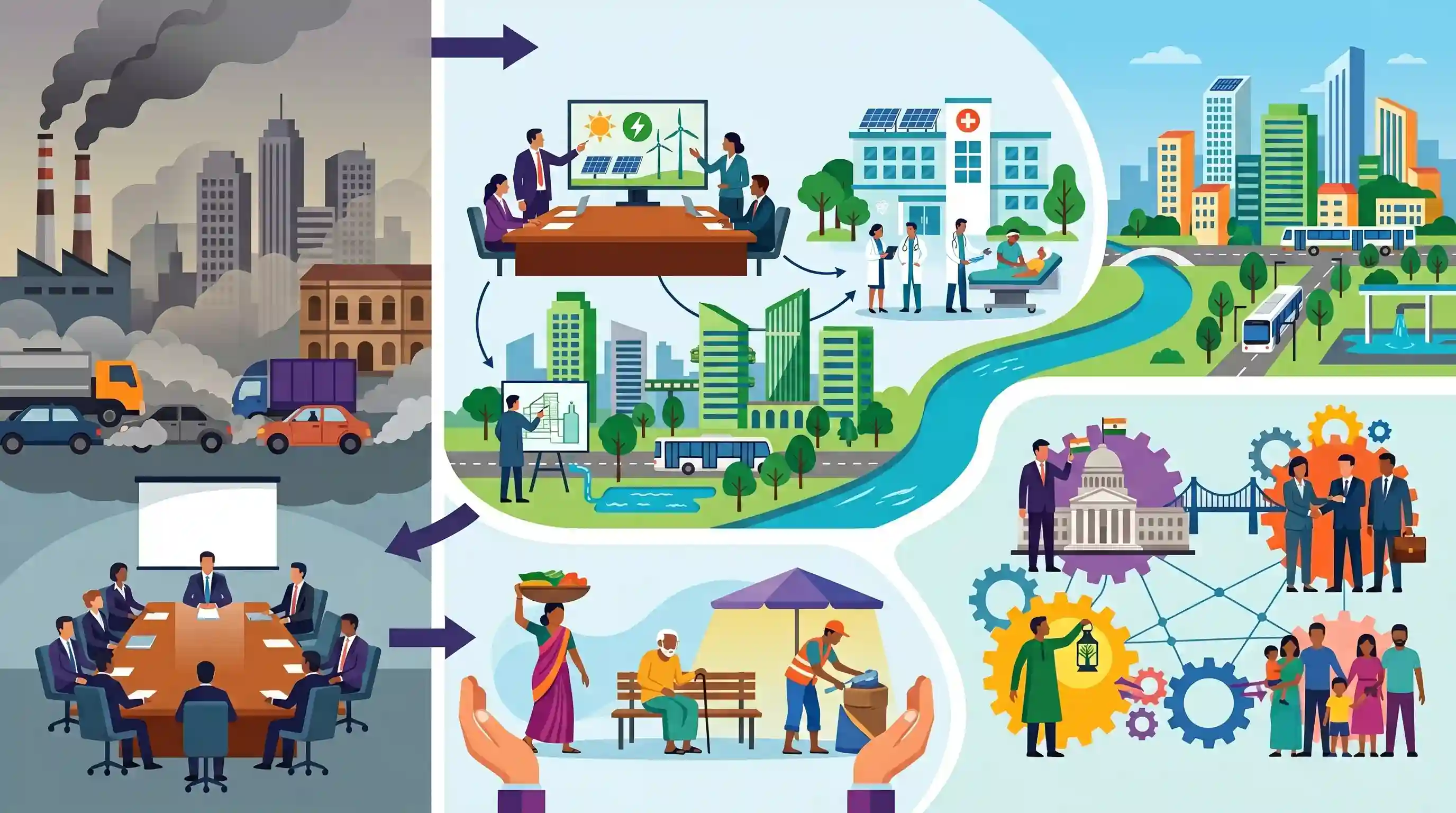
Speaking at the Mumbai Climate Week, Tata Trusts CEO Siddharth Sharma emphasized that India's climate challenges cannot be resolved solely through high-level discussions in conference rooms. Instead, climate action must be mainstreamed into everyday decisions across board rooms, health facilities, and urban infrastructure planning. He highlighted the necessity of inclusive adaptation, noting that climate impacts disproportionately affect vulnerable groups like informal workers, women, and the elderly. Furthermore, he called out the alarming normalization of air pollution in Indian cities and stressed the need for cohesive collaboration among governments, businesses, philanthropists, and communities to scale effective climate solutions.
Key Points
- Climate solutions must move beyond conference rooms and be integrated into the everyday operational decisions of businesses, transport authorities, building codes, and waste management systems.
- Climate adaptation strategies must be inclusive, prioritizing the most vulnerable demographics such as informal workers, residents of informal settlements, women, children, and the elderly.
- The normalization of severe air pollution in Indian cities, where it is treated as mere background noise, is a critical issue that needs immediate attention.
- Achieving climate goals requires multi-stakeholder alignment, bringing together governments, philanthropists, businesses, researchers, and local communities.
Important Terms
Tata Trusts

India's oldest philanthropic organization (est. 1892), owning 66% of Tata Sons. It funds large-scale initiatives in healthcare, education, and rural development, significantly influencing India's social sector landscape.
UPSC context
GS Paper 2: Role of NGOs and Philanthropy in development; GS Paper 3: Inclusive growth and sustainable development.
WRI India
The Indian arm of the World Resources Institute, a global research non-profit focusing on sustainable urban development, clean energy transition, and climate resilience through data-driven policy recommendations.
UPSC context
GS Paper 3: Environmental conservation and climate change; tests knowledge of international think tanks and their policy impact.
Mumbai First
A public-private partnership (PPP) platform and think tank involving major industries to transform the Mumbai Metropolitan Region into a world-class urban center through infrastructure and governance reforms.
UPSC context
GS Paper 1: Urbanization and its problems; GS Paper 2: Public-Private Partnerships (PPP) in urban governance.
Inclusive Adaptation
A climate strategy ensuring that the most vulnerable groups—such as informal workers, women, and the elderly—are central to the design and benefits of climate resilience and disaster management plans.
UPSC context
GS Paper 3: Disaster Management and Climate Change; GS Paper 2: Social Justice for vulnerable sections.
Mainstreaming Climate Action
The integration of climate-related considerations into all levels of policy-making, urban planning, and corporate strategy, rather than treating environmental issues as a separate or secondary concern.
UPSC context
GS Paper 3: Environmental Governance; GS Paper 2: Government policies and interventions for development.
Global South
A term for developing nations in Asia, Africa, and Latin America. In climate discourse, it highlights the need for equitable financing and scalable solutions tailored to non-Western developmental contexts.
UPSC context
GS Paper 2: International Relations (Global groupings); GS Paper 3: Climate Finance and Common But Differentiated Responsibilities (CBDR).
Prelims Trap
The National Adaptation Fund for Climate Change (NAFCC) is primarily financed by the Green Climate Fund (GCF) under the UNFCCC.
NAFCC is actually a 100% Central Sector Scheme set up by the Government of India to assist States, not funded by the GCF.
Static Concepts Connected
What is the fundamental difference between Climate Mitigation and Climate Adaptation?
- Mitigation: Actions aimed at reducing or preventing greenhouse gas emissions, such as shifting to renewable energy or expanding forest carbon sinks.
- Adaptation: Adjusting ecological, social, or economic systems in response to actual or expected climate impacts, such as building seawalls or developing drought-resistant crops.
- Policy overlap: Measures like urban green spaces serve dual purposes: sequestering carbon (mitigation) while reducing urban heat islands and flood risks (adaptation).
How does the FCRA framework regulate environmental NGOs and philanthropies in India?
- Strict regulation: Restricts foreign contributions to prevent funding of activities that the state deems detrimental to national interest or economic security.
- Sub-granting ban: The 2020 amendment prohibited NGOs from transferring received foreign contributions to other entities, severely impacting grassroots environmental action.
- Designated accounts: All foreign funds must be received in a designated FCRA account at the SBI main branch in New Delhi, centralizing financial oversight.
Cross-Topic Patterns
Urban Flooding & Municipal Governance
Climate-induced urban flooding connects to 74th CAA limitations; municipalities lack the autonomous funds to upgrade legacy drainage networks or strictly enforce modern building codes.
Just Transition & The Informal Economy
The shift toward green technologies often disrupts informal sectors. A 'Just Transition' requires integrating reskilling and social security to protect vulnerable populations during climate mitigation.

Expect a 2026 Mains GS-3 question linking urban governance (74th CAA) with climate adaptation, probing how local bodies fund resilience.
Linked PYQs · 4
Linked PYQs · 4
- 2025MainsGS1
Achieving sustainable growth with emphasis on environmental protection could come into conflict with poor people's needs in a country like India – Comment.
- 2023MainsGS1
Does urbanization lead to more segregation and/or marginalization of the poor in Indian metropolises?
- 2015MainsGS2
How can the role of NGOs be strengthened in India for development works relating to protection of the environment? Discuss throwing light on the major constraints.
- 2025MainsGS2
What are environmental pressure groups? Discuss their role in raising awareness, influencing policies and advocating for environmental protection in India.
