Urban Climate Adaptation and Challenges for Indian Cities
Source:The Hindu ↗
Why It Matters
The article provides a practical perspective on climate adaptation, emphasizing bottom-up approaches, urban governance (water pricing, waste management), and the critical role of corporate philanthropy and civil society in addressing the needs of marginalized communities.
Summary
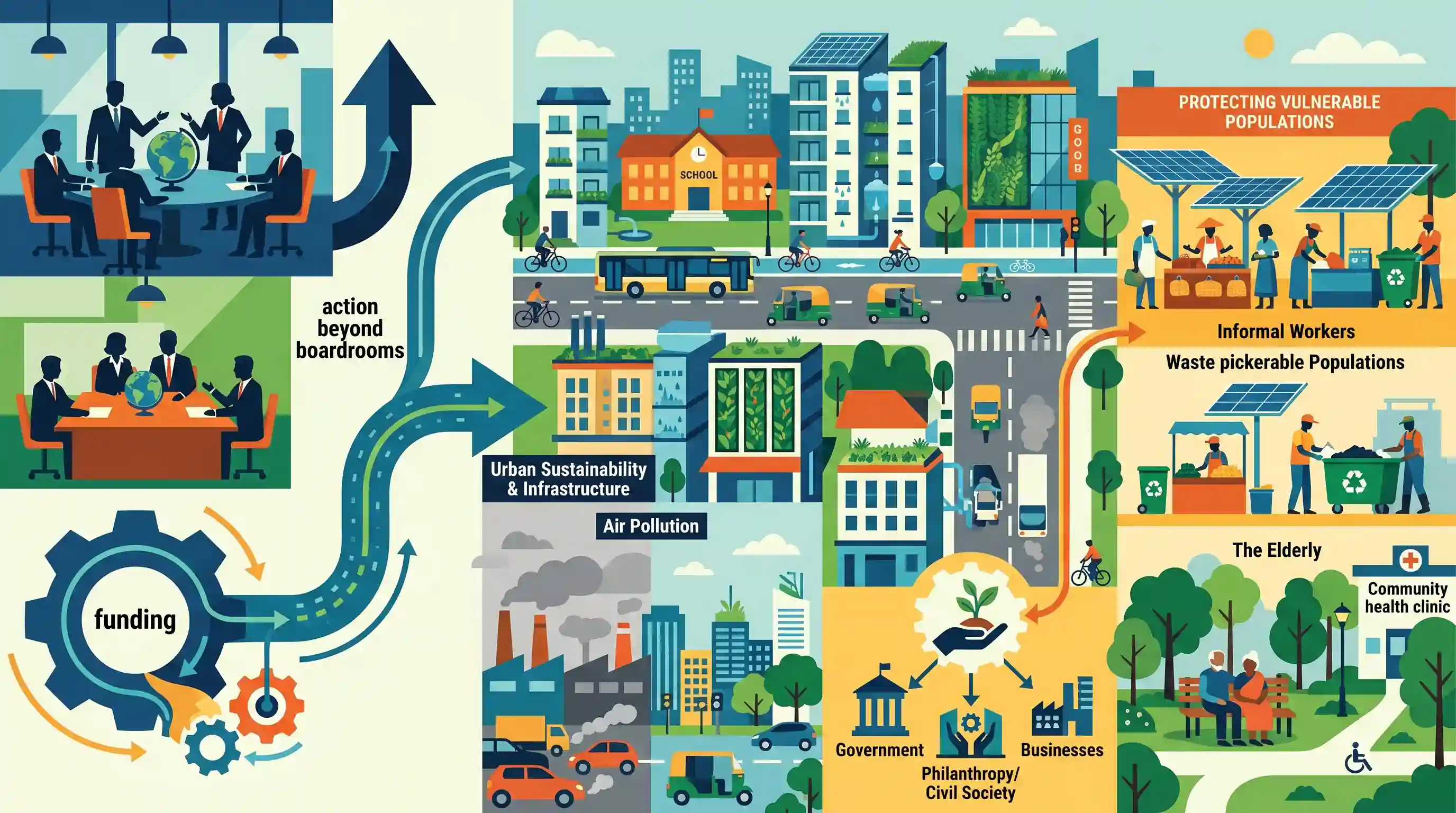
Speaking at the Mumbai Climate Week, Tata Trusts CEO Siddharth Sharma highlighted that effective climate action in India must go beyond boardrooms and be integrated into everyday urban governance and infrastructure. He stressed the importance of protecting vulnerable populations—such as informal workers and the elderly—while calling for a collaborative approach among governments, businesses, and philanthropists to address normalized issues like air pollution and promote urban sustainability.
Key Points
- Tata Trusts CEO Siddharth Sharma emphasized that India's climate challenge requires practical, everyday decisions rather than just high-level conference discussions.
- Climate adaptation efforts must prioritize the most vulnerable groups, including informal workers, slum dwellers, women, children, and the elderly.
- Key focus areas for urban sustainability include transport, housing, water pricing, waste management, and mangrove restoration.
- There is a critical need for alignment between governments, philanthropists, businesses, and communities to tackle normalized issues like severe air pollution in Indian cities.
Important Terms
Climate Change Adaptation

Adjustments in ecological, social, or economic systems in response to actual or expected climatic stimuli and their effects to moderate harm or exploit beneficial opportunities.
UPSC context
GS III: Environment; essential for disaster management and India's National Action Plan on Climate Change (NAPCC).
Urban Governance
The planning, management, and regulation of city affairs through interactions between local bodies, the private sector, and civil society to ensure efficient public service delivery.
UPSC context
GS II: Governance; tests the implementation of the 74th Amendment and decentralized administration for resilient urban infrastructure.
Urban Sustainability
The design and management of cities to minimize environmental impact while providing resilient infrastructure and equitable living conditions for current and future generations.
UPSC context
GS I: Urbanization and GS III: Infrastructure; relevant for the Smart Cities Mission and SDG 11.
Climate Philanthropy
Private funding from foundations and individuals aimed at bridging the finance gap for climate resilience, grassroots innovation, and the protection of vulnerable communities.
UPSC context
GS II: Governance; examines the role of civil society and NGOs in the development and climate action sectors.
Vulnerable Sections
Groups such as informal workers, women, and the elderly who face disproportionate risks from climate-induced hazards due to socio-economic marginalization.
UPSC context
GS II: Social Justice; focuses on inclusive growth and protection of marginalized populations from environmental shocks.
Tata Trusts
A major Indian philanthropic entity that funds social and economic development projects, including climate resilience, healthcare, and education.
UPSC context
GS II: Role of various groups and associations (NGOs, Foundations) in the development process.
Prelims Trap
"India's formal climate governance relies exclusively on state-led mitigation strategies, largely excluding private or philanthropic adaptation interventions."
The NAPCC focuses on both mitigation and adaptation. Furthermore, India's climate policy explicitly encourages non-state actors (philanthropies, NGOs, private sector) to drive localized adaptation.
Static Concepts Connected
How do non-state actors (CSOs/Philanthropies) contribute to urban climate governance?
- Capacity Building: They supplement state efforts by providing agile funding, localized data, and technical expertise for building community resilience.
- Last-mile Delivery: They bridge the gap between macro-policies and micro-implementation, ensuring vulnerable groups like informal workers and slum dwellers are not left behind.
- Behavioral Change: They drive civic awareness and participatory governance for sustainable municipal practices like waste management and water conservation.
How do mangroves act as critical urban climate infrastructure?
- Natural Bio-shields: Their dense, complex root systems dissipate wave energy, protecting coastal metropolises from storm surges and severe urban flooding.
- Carbon Sinks: They possess a disproportionately high capacity for blue carbon sequestration, aiding long-term climate mitigation alongside immediate adaptation.
- Ecosystem Services: They prevent coastal erosion, filter pollutants to improve urban water quality, and support local biodiversity and traditional livelihoods.
Cross-Topic Patterns
Urbanization as a Climate Risk Multiplier
Unplanned urbanization exacerbates climate vulnerabilities, linking GS1 (Urbanization) with GS3 (Disaster Management) through issues like urban flooding and heat islands severely affecting informal workers.
Local Body Finances and Climate Action
Rationalizing municipal revenue streams (like water pricing and waste levies) is crucial for funding localized climate adaptation, linking GS2 (74th Amendment) to GS3 (Environment).
Philanthropy's role in Climate Adaptation
The shift from traditional charity to strategic climate funding connects GS2 (Role of NGOs/Trusts) with GS3 (Climate Finance), pushing adaptation beyond standard government allocations.

Expect a Mains question linking GS2 and GS3: analyzing the supplementary role of non-state actors (philanthropies) in urban climate adaptation.
Linked PYQs · 4
Linked PYQs · 4
- 2024MainsGS3
Flooding in urban areas is an emerging climate-induced disaster. Discuss the causes of this disaster. Mention the features of two such major floods in the last two decades in India. Describe the policies and frameworks in India that aim at tackling such floods.
- 2021MainsGS3
Describe the key points of the revised Global Air Quality Guidelines (AQGs) recently released by the World Health Organisation (WHO). How are these different from its last update in 2005? What changes in India's National Clean Air Programme are required to achieve these revised standards?
- 2023MainsGS1
Does urbanization lead to more segregation and/or marginalization of the poor in Indian metropolises?
- 2021MainsGS2
Can Civil Society and Non-Governmental Organizations present an alternative model of public service delivery to benefit the common citizen? Discuss the challenges of this alternative model.
