Sub-National Reforms and State-Level China Plus One Strategy
Source:The Hindu ↗
આ શા માટે મહત્વનું છે
It directly addresses India's industrial growth bottlenecks, manufacturing sector expansion, and the implementation of 'China+1' strategies through sub-national governance, which is a core theme in GS3.
સારાંશ
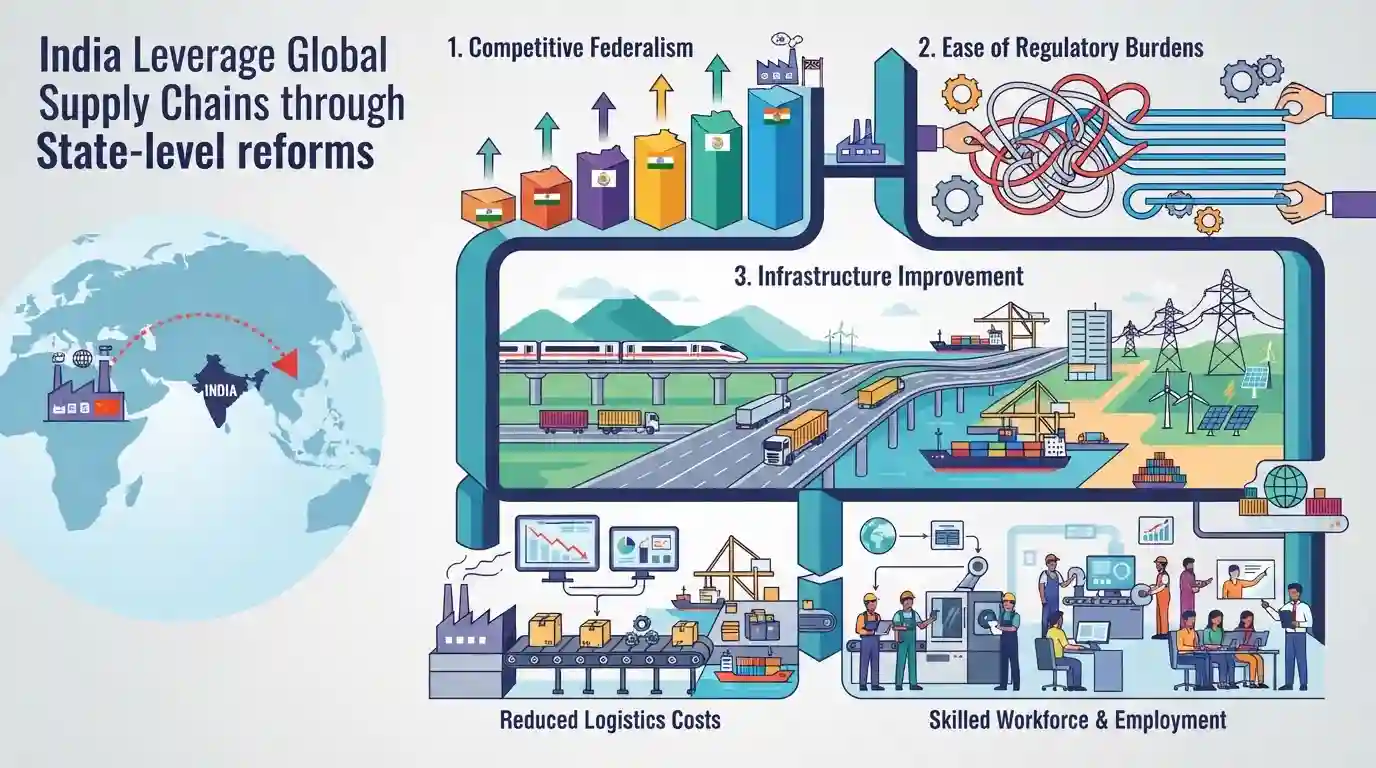
The article discusses how India can leverage the 'China+1' global supply chain diversification strategy by focusing on internal structural reforms at the state level. It argues that national policies alone are insufficient; states must improve infrastructure, reduce logistics and power costs, ease regulatory burdens, and foster competitive federalism to attract global manufacturing investments.
મુખ્ય મુદ્દા
- India's pursuit of capturing the 'China+1' global manufacturing shift requires looking inward at state-level structural and regulatory reforms rather than solely relying on national-level trade protectionism or macro policies.
- Disparities among Indian States are massive; while a few states perform well, many lag in infrastructure, logistics, power costs, and ease of doing business, hindering pan-India manufacturing competitiveness.
- Sub-national competitiveness, cooperative and competitive federalism, labor reforms, land acquisition transparency, and regulatory ease at the state and local levels are vital to scale up manufacturing.
- To compete with nations like Vietnam and Bangladesh, Indian states need to build robust plug-and-play industrial ecosystems and lower compliance burdens.
સંલગ્ન સ્થિર ખ્યાલો
What are the key constitutional provisions and institutional mechanisms governing cooperative and competitive federalism in India?
- Institutional Forums: Article 263 provides for the Inter-State Council to coordinate policy, while bodies like NITI Aayog drive competitive federalism via index-based state rankings.
- Legislative Division: Seventh Schedule divides legislative powers into Union, State, and Concurrent lists, requiring state-level concurrence for comprehensive industrial and labor reforms.
- Fiscal Federalism: GST Council (Article 279A) exemplifies cooperative federalism through a joint institutional forum for indirect tax harmonization.
આંતર-વિષય પેટર્ન
Competitive federalism & post-liberalization industrial decentralization
State-level FDI attraction under China+1 mirrors the pre-1991 License Raj decentralization debates, testing whether cooperative federalism can replace top-down industrial licensing.

China+1 strategy paired with competitive federalism will likely be tested via a multi-statement question on sub-national regulatory bottlenecks.
સંલગ્ન PYQ · 1
સંલગ્ન PYQ · 1
- 2017MainsGS3
Account for the failure of manufacturing sector in achieving the goal of labour-intensive exports. Suggest measures for more labour-intensive rather than capital-intensive exports.
