Power Grid Upgrades Needed to Integrate Cheap Renewable Energy
Source:The Hindu ↗
Why It Matters
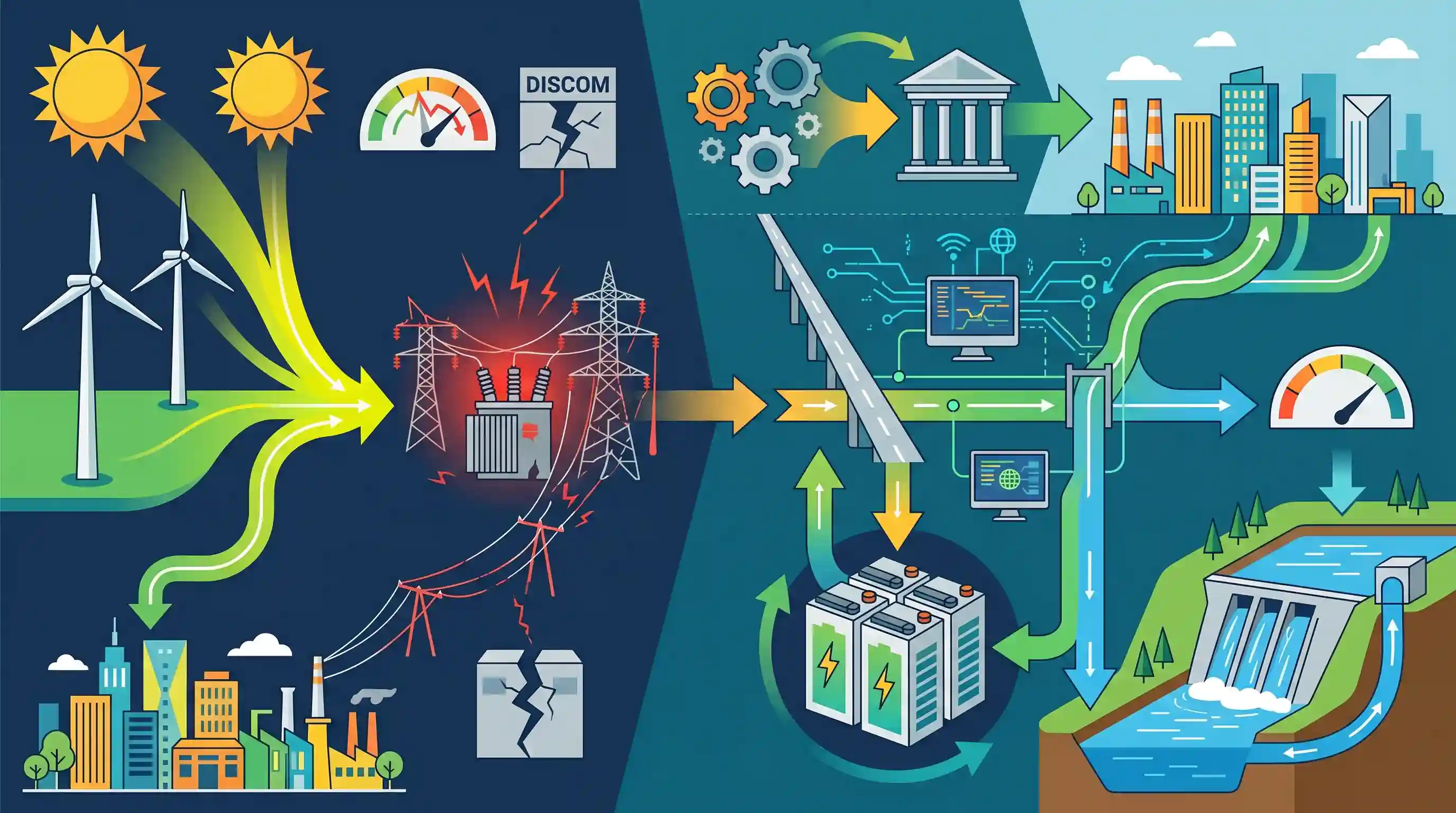
As India moves toward its ambitious goal of 500 GW of non-fossil fuel capacity by 2030, understanding the structural and infrastructural bottlenecks in grid integration is essential for tracking India's energy transition path and evaluating the viability of sustainable development.
Summary
The article highlights that while renewable energy (RE) has become the cheapest source of power in India, the national power grid is not yet fully equipped to handle the rapid influx of intermittent solar and wind energy. To fully capitalize on cheap renewables, India must urgently upgrade its transmission infrastructure, deploy smart grids, and invest heavily in energy storage solutions like battery storage and pumped hydro. The transition also necessitates policy support and structural reforms in the power distribution sector (DISCOMs) to ensure grid stability, manage peak demand, and guarantee long-term energy security.
Key Points
- Renewable power generation costs (especially solar and wind) have fallen significantly, making them cheaper than traditional thermal power in India.
- The inherent intermittency and variability of solar and wind energy pose major challenges to grid stability and load balancing.
- Upgrading the transmission infrastructure and adopting smart grid technologies are urgently needed to smoothly integrate decentralized renewable energy sources.
- Robust energy storage solutions, such as Battery Energy Storage Systems (BESS) and Pumped Storage Hydropower (PSH), are critical for storing surplus energy and releasing it during peak demand.
- Financial health and operational efficiency of DISCOMs must be improved to facilitate large-scale investments in grid modernization and energy storage.
Important Terms
DISCOMs

Electricity distribution companies that purchase power from generators and supply it to end-consumers. They manage last-mile infrastructure and billing, and are currently undergoing reforms to handle cheap renewable energy integration.
UPSC context
GS-3 Economy/Infrastructure. Tests understanding of structural challenges like AT&C losses and the financial sustainability of India's power distribution value chain.
Green Energy Corridor
A dedicated transmission infrastructure project designed to evacuate and synchronize large-scale renewable energy (solar and wind) from resource-rich states with India’s national power grid to ensure stability.
UPSC context
GS-3 Environment/Infrastructure. Crucial for questions on India's 500 GW renewable energy target and the technical challenges of grid integration.
Central Electricity Authority (CEA)
An apex statutory body that advises the Indian government on national electricity policy, formulates long-term power development plans, and sets technical and safety standards for the grid.
UPSC context
GS-2/3 Governance and Infrastructure. Tests knowledge of the regulatory framework and planning required for the nation’s evolving energy security.
Green Grid Initiative (GGI-OSOWOG)
A global initiative, jointly led by India and the UK, to interconnect national power grids across time zones, enabling 24/7 solar energy sharing under the principle "The Sun Never Sets."
UPSC context
GS-2 International Relations/GS-3 Environment. Evaluates India’s leadership in global climate diplomacy and large-scale green energy connectivity.
International Solar Alliance (ISA)
An India-led intergovernmental organization headquartered in Gurugram, launched with France to scale up global solar energy deployment by reducing technology costs and mobilizing massive investments.
UPSC context
GS-2 International Relations. Tests India's role in global climate governance, South-South cooperation, and clean energy diplomacy.
Prelims Trap
Pumped Storage Hydropower plants act as primary base-load renewable energy generators for continuous power supply.
PSH is an energy storage system, not a primary generator. It consumes more power pumping water up than it generates coming down, acting as a battery for peak-load management.
Static Concepts Connected
What constitutes Aggregate Technical and Commercial (AT&C) losses in the power sector?
- Technical Losses: Energy lost as heat in transmission lines, transformers, and distribution networks due to inherent equipment inefficiencies.
- Commercial Losses: Financial losses occurring due to power theft, unmetered usage, faulty billing, and failure to collect consumer payments.
How do Smart Grids functionally resolve renewable energy intermittency?
- Two-way Communication: Enables the bidirectional flow of both electricity and real-time data between utility providers and consumers.
- Demand Response: Automatically adjusts non-essential consumer loads (like smart appliances) during peak pricing or sudden renewable supply drops.
- Dynamic Forecasting: Uses AI and Advanced Metering Infrastructure to predict supply dips and instantly trigger battery storage release.
Cross-Topic Patterns
Grid Storage + Critical Minerals
Scaling Battery Energy Storage Systems (BESS) directly ties India's domestic grid stability to geostrategic supply chains and import dependencies for Lithium, Cobalt, and Nickel.
Green Grids + International Diplomacy
Domestic grid capacity upgrades parallel India’s foreign policy push via the International Solar Alliance and the 'One Sun, One World, One Grid' (OSOWOG) initiative.

Expect a 2026 prelims question combining Pumped Storage Hydro mechanics, BESS critical mineral dependencies, and grid intermittency.
Linked PYQs · 5
Linked PYQs · 5
- 2022MainsGS3
Do you think India will meet 50 percent of its energy needs from renewable energy by 2030 ? Justify your answer. How will the shift of subsidies from fossil fuels to renewables help achieve the above objective ? Explain.
- 2021MainsGS3
Explain the purpose of the Green Grid Initiative launched at World Leaders Summit of the COP26 UN Climate Change Conference in Glasgow in November, 2021. When was this idea first floated in the International Solar Alliance (ISA)?
- 2020MainsGS3
Describe the benefits of deriving electric energy from sunlight in contrast to the conventional energy generation. What are the initiatives offered by our Government for this purpose?
- 2024PrelimsGS1
Recently, the term "pumped-storage hydropower" is actually and appropriately discussed in the context of which one of the following?
- 2024PrelimsGS1
Consider the following: 1. Battery storage 2. Biomass generators 3. Fuel cells 4. Rooftop solar photovoltaic units How many of the above are considered "Distributed Energy Resources"?
