India Current Account Deficit Widens to 42 Billion USD in Q1FY27
Source:The Hindu ↗
हे का महत्त्वाचे आहे
Understanding trends in India's Current Account Deficit (CAD) and Balance of Payments is critical for analyzing external economic stability, foreign exchange reserves, currency fluctuations, and macroeconomic management.
सारांश
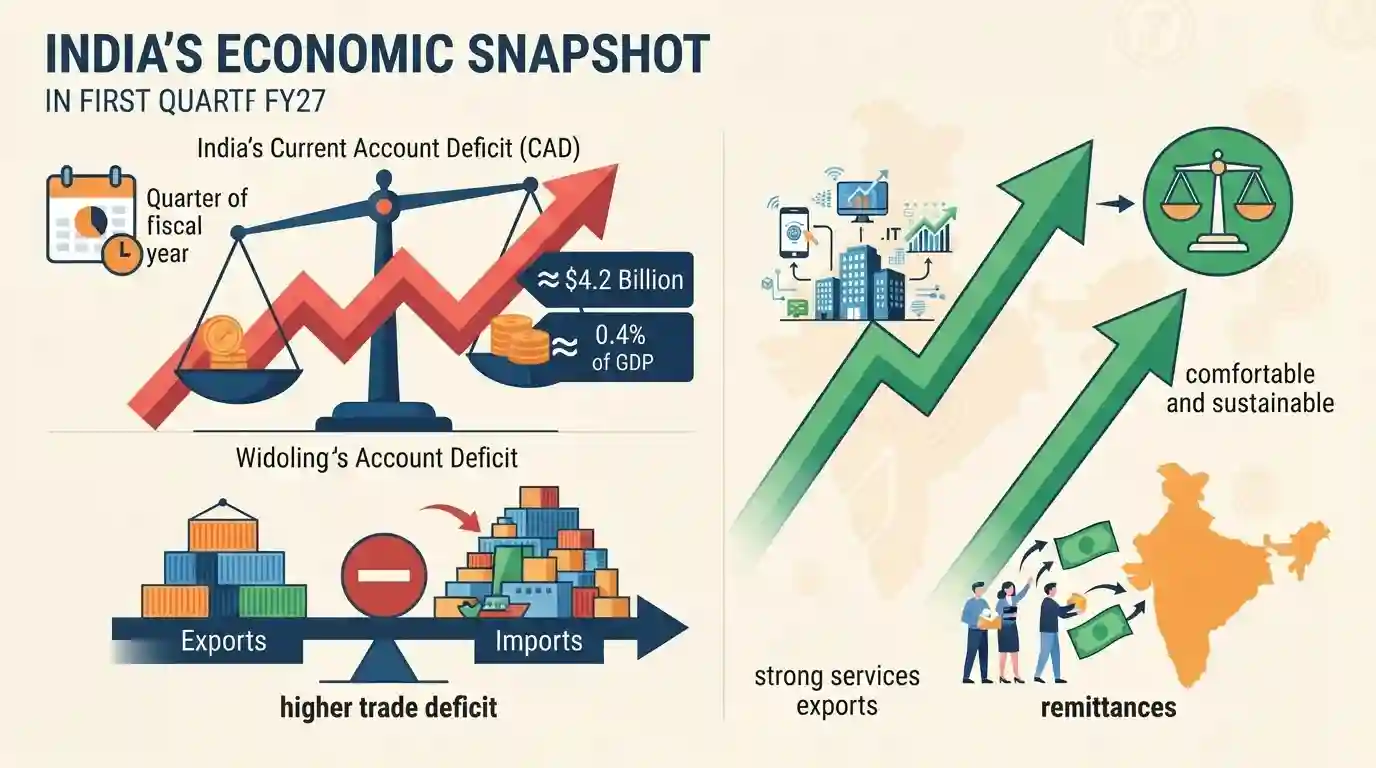
India's Current Account Deficit (CAD) widened to $4.2 billion, or 0.4% of GDP, in the first quarter of FY27, driven by a higher trade deficit. However, strong services exports and remittances helped keep the deficit within comfortable and sustainable limits.
मुख्य मुद्दे
- India's Current Account Deficit (CAD) widened to $4.2 billion (0.4% of GDP) in Q1FY27.
- The widening of CAD is primarily driven by a higher merchandise trade deficit compared to the previous quarters.
- Robust services exports and private transfer receipts (remittances) continued to cushion the current account balance, preventing a steeper widening.
- External sector stability remains manageable as the CAD level is well within sustainable thresholds.
महत्त्वाच्या संज्ञा
Current Account Deficit (CAD)

The difference between a country's total exports and imports of goods and services, alongside net earnings and transfer payments, reflecting its broader transactions with the rest of the world.
UPSC context
UPSC Prelims/Mains (Economy): Essential indicator of external sector stability, macroeconomic health, and trade imbalances.
Balance of Payments (BoP)
A statement summarizing all economic transactions between residents of a country and the rest of the world over a specific period, categorized into current, capital, and financial accounts.
UPSC context
UPSC Prelims/Mains (Economy): Evaluates foreign exchange reserves, currency stability, and international economic standing.
Merchandise Trade Deficit
The gap between a country's exports and imports of physical goods (merchandise), excluding services and transfers.
UPSC context
UPSC Prelims/Mains (Economy): Key component tracking physical international trade performance and import dependency.
संबंधित स्थिर संकल्पना
What are the primary components and structural determinants of India's Current Account Deficit (CAD)?
- Merchandise Trade:: Measures net trade in physical goods; India traditionally runs a structural deficit here due to energy and gold imports.
- Services (Invisibles):: Includes software, business, and travel services; India maintains a strong net surplus, offsetting the merchandise gap.
- Primary Income:: Comprises investment income (interest and dividends) on cross-border financial holdings.
- Secondary Income:: Consists of unrequited transfers such as worker remittances (highest from the Gulf and North America) and foreign grants.
आंतर-विषय नमुने
CAD and RBI Monetary Policy Liquidity Linkage
A wider CAD increases external vulnerability and puts downward pressure on the rupee, forcing the RBI to deploy forex reserves, which directly impacts domestic monetary liquidity management.
Services Surplus vs. Merchandise Deficit Dynamics
India's structural merchandise trade deficit is consistently counterbalanced by invisible surpluses (software services and remittances), linking external sector data directly to IT sector performance and West Asian diaspora employment trends.

Expect statement-based questions combining CAD components (goods vs. services vs. transfers) with external debt and capital account sustainability.
संबंधित PYQ · 2
संबंधित PYQ · 2
- 2014PrelimsGS1
With reference to Balance of Payments, which of the following constitutes/constitute the Current Account? 1. Balance of trade 2. Foreign assets 3. Balance of invisibles 4. Special Drawing Rights Select the correct answer using the code given below.
- 2016MainsGS3
Justify the need for FDI for the development of the Indian economy. Why there is gap between MOUs signed and actual FDIs? Suggest remedial steps to be taken for increasing actual FDIs in India.
