India current account deficit moderation and balance of payments
Source:The Hindu ↗
Why It Matters
Understanding the components and trends of the Current Account Deficit (CAD) and Balance of Payments (BoP) is crucial for evaluating India's macroeconomic stability, vulnerability to external shocks, and its currency valuation.
Summary
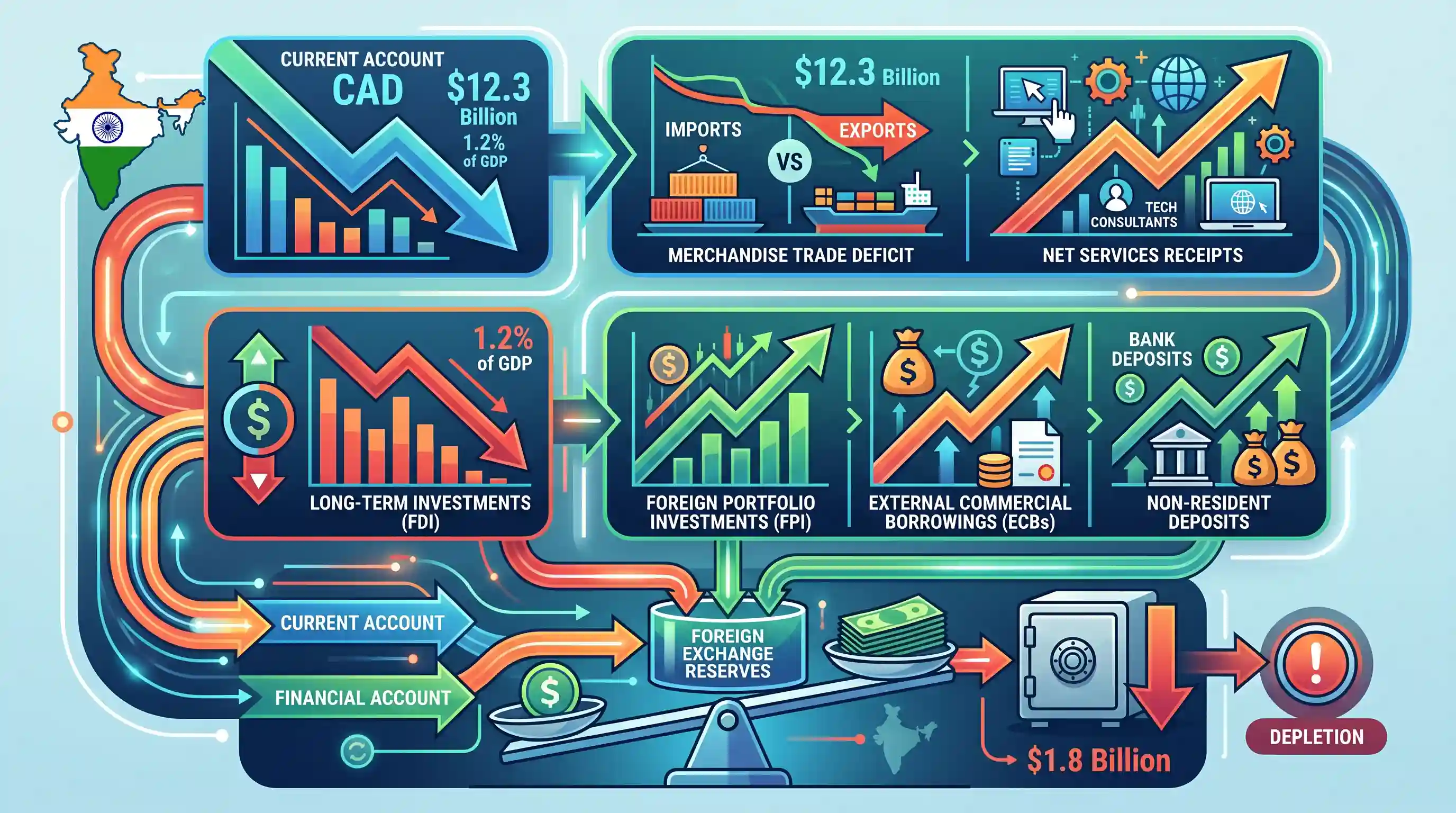
India's Current Account Deficit (CAD) narrowed to $12.3 billion, or 1.2% of the GDP, during the July-September quarter (Q2) of the financial year 2025-26, according to the Reserve Bank of India. This moderation was primarily driven by a lower merchandise trade deficit and an increase in net services receipts. The financial account showed mixed outcomes; while net Foreign Direct Investment (FDI) inflows declined significantly, Foreign Portfolio Investments (FPI), External Commercial Borrowings (ECBs), and non-resident deposits recorded strong net inflows. However, the overall balance of payments resulted in a depletion of foreign exchange reserves by $1.8 billion during the quarter.
Key Points
- India's Current Account Deficit (CAD) moderated to $12.3 billion (1.2% of GDP) in Q2 FY26, down from $14.1 billion (1.5% of GDP) in Q2 FY25.
- The narrowing of the CAD was supported by a slightly lower merchandise trade deficit and a rise in net services receipts.
- The financial account witnessed varying trends: Net FDI inflows declined to $1.1 billion, while net FPI recorded a strong inflow of $15.5 billion.
- Net external commercial borrowings (ECBs) and non-resident deposits both recorded net inflows during the quarter.
- Despite the lower CAD, India saw a depletion of foreign exchange reserves by $1.8 billion on a Balance of Payments (BoP) basis in Q2 FY26.
Important Terms
Balance of Payments (BoP)

A comprehensive record of all economic transactions between residents of a country and the rest of the world over a specific period.
UPSC context
GS Paper III/Economy; tests understanding of external sector resilience and macroeconomic stability.
Current Account Deficit (CAD)
The shortfall between a country's total earnings from exports and transfers versus its total expenditure on imports of goods and services.
UPSC context
GS Paper III/Economy; a vital indicator of trade competitiveness and external sector vulnerability.
Foreign Direct Investment (FDI)
Long-term investment by foreign entities in domestic productive assets, involving management control and at least 10% equity stake.
UPSC context
GS Paper III/Economy; assessed as a stable, non-debt capital source for infrastructure and growth.
Foreign Portfolio Investment (FPI)
Passive investment by non-residents in domestic financial assets like stocks and bonds, without direct ownership or management control.
UPSC context
GS Paper III/Economy; known as 'hot money' for its volatility and market impact.
External Commercial Borrowings (ECB)
Loans raised by Indian corporate entities from non-resident lenders in foreign currencies for commercial purposes, under RBI regulations.
UPSC context
GS Paper III/Economy; a major component of India’s external debt and capital account.
Foreign Exchange (Forex) Reserves
Assets held by the Reserve Bank of India in foreign currencies, gold, and SDRs to manage economic shocks.
UPSC context
GS Paper III/Economy; essential for assessing currency stability and import cover capacity.
Net Services Receipts
The surplus earned from the export of services minus the import of services; typically offsets India's goods trade deficit.
UPSC context
GS Paper III/Economy; highlights India's strength in IT and professional service exports.
Prelims Trap
"A moderation in the Current Account Deficit guarantees an increase in India's Foreign Exchange Reserves."
Forex reserves deplete if the net capital account surplus (FDI, FPI, ECBs) is smaller than the CAD, even if the CAD itself has narrowed.
Static Concepts Connected
What distinguishes the Current Account from the Capital Account in India's BoP?
- Current Account: Records trade in goods, services (invisibles), income (profits, interest), and unilateral transfers like remittances.
- Capital Account: Records changes in asset ownership via FDI, FPI, External Commercial Borrowings (ECBs), and NRI deposits.
What causes a depletion in foreign exchange reserves on a BoP basis?
- BoP Deficit: Occurs when autonomous outflows (like imports) exceed autonomous inflows, requiring forex reserves to bridge the gap.
- Accommodating Transactions: The RBI sells foreign currency from its reserves to balance the overall deficit (official reserve sale).
Cross-Topic Patterns
FPI volatility vs stable FDI
While FPI is highly liquid "hot money," FDI is stable and non-debt creating. Categorizing debt vs. non-debt creating capital flows is a recurring UPSC Prelims theme.
The structural merchandise trade deficit
India's CAD is chronically offset by a surplus in services and remittances, tying macroeconomic stability directly to global IT and service sector demand.

Expect a 2026 Prelims statement tricking you into classifying ECBs or NRI deposits under the Current Account instead of Capital.
Linked PYQs · 5
Linked PYQs · 5
- 2014PrelimsGS1
With reference to Balance of Payments, which of the following constitutes/constitute the Current Account? 1. Balance of trade 2. Foreign assets 3. Balance of invisibles 4. Special Drawing Rights Select the correct answer using the code given below.
- 2013PrelimsGS1
The balance of payments of a country is a systematic record of
- 2021PrelimsGS1
Consider the following : 1. Foreign currency convertible bonds 2. Foreign institutional investment with certain conditions 3. Global depository receipts 4. Non-resident external deposits Which of the above can be included in Foreign Direct Investments?
- 2020PrelimsGS1
With reference to Foreign Direct Investment in India, which one of the following is considered its major characteristic?
- 2018MainsGS3
How would the recent phenomena of protectionism and currency manipulations in world trade affect macroeconomic stability of India?
