Evolution of India Foreign Policy Doctrine and Counter Terror Strategy
Source:Indian Express ↗
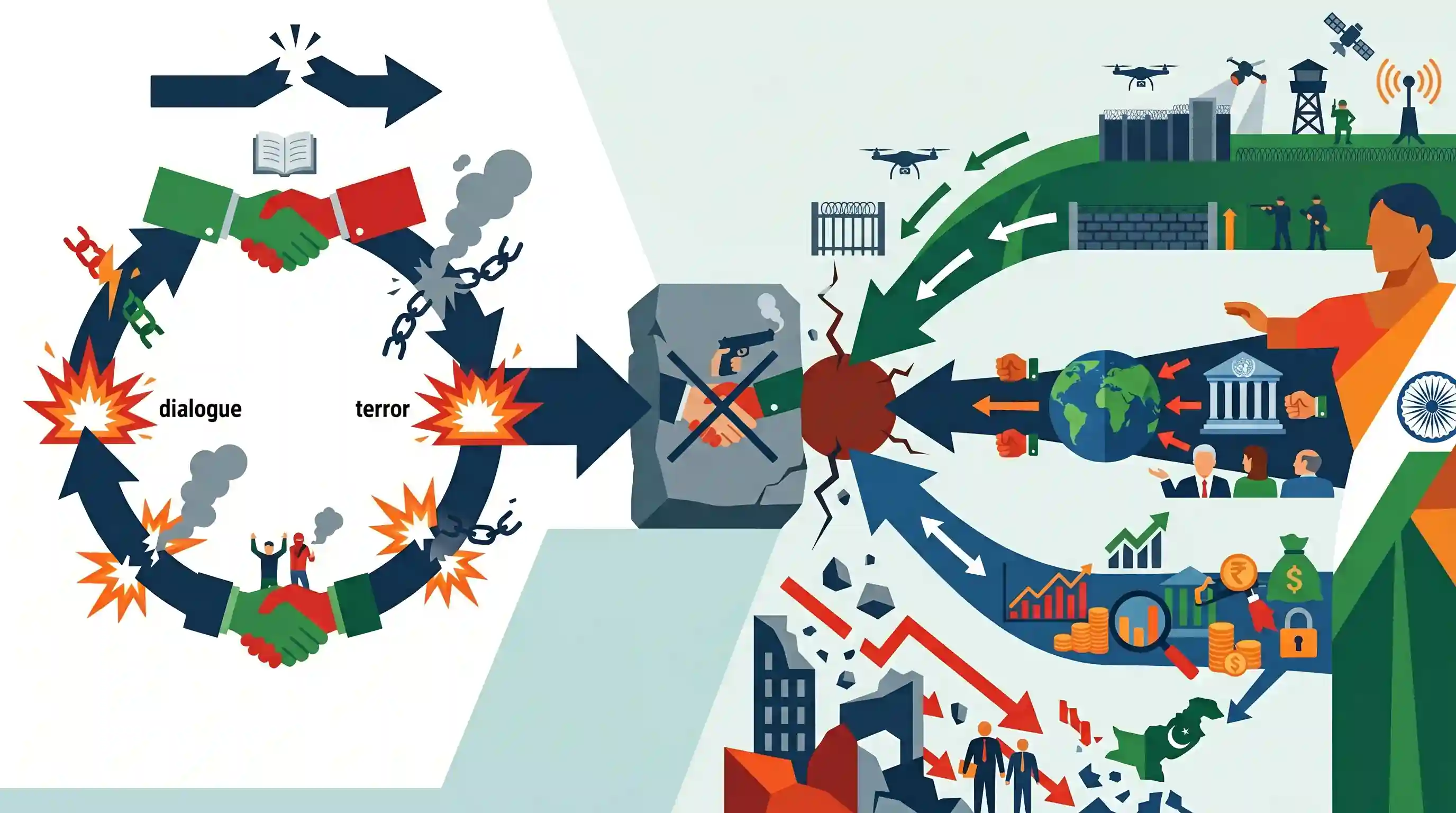
Why It Matters
Understanding the evolution of India's stance on Pakistan from 'strategic restraint' and cyclical dialogue to 'sustained pressure' is crucial for answering Mains questions on neighborhood relations, counter-terrorism diplomacy, and internal security dynamics along the border.
Summary
The article analyzes a defining shift in India’s foreign policy approach toward Pakistan. Rather than engaging in the traditional cycle of dialogue disrupted by terror attacks, India has instituted a policy of sustained, multi-dimensional pressure. This strategy is anchored in the premise that state-sponsored cross-border terrorism and diplomatic talks cannot coexist. By consistently maintaining rigorous border security protocols and actively working to isolate Pakistan on global platforms like the UN and FATF, New Delhi aims to systematically raise the geopolitical and economic costs for Islamabad's reliance on proxy warfare.
Key Points
- India's foreign policy towards Pakistan has fundamentally transitioned from episodic engagement to a strategy of 'sustained pressure'.
- New Delhi has moved away from the historical cycle of initiating peace talks, experiencing a cross-border terror attack, suspending dialogue, and eventually returning to the negotiating table.
- The current diplomatic doctrine asserts that normalized bilateral relations and formal dialogue are strictly contingent on the cessation of state-sponsored terrorism ('terror and talks cannot go together').
- The strategy involves actively leveraging international platforms to expose and diplomatically isolate Pakistan over its support for proxy warfare and terror financing.
- This paradigm shift aims to permanently alter Islamabad's cost-benefit calculus regarding border adventurism and regional destabilization.
Important Terms
Financial Action Task Force (FATF)

An intergovernmental organization that sets global standards to combat money laundering and terrorist financing, using lists to pressure non-compliant nations.
UPSC context
GS Paper 2 (International Institutions) and Paper 3 (Internal Security); tests understanding of global counter-terror mechanisms.
Cross-border Terrorism
Terrorist activities where a country's territory is used to plan or launch attacks against another, often involving state-supported non-state actors.
UPSC context
GS Paper 3 (Internal Security); a primary challenge involving external state and non-state actors.
Proxy Warfare
A conflict where a state supports third parties (such as militants) to fight its adversaries indirectly, avoiding direct military confrontation.
UPSC context
GS Paper 3 (Security); critical for analyzing asymmetric threats and India-Pakistan security dynamics.
Diplomatic Isolation
A foreign policy strategy to sever a country's international ties and global influence to force behavioral changes, often regarding terrorism.
UPSC context
GS Paper 2 (India and its Neighborhood); tests strategic maneuvering and soft-power application.
FATF Grey List
The FATF's list of 'Jurisdictions under Increased Monitoring' that face close scrutiny for deficiencies in countering money laundering and terror financing.
UPSC context
GS Paper 2/3; concerns global economic pressure as a tool against state-sponsored terror.
United Nations (UN)
An international organization of 193 member states established to maintain global peace, security, and promote cooperation among nations.
UPSC context
GS Paper 2 (International Relations); focuses on India's multilateral diplomacy and pursuit of global reforms.
Prelims Trap
FATF is a specialized agency of the United Nations used to impose binding economic sanctions on terror-financing states.
FATF is not a UN body; it was established by the G7. It issues recommendations (grey/black lists) but does not impose direct binding UN Security Council-style sanctions.
Static Concepts Connected
What is the mandate and structure of the FATF?
- Origin & Mandate: Established by the G7 in 1989 to tackle money laundering; its mandate was expanded in 2001 to include combating terrorist financing.
- Listing Mechanism: Maintains a 'Grey List' (jurisdictions under increased monitoring) and a 'Black List' (high-risk jurisdictions subject to a call for action).
- Enforcement Power: It relies on peer pressure, reputational damage, and resultant loss of foreign investment rather than direct penal or UN-backed sanctions.
What principles govern the historical framework of India-Pakistan dialogue?
- Shimla Agreement (1972): Signed after the 1971 war, it established the principle of strict bilateralism, meaning disputes must be resolved peacefully without third-party mediation.
- Lahore Declaration (1999): Reaffirmed the Shimla principles and added explicit commitments to avoid nuclear conflict and combat terrorism.
- Current Precondition: India has not abandoned bilateralism, but has made the cessation of state-sponsored terrorism a strict precondition for resuming the Shimla/Lahore dialogue framework.
Cross-Topic Patterns
Global FATF mandates & domestic PMLA
India uses FATF to isolate Pakistan globally, while strict domestic compliance with FATF recommendations drives the rigorous bail conditions and frequent amendments to India's Prevention of Money Laundering Act (PMLA).
Indus Waters Treaty (IWT) as strategic pressure
India's "sustained pressure" strategy extends to resource diplomacy, evidenced by New Delhi issuing formal modification notices to Pakistan regarding the 1960 Indus Waters Treaty, signaling an end to historical accommodation.

Expect a GS2/GS3 Mains question linking India's "sustained pressure" doctrine to FATF's effectiveness in curbing proxy terror financing.
Linked PYQs · 3
Linked PYQs · 3
- 2015MainsGS2
Terrorist activities and mutual distrust have clouded India-Pakistan relations. To what extent the use of soft power like sports and cultural exchanges could help generate goodwill between the two countries? Discuss with suitable examples.
- 2020MainsGS3
For effective border area management, discuss the steps required to be taken to deny local support to militants and also suggest ways to manage favourable perception among locals.
- 2021MainsGS3
Analyse the complexity and intensity of terrorism, its causes, linkages and obnoxious nexus. Also suggest measures required to be taken to eradicate the menace of terrorism.
