India Air Pollution Crisis and Health Impact Data
Source:The Hindu ↗
Why It Matters
This article provides critical current data (State of Global Air 2025) on the impacts of air pollution, making it highly relevant for GS3 Environment and GS2 Health sections. It directly addresses the shortcomings of the National Clean Air Programme (NCAP) and highlights the urgency of aligning India's NAAQS with WHO air quality guidelines, topics explicitly tested in UPSC Mains.
Summary
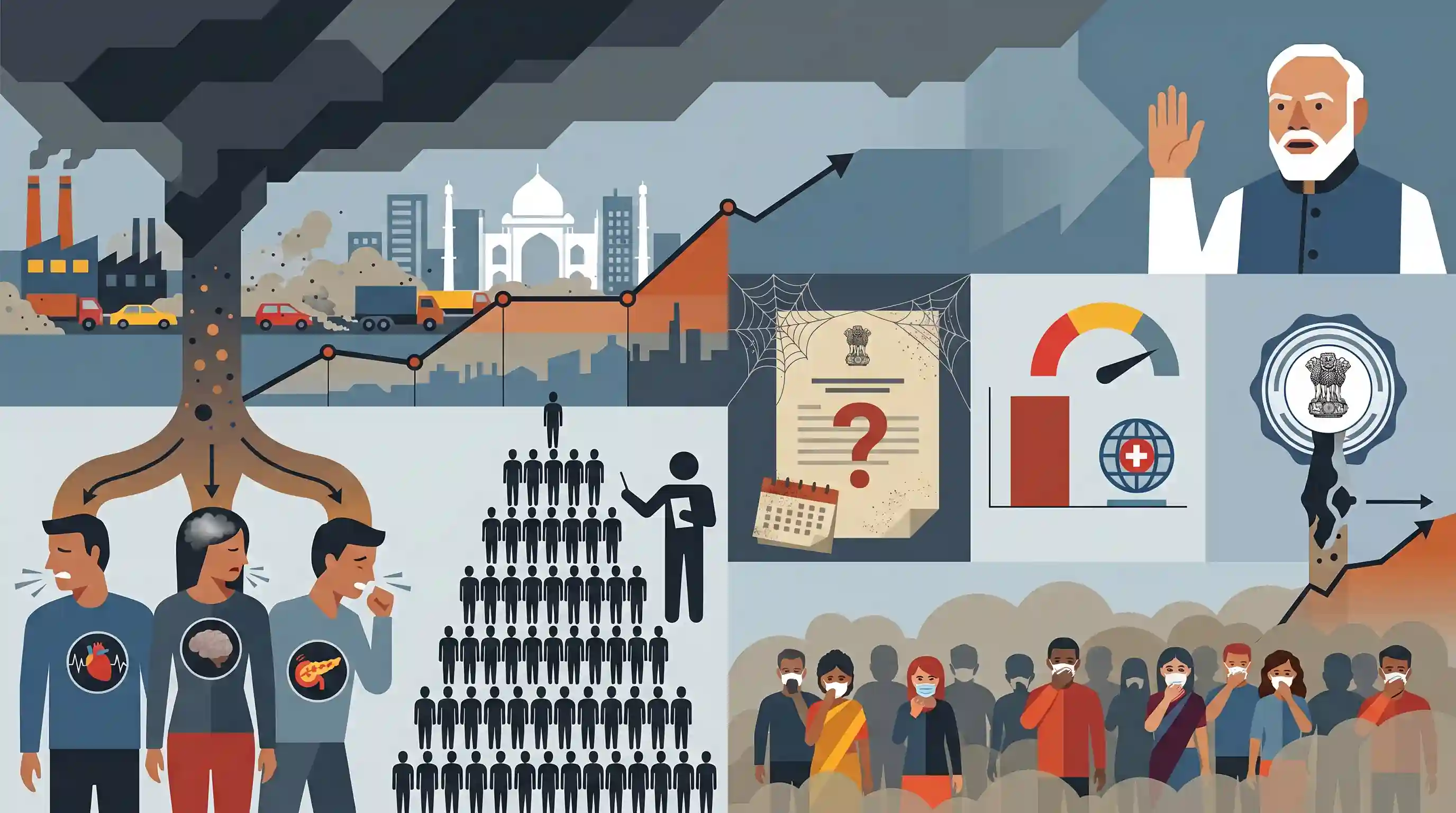
The article highlights India's escalating air pollution crisis, describing it as a massive public health and national security threat. According to the State of Global Air 2025 report, air pollution caused approximately 2 million deaths in India in 2023, primarily driven by non-communicable diseases (NCDs) like heart disease, diabetes, and dementia. Congress leader Jairam Ramesh emphasized that India's National Ambient Air Quality Standards (NAAQS) have not been updated since 2009, and the PM2.5 limits remain drastically higher than WHO guidelines. Despite the launch of the National Clean Air Programme (NCAP) in 2017, air pollution levels have continued to rise, exposing the entire population to hazardous PM2.5 levels.
Key Points
- The State of Global Air 2025 report links nearly 2 million deaths in India in 2023 to air pollution, marking a 43% increase since 2000.
- Nearly 90% of these air pollution-attributed deaths are due to non-communicable diseases (NCDs) such as stroke, heart disease, diabetes, and dementia.
- India's current PM2.5 standards are severely outdated (promulgated in 2009) and remain up to eight times higher than the annual WHO guidelines.
- The National Clean Air Programme (NCAP), launched in 2017, has failed to check rising PM2.5 levels, with every Indian living in areas exceeding WHO safety limits.
- India records about 186 air pollution-related deaths per 100,000 people, a rate over ten times higher than that in high-income countries.
Important Terms
National Clean Air Programme (NCAP)

A 2019 national initiative aiming for a 20-30% reduction (revised to 40% by 2026) in particulate matter concentrations across 131 non-attainment cities.
UPSC context
GS III: Environmental Pollution. Tests effectiveness of policy interventions and urban air quality management targets.
National Ambient Air Quality Standards (NAAQS)
Standards notified by the CPCB in 2009 for 12 pollutants (e.g., PM2.5, SO2, NO2) to define permissible limits for protecting public health.
UPSC context
GS III: Environment. Critical for understanding domestic regulatory frameworks vs global health benchmarks.
PM2.5
Fine inhalable particles (diameter ≤2.5 micrometers) that penetrate deep into lungs and the bloodstream, causing severe cardiovascular and respiratory diseases.
UPSC context
GS III: Environment and GS II: Health. Essential for technical analysis of pollutant toxicity and health outcomes.
Non-Communicable Diseases (NCDs)
Chronic, non-infectious diseases (e.g., heart disease, stroke, diabetes) that account for over 65% of deaths in India and are exacerbated by pollution.
UPSC context
GS II: Health. Tests awareness of India's shifting disease burden and public health challenges.
WHO Air Quality Guidelines
International health-based benchmarks updated in 2021, recommending a strict annual PM2.5 limit of 5 μg/m³, significantly lower than India's current 40 μg/m³.
UPSC context
GS III: Environment. Used to critique domestic standards and advocate for health-centric policy revisions.
Prelims Trap
"NCAP is a legally binding framework covering all Indian cities to ensure compliance with WHO air quality standards."
NCAP is not legally binding. It targets specific "non-attainment cities" failing domestic NAAQS norms, aiming for percentage reductions rather than strict WHO standards.
Static Concepts Connected
What are the 12 pollutants measured under the NAAQS?
- Particulates: PM10 and PM2.5.
- Gases: Sulphur Dioxide (SO2), Nitrogen Dioxide (NO2), Carbon Monoxide (CO), Ozone (O3), Ammonia (NH3). (Note: CO2 is NOT included).
- Toxins & Metals: Lead, Benzene, Benzo(a)pyrene (BaP), Arsenic, and Nickel.
What defines a "Non-Attainment City" under India's NCAP?
- Criteria: Cities that consistently do not meet the National Ambient Air Quality Standards (NAAQS) over a period of five years.
- NCAP Target: To reduce PM2.5 and PM10 concentrations by 40% by 2026 (revised from the initial 20-30% by 2024 target) using 2017 baseline levels.
Cross-Topic Patterns
Pollution eroding demographic dividend
Rising NCDs (diabetes, stroke) linked to air pollution shift the health burden to chronic care, directly threatening the productivity of India's working-age population.
Airshed management vs. city-centric policy
NCAP targets individual non-attainment cities, but pollutants ignore borders. UPSC often tests regional "airshed" governance (like CAQM in NCR) as a solution to federal limitations.

Expect a 2026 Prelims question comparing WHO AQG (5 µg/m³ for PM2.5) vs India's NAAQS (40 µg/m³) and identifying the 12 NAAQS pollutants.
Linked PYQs · 2
Linked PYQs · 2
- 2021MainsGS3
Describe the key points of the revised Global Air Quality Guidelines (AQGs) recently released by the World Health Organisation (WHO). How are these different from its last update in 2005? What changes in India's National Clean Air Programme are required to achieve these revised standards?
- 2020MainsGS3
What are the key features of the National Clean Air Programme (NCAP) initiated by the Government of India?
