IndiaAI Mission and Strategic Roadmap for Artificial Intelligence
Source:Indian Express ↗
Why It Matters
The IndiaAI Mission is a cornerstone of India's digital strategy and is directly relevant to GS-3 (Science and Technology, Awareness in IT). Understanding this mission helps aspirants address questions on technological self-reliance, data sovereignty, challenges in emerging tech (like semiconductor supply chains), and the ethical governance of AI.
Summary
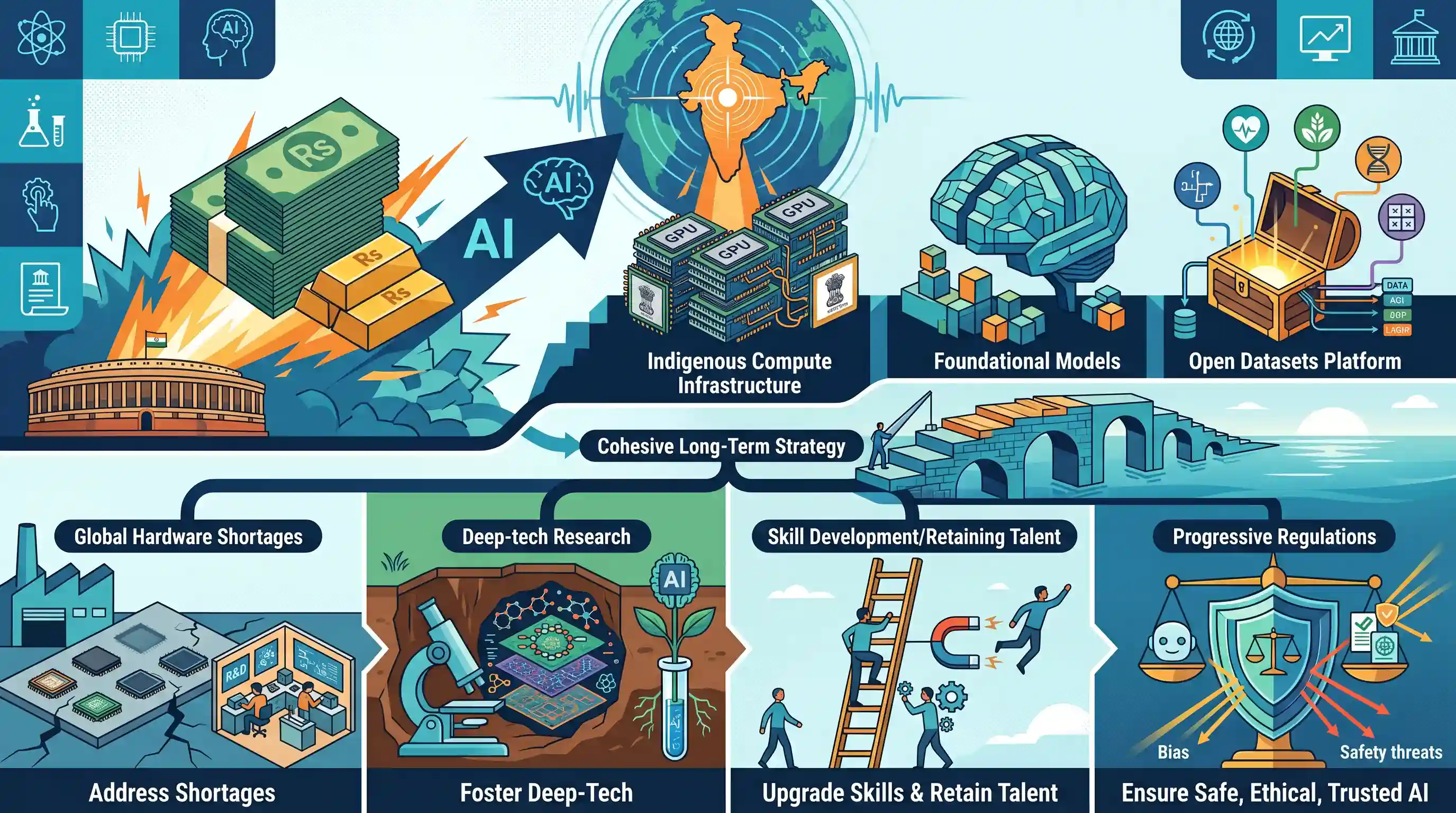
The Union Cabinet’s approval of the Rs 10,371 crore IndiaAI Mission provides a significant boost to India's ambition of becoming a global hub for Artificial Intelligence. The mission targets the creation of a comprehensive AI ecosystem by developing indigenous compute infrastructure, foundational models, and an open datasets platform. However, the article asserts that this financial and policy lift must be backed by a cohesive long-term strategy. To sustain this momentum, India must address global shortages in AI hardware, foster deep-tech research, upgrade skill development frameworks to retain talent, and implement progressive regulations that ensure the deployment of safe, ethical, and trusted AI technologies.
Key Points
- The Rs 10,371 crore IndiaAI Mission aims to establish a robust AI ecosystem, primarily focusing on building sovereign AI compute capacity (e.g., 10,000 GPUs) through public-private partnerships.
- The initiative includes setting up the IndiaAI Datasets Platform to democratize access to non-personal data, which is essential for developing foundational models tailored to local languages and contexts.
- Global supply chain constraints for advanced AI hardware (semiconductors) pose a significant challenge, necessitating synergy between the AI mission and the India Semiconductor Mission.
- While the initial funding provides a necessary lift, a sustained, long-term strategy must focus on talent retention, deep-tech research, and establishing a robust regulatory framework for Safe and Trusted AI.
Important Terms
IndiaAI Mission

A national mission with a ₹10,371 crore outlay to establish a comprehensive ecosystem for AI innovation, indigenous compute capacity, and foundational models.
UPSC context
GS III: Science & Technology; critical for topics on indigenization and the Fourth Industrial Revolution.
India Semiconductor Mission
A nodal agency driving India's long-term strategy for semiconductor manufacturing, chip design, and display ecosystems to achieve technological self-reliance.
UPSC context
GS III: Infrastructure and Economy; relevant for supply chain resilience and Aatmanirbhar Bharat goals.
Digital India
An umbrella flagship program aimed at transforming India into a digitally empowered society through infrastructure, governance, and electronic service delivery.
UPSC context
GS II: Government Policies; fundamental to e-governance, digital economy, and administrative reforms.
IndiaAI Innovation Centre
A specialized center under the IndiaAI Mission focused on developing indigenous Large Multimodal Models (LMMs) and domain-specific AI foundational models.
UPSC context
GS III: Science & Technology; tests knowledge of institutional R&D and indigenous technology development.
IndiaAI Datasets Platform
A national platform (AI Kosh) providing structured, non-personal datasets to startups and researchers to train and improve AI models.
UPSC context
GS III: S&T and IT; significant for data governance and big data analytics themes.
Large Multimodal Models
AI models that can interpret and generate multiple data types (text, image, audio) concurrently, targeted for indigenous development under the IndiaAI Mission.
UPSC context
GS III: Science & Technology; relevant for awareness of emerging AI trends and local language applications.
Prelims Trap
The IndiaAI Datasets Platform provides startups open access to both personal and non-personal citizen data.
The platform strictly hosts 'non-personal' data. Utilizing personal data without explicit user consent for AI model training would violate the Digital Personal Data Protection (DPDP) Act 2023.
Static Concepts Connected
What constitutes 'Non-Personal Data' (NPD) in Indian governance frameworks?
- Definition: Data that never related to an identified natural person, or formerly personal data that has been irrevocably anonymized (e.g., aggregated weather or traffic data).
- Gopalakrishnan Committee: Tasked by MeitY, this committee recommended a framework for sharing NPD to harness its economic value for domestic startups while preventing data monopolization.
- AI Utility: It forms the bedrock of the IndiaAI Datasets Platform, allowing researchers to train large foundational models safely without breaching citizen privacy.
Why are GPUs preferred over CPUs for training AI foundational models?
- Core Architecture: CPUs have a few powerful cores designed for fast sequential processing, whereas GPUs possess thousands of smaller, specialized cores.
- Parallel Processing: GPUs execute thousands of mathematical operations simultaneously. This is critical for the heavy matrix multiplications required to train deep neural networks.
- Throughput Capacity: Because of their high throughput and parallel nature, GPUs drastically reduce the time needed to process massive datasets, a requirement for building Sovereign AI.
Cross-Topic Patterns
Data Privacy vs. AI Model Training
The DPDP Act's strict consent architecture limits personal data use, pushing the IndiaAI Mission to build robust "non-personal data" repositories to train indigenous models legally without violating privacy rights.
Sovereign Compute & Fab Ecosystems
AI ambitions are bottlenecked by global GPU supply. True indigenous technology relies on synergizing the IndiaAI Mission's compute goals with the hardware fabrication targets of the India Semiconductor Mission.

Expect a 2026 Prelims question linking IndiaAI Mission components (10,000 GPUs via PPP, non-personal data) with the Semiconductor Mission.
Linked PYQs · 3
Linked PYQs · 3
- 2023MainsGS3
Introduce the concept of Artificial Intelligence (AI). How does Al help clinical diagnosis? Do you perceive any threat to privacy of the individual in the use of Al in healthcare?
- 2025MainsGS3
India aims to become a semiconductor manufacturing hub. What are the challenges faced by the semiconductor industry in India? Mention the salient features of the India Semiconductor Mission.
- 2020PrelimsGS1
With the present state of development, Artificial Intelligence can effectively do which of the following? 1. Bring down electricity consumption in industrial units 2. Create meaningful short stories and songs 3. Disease diagnosis 4. Text-to-Speech Conversion 5. Wireless transmission of electrical energy Select the correct answer using the code given below:
