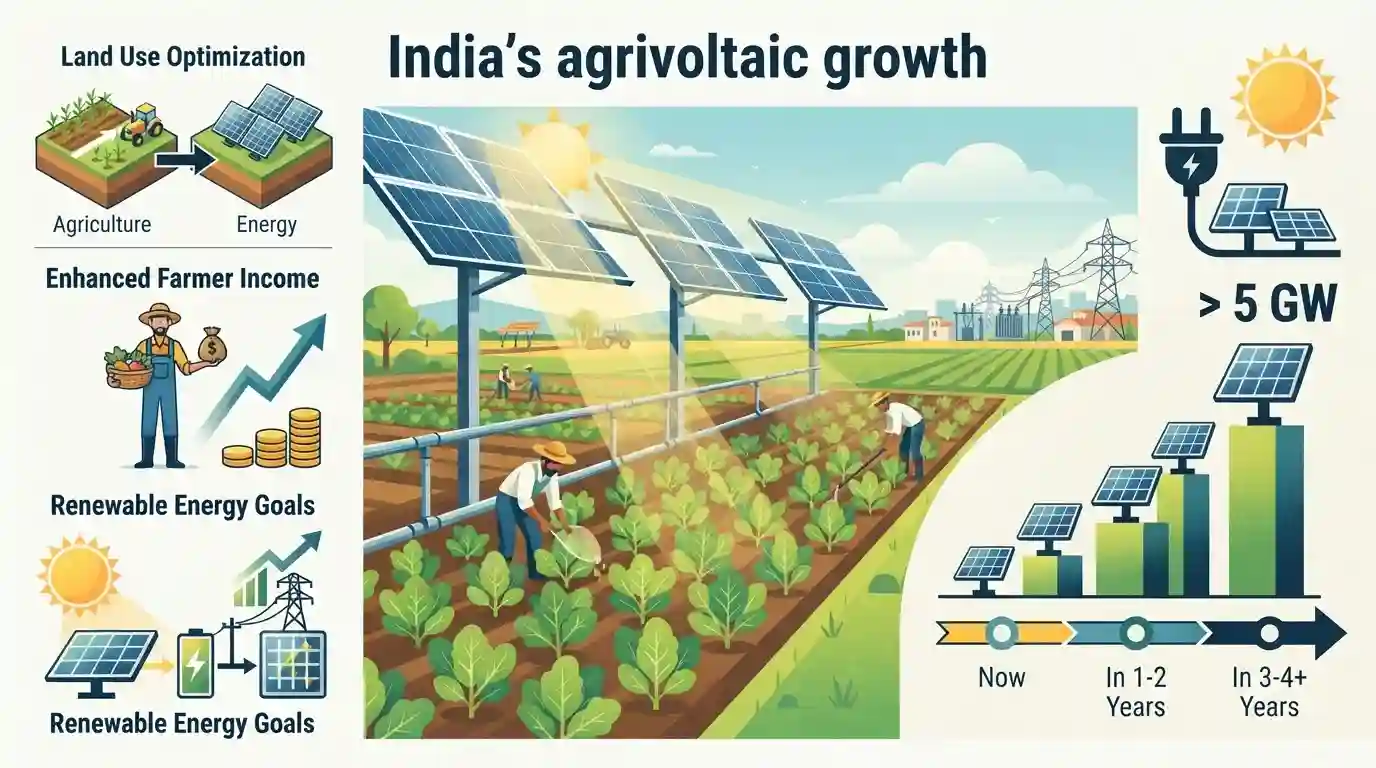
India Agrivoltaic Capacity Growth Projection for Solar Power
Source:The Hindu ↗
ఇది ఎందుకు ముఖ్యం
Agrivoltaics presents an innovative technological and policy solution to optimize scarce land resources, balance food security with green energy expansion, and fulfill India's commitments to climate action and augmented farm income.
సారాంశం
According to the Ministry of New and Renewable Energy (MNRE) Secretary, India's agrivoltaic capacity—combining agricultural production and solar photovoltaic power generation on the same land—is expected to surpass 5 gigawatts in the next 3 to 4 years. This model addresses land competition, enhances farmers' income, and contributes significantly to India's renewable energy goals.
ముఖ్య అంశాలు
- India's agrivoltaic capacity (dual-use of land for agriculture and solar power generation) is projected to exceed 5 gigawatts over the next 3 to 4 years.
- MNRE Secretary highlights that agrivoltaics optimizes land utilization, addresses land scarcity issues for renewable expansion, and provides an additional income stream for farmers.
- The growth is supported by favorable policy frameworks, technological advancements, and rising government emphasis on decentralized renewable energy applications.
- Agrivoltaics helps mitigate micro-climatic stress on certain crops while simultaneously generating clean energy.
ముఖ్యమైన పదాలు
Ministry of New and Renewable Energy (MNRE)

The nodal ministry in the Government of India responsible for formulating and implementing policies, programs, and research related to new and renewable energy sources, including solar and wind power.
UPSC context
UPSC Prelims/Mains (GS Paper III - Infrastructure: Energy): Tests knowledge of key nodal governance bodies for India's clean energy transition.
Agrivoltaics
A dual-use land management strategy that combines agricultural crop cultivation and solar photovoltaic power generation on the same plot of land to optimize resource use.
UPSC context
UPSC Prelims/Mains (GS Paper III - Agriculture & Economy): Tests understanding of sustainable land use, farm income diversification, and renewable energy integration.
ప్రిలిమ్స్ ఉచ్చు
Agrivoltaic systems are primarily engineered to maximize photovoltaic energy output by clearing land of all vegetation.
Aspirants often assume agrivoltaics is exclusively focused on maximizing power output, whereas its core design principle is the simultaneous optimization of agricultural yield and solar generation.
అనుసంధానమైన స్థిర భావనలు
What are the key land-use and environmental challenges associated with utility-scale solar energy expansion in India?
- Land Scarcity: Arable land conversion from agriculture to solar parks triggers severe food security and land-tenure conflicts in densely populated states.
- Ecological Impact: Large ground-mounted installations cause micro-climatic shifts, soil compaction, and disrupt local hydrological and ecological corridors.
- Dual-Use Solution: Agrivoltaics resolves this by combining crop cultivation and electricity generation on the same footprint, optimizing resource efficiency.
అంతర-అంశ నమూనాలు
Renewable Energy + Doubling Farm Incomes
Agrivoltaics directly ties renewable energy targets to rural income diversification, mirroring the convergence sought under PM-KUSUM for decentralized solar pumps and grid-connected farm solarization.

Agrivoltaic dual-use land models will feature in GS Paper 3 (Energy/Agriculture) as a structural solution to land-use conflict.
అనుసంధాన PYQలు · 2
అనుసంధాన PYQలు · 2
- 2022MainsGS3
Do you think India will meet 50 percent of its energy needs from renewable energy by 2030 ? Justify your answer. How will the shift of subsidies from fossil fuels to renewables help achieve the above objective ? Explain.
- 2024PrelimsGS1
Consider the following: 1. Battery storage 2. Biomass generators 3. Fuel cells 4. Rooftop solar photovoltaic units How many of the above are considered "Distributed Energy Resources"?
