India faces healthcare financing gap for missing middle population
Source:The Hindu ↗
આ શા માટે મહત્વનું છે
The 'missing middle' represents a critical vulnerability in India's social protection framework, directly impacting human capital formation, poverty alleviation, and the goal of Universal Health Coverage (UHC).
સારાંશ
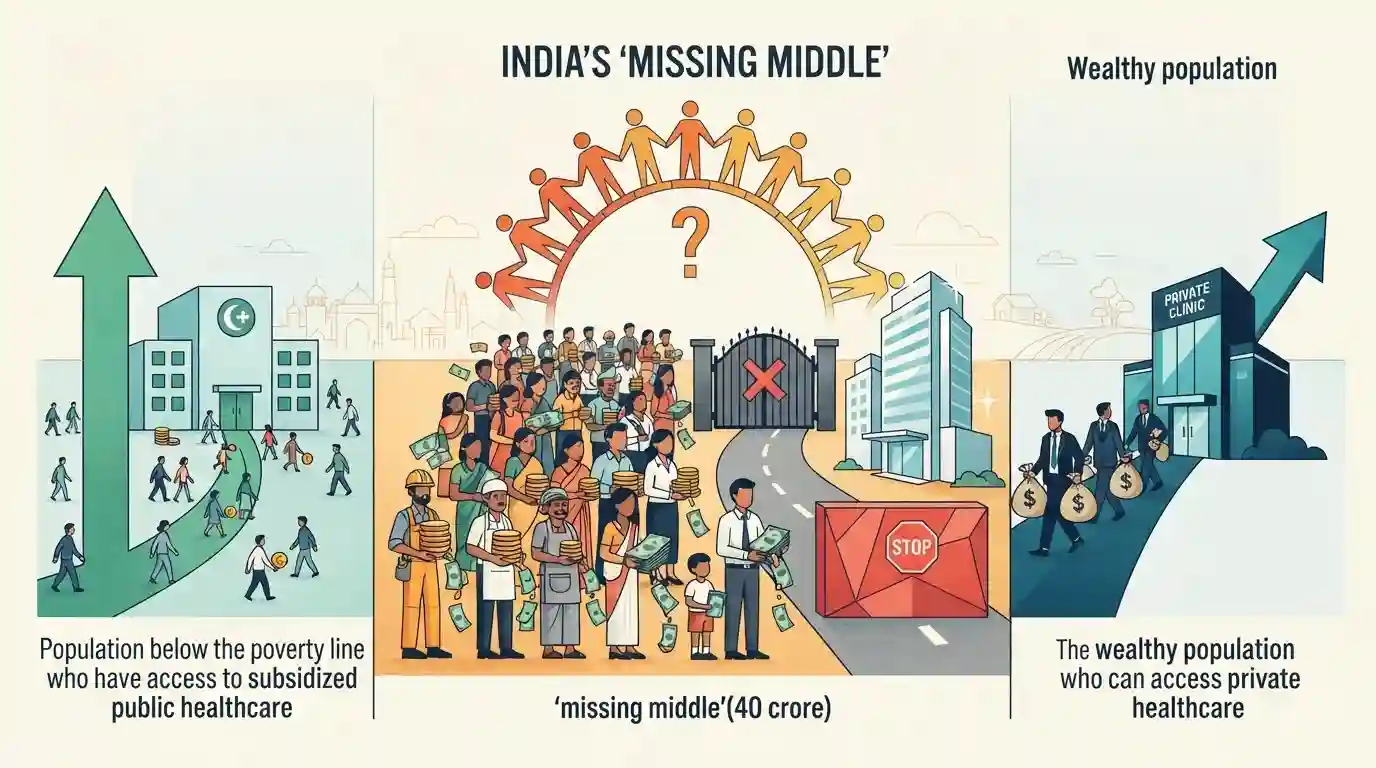
The article highlights India's 'missing middle'—approximately 40 crore individuals who do not qualify for subsidized public health schemes meant for the poor, yet cannot afford private healthcare. This population faces high out-of-pocket expenditure, underscoring systemic gaps in India's healthcare financing and public infrastructure.
મુખ્ય મુદ્દા
- India has a 'missing middle' population of around 40 crore people who are neither poor enough to qualify for free public healthcare schemes like Ayushman Bharat nor rich enough to afford expensive private healthcare.
- High out-of-pocket expenditure (OOPE) pushes millions into poverty due to medical debt and catastrophic health shocks.
- Public healthcare infrastructure remains overburdened and underfunded, forcing citizens to rely on the costly private sector.
- There is an urgent need to design comprehensive health insurance or mixed-financing models targeted at the informal sector and middle-to-low-income non-poor households.
મહત્વપૂર્ણ શબ્દો
Ayushman Bharat Pradhan Mantri Jan Arogya Yojana

The world's largest health assurance scheme, providing up to ₹5 lakh per family annually for secondary and tertiary hospitalization to vulnerable, low-income households.
UPSC context
UPSC Paper II (Social Justice / Health): Tests government welfare interventions, universal health coverage, and healthcare safety nets for vulnerable populations.
PM-JAY
The health insurance component of Ayushman Bharat targeting the bottom socioeconomic strata with cashless secondary and tertiary care hospitalization benefits.
UPSC context
UPSC Paper II (Governance & Social Sector Schemes): Evaluates public financing mechanisms, implementation challenges, and healthcare access gaps like the 'missing middle'.
NITI Aayog
The apex public policy think tank of the Government of India that provides strategic inputs, policy frameworks, and analytical reports on socioeconomic development and gaps like health insurance coverage.
UPSC context
UPSC Paper II (Constitution, Polity & Governance): Tests the role, advisory functions, and policy formulation of statutory/extra-constitutional bodies in developmental planning.
પ્રિલિમ્સ ટ્રેપ
Ayushman Bharat provides universal health coverage to all Indian citizens regardless of income status.
Ayushman Bharat PM-JAY is often mistakenly believed to be universal. In reality, it targets the bottom 40-50% (vulnerable families based on SECC 2011 and expanded criteria), leaving the 'missing middle' uncovered.
સંલગ્ન સ્થિર ખ્યાલો
What are the key structural components and funding targets of India's National Health Policy (NHP) 2017?
- GDP Target: Public Expenditure target: Aims to increase public health expenditure to 2.5% of the GDP by 2017 (now revised timelines).
- Primary Care: Primary Care focus: Allocating major proportions (two-thirds or more) of resources to primary healthcare and Health and Wellness Centres (HWCs).
- Universal Health: Universal access: Attaining the highest possible level of health and well-being through a preventive and promotive health care orientation.
આંતર-વિષય પેટર્ન
Healthcare Financing + Rural Agrarian Distress Trap
High out-of-pocket medical expenditure remains a primary driver of rural indebtedness and land alienation, directly linking public health gaps to agrarian distress and poverty traps.
Universal Health Coverage + Primary Healthcare Infrastructure
While Ayushman Bharat expands secondary/tertiary care, primary health infrastructure deficits force the missing middle into expensive private outpatient care, bypassing insurance safety nets.

Missing middle health financing + National Health Policy 2.5% GDP target likely to feature in mains GS-2 governance/health questions.
સંલગ્ન PYQ · 1
સંલગ્ન PYQ · 1
- 2024MainsGS2
In a crucial domain like the public healthcare system the Indian State should play a vital role to contain the adverse impact of marketisation of the system. Suggest some measures through which the State can enhance the reach of public healthcare at the grassroots level.
