रिपोर्ट के अनुसार 2025 में भारत के कार्बन उत्सर्जन की वृद्धि धीमी रही
स्रोत:द हिंदू ↗
क्यों मायने रखता है
The article provides critical data on India's emission trajectory, contextualizing India's stance on climate justice (high absolute emissions but low per capita footprint). It also offers concrete evidence of how domestic renewable energy expansion and weather patterns directly influence national carbon outputs, which is highly relevant for GS3 questions on energy transition and climate change mitigation.
सारांश
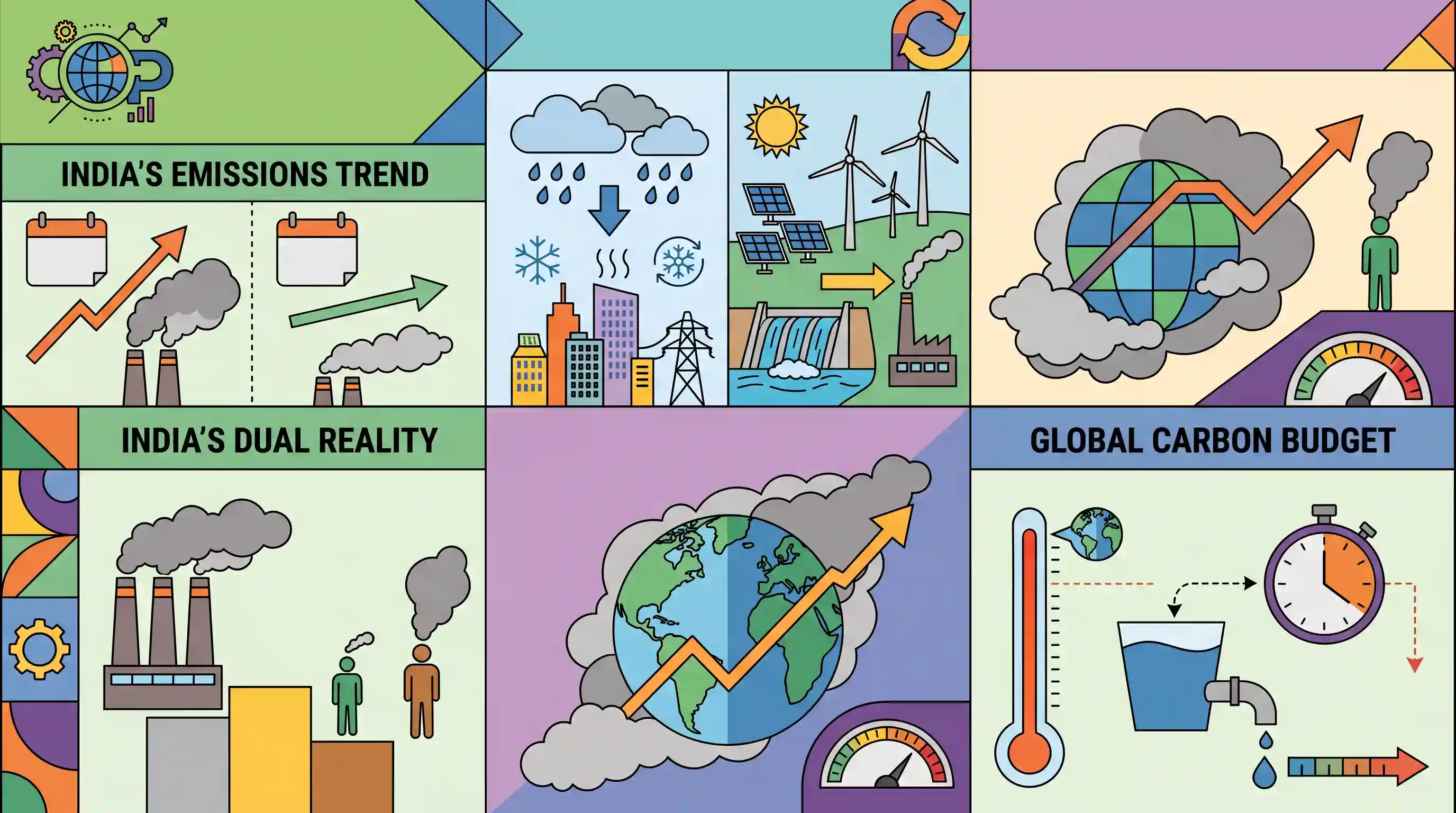
According to a report by the Global Carbon Project, India's carbon emissions grew by 1.4% in 2025, marking a significantly slower pace compared to the 4% rise recorded in 2024. This moderation was primarily driven by a favourable monsoon that reduced electricity demand for cooling, coupled with robust additions to renewable energy capacity that displaced a portion of coal generation. Despite this progress, global emissions are projected to rise by 1.1% in 2025 to 38 billion tonnes. The report highlights India's dual reality in the climate debate: it is the third-largest overall emitter, yet its per capita emissions remain exceptionally low at 2.2 tonnes. Critically, the study warns that the global carbon budget required to limit warming to 1.5°C is virtually exhausted and will likely run out before 2030.
मुख्य बिंदु
- India's carbon emissions growth slowed down to 1.4% in 2025, a significant drop from the 4% increase observed in 2024.
- The deceleration is attributed to a favourable monsoon reducing the energy demand for cooling, alongside substantial growth in renewable energy which offset some coal usage.
- Global carbon emissions are projected to rise by 1.1% in 2025, reaching a total of 38 billion tonnes.
- भारत दुनिया का तीसरा सबसे बड़ा कार्बन उत्सर्जक (सालाना 3.2 बिलियन टन) बना हुआ है, लेकिन इसकी प्रति व्यक्ति उत्सर्जन दर 2.2 टन है, जो बहुत कम है (शीर्ष 20 अर्थव्यवस्थाओं में दूसरी सबसे कम)।
- The remaining global carbon budget for limiting warming to 1.5°C is estimated at 170 billion tonnes, which is expected to be virtually exhausted before 2030 at current emission levels.
महत्वपूर्ण शब्द
ग्लोबल कार्बन प्रोजेक्ट (GCP)

Future Earth और WCRP के तहत एक अंतर्राष्ट्रीय अनुसंधान संघ जो जलवायु नीति चर्चा के लिए वैज्ञानिक आधार प्रदान करने हेतु वैश्विक ग्रीनहाउस गैस उत्सर्जन को ट्रैक करता है।
UPSC context
GS पेपर 3 (पर्यावरण); इसकी वार्षिक Global Carbon Budget रिपोर्ट और वैश्विक उत्सर्जनकर्ता रैंकिंग (global emitter rankings) के माध्यम से परीक्षण।
कार्बन बजट
कार्बन डाइऑक्साइड उत्सर्जन की वह संचयी मात्रा जो वैश्विक तापमान को पूर्व-औद्योगिक स्तरों से एक विशिष्ट सीमा, जैसे कि 1.5°C या 2°C, के भीतर बनाए रखने के लिए वैश्विक स्तर पर अनुमत है।
UPSC context
GS पेपर 3 (पारिस्थितिकी); 'जलवायु न्याय' (climate justice) और ऐतिहासिक उत्तरदायित्व की चर्चाओं का केंद्र।
पेरिस समझौता
2015 की एक कानूनी रूप से बाध्यकारी अंतरराष्ट्रीय संधि जिसका उद्देश्य ग्लोबल वार्मिंग को पूर्व-औद्योगिक स्तरों की तुलना में 2°C से काफी नीचे, और अधिमानतः 1.5°C तक सीमित करना है।
UPSC context
GS पेपर 2 और 3; भारत के NDCs और वैश्विक जलवायु शासन पर प्रश्नों के लिए मौलिक।
प्रति व्यक्ति उत्सर्जन
किसी देश में प्रति व्यक्ति उत्पादित कार्बन उत्सर्जन की औसत मात्रा, जिसका उपयोग विभिन्न देशों के बीच व्यक्तिगत फुटप्रिंट की तुलना करने के लिए किया जाता है।
UPSC context
GS Paper 3; वैश्विक औसत की तुलना में भारत के कम व्यक्तिगत फुटप्रिंट (2.2 टन) को रेखांकित करता है।
राष्ट्रीय स्तर पर निर्धारित योगदान (NDCs)
पेरिस समझौते के तहत उत्सर्जन को कम करने और जलवायु प्रभावों के प्रति अनुकूलन के लिए देशों द्वारा प्रस्तुत स्व-निर्धारित जलवायु लक्ष्य और कार्य योजनाएं।
UPSC context
GS पेपर 3; भारत के लक्ष्य (जैसे, 45% तीव्रता में कमी) प्रीलिम्स/मेंस के लिए महत्वपूर्ण कंटेंट हैं।
समान लेकिन अलग-अलग जिम्मेदारियां (CBDR)
UNFCCC का एक सिद्धांत जो यह स्वीकार करता है कि यद्यपि सभी देशों को जलवायु परिवर्तन की समस्या का समाधान करना चाहिए, विकसित देशों की ऐतिहासिक और वित्तीय जिम्मेदारी अधिक है।
UPSC context
GS पेपर 2 (अंतर्राष्ट्रीय संबंध); जलवायु वार्ता में भारत के रुख को समझने के लिए महत्वपूर्ण।
प्रारंभिक ट्रैप
भारत के कुल निरपेक्ष कार्बन उत्सर्जन में अनुकूल मानसून और नवीकरणीय ऊर्जा क्षमता में उल्लेखनीय वृद्धि के कारण 2025 में गिरावट आई।
भारत की उत्सर्जन वृद्धि दर धीमी होकर 1.4% पर आ गई, लेकिन पूर्ण उत्सर्जन में अभी भी वृद्धि हुई। घटती हुई वृद्धि दर का अर्थ कुल उत्सर्जन में कमी नहीं है।
संबंधित अवधारणाएँ
पेरिस समझौते के संदर्भ में ग्लोबल कार्बन बजट क्या है?
- परिभाषा: ग्लोबल वार्मिंग को एक विशिष्ट तापमान सीमा (जैसे 1.5°C) से नीचे रखने के लिए अनुमत संचयी शुद्ध वैश्विक मानवजनित (anthropogenic) CO2 उत्सर्जन की अधिकतम मात्रा।
- वैज्ञानिक आधार: यह संचयी CO2 उत्सर्जन और वैश्विक सतह के तापमान में वृद्धि के बीच वैज्ञानिक रूप से स्थापित निकट-रैखिक संबंध से प्राप्त होता है।
- समाप्ति की समयरेखा: 1.5°C के लिए वर्तमान शेष बजट लगभग 170 बिलियन टन है, जिसके उत्सर्जन की वर्तमान दरों पर 2030 से पहले समाप्त होने का अनुमान है।
ग्लोबल कार्बन प्रोजेक्ट (GCP) क्या है?
- संगठन का स्वरूप: यह 2001 में स्थापित एक अंतरराष्ट्रीय वैज्ञानिक अनुसंधान संघ (consortium) है, न कि संयुक्त राष्ट्र (UN) की कोई अंतर-सरकारी एजेंसी।
- अम्ब्रेला पहलें: यह Future Earth पहल और World Climate Research Programme के अंतर्गत एक वैश्विक शोध परियोजना के रूप में कार्य करता है।
- मुख्य निष्कर्ष: यह वार्षिक 'Global Carbon Budget' रिपोर्ट तैयार करता है, जो वैश्विक ग्रीनहाउस गैस उत्सर्जन और उनके प्राथमिक कारकों का आकलन करती है।
अंतर-विषय पैटर्न
मानसून की गतिशीलता और ऊर्जा की मांग
एक अनुकूल मानसून शीतलन (cooling) आवश्यकताओं को कम करके और जल-विद्युत उत्पादन को बढ़ाकर तापीय ऊर्जा की मांग को सीधे तौर पर कम करता है, जो भारतीय भौगोलिक जलवायु परिघटनाओं को सीधे देश के राष्ट्रीय कार्बन फुटप्रिंट से जोड़ता है।
CBAM बनाम प्रति व्यक्ति वास्तविकता
भारत के कम प्रति व्यक्ति उत्सर्जन (2.2t) का उपयोग यूरोपीय संघ (EU) के CBAM जैसी पूर्ण-उत्सर्जन-केंद्रित व्यापार बाधाओं का मुकाबला करने के लिए किया जाएगा, जिससे व्यापार वार्ताओं में 'Common but Differentiated Responsibilities' (CBDR) के सिद्धांत को फिर से पुष्ट किया जा सके।

2026 की prelims में Global Carbon Project की गैर-UN उत्पत्ति और भारत के 'emission growth vs absolute decline' के जाल को जोड़कर पूछे जाने वाले एक प्रश्न की अपेक्षा करें।
संबद्ध PYQ · 5
संबद्ध PYQ · 5
- 2022MainsGS3
Discuss global warming and mention its effects on the global climate. Explain the control measures to bring down the level of greenhouse gases which cause global warming, in the light of the Kyoto Protocol, 1997.
- 2022MainsGS3
Do you think India will meet 50 percent of its energy needs from renewable energy by 2030 ? Justify your answer. How will the shift of subsidies from fossil fuels to renewables help achieve the above objective ? Explain.
- 2021MainsGS3
Describe the major outcomes of the 26th session of the Conference of the Parties (COP) to the United Nations Framework Convention on Climate Change (UNFCCC). What are the commitments made by India in this conference?
- 2016PrelimsGS1
With reference to the Agreement at the UNFCCC Meeting in Paris in 2015, which of the following statements is/are correct? 1. The Agreement was signed by all the member countries of the UN and it will go into effect in 2017. 2. The Agreement aims to limit the greenhouse gas emissions so that the rise in average global temperature by the end of this century does not exceed 2°C or even 1.5°C above pre-industrial levels. 3. Developed countries acknowledged their historical responsibility in global warming and committed to donate $ 1000 billion a year from 2020 to help developing countries to cope with climate change. Select the correct answer using the code given below.
- 2025PrelimsGS1
Consider the following statements : Statement I: Article 6 of the Paris Agreement on climate change is frequently discussed in global discussions on sustainable development and climate change. Statement II: Article 6 of the Paris Agreement on climate change sets out the principles of carbon markets. Statement III : Article 6 of the Paris Agreement on climate change intends to promote inter-country non-market strategies to reach their climate targets. Which one of the following is correct in respect of the above statements?
