India Carbon Emissions Growth Slows Down in 2025 Report
Source:The Hindu ↗
Why It Matters
The article provides critical data on India's emission trajectory, contextualizing India's stance on climate justice (high absolute emissions but low per capita footprint). It also offers concrete evidence of how domestic renewable energy expansion and weather patterns directly influence national carbon outputs, which is highly relevant for GS3 questions on energy transition and climate change mitigation.
Summary
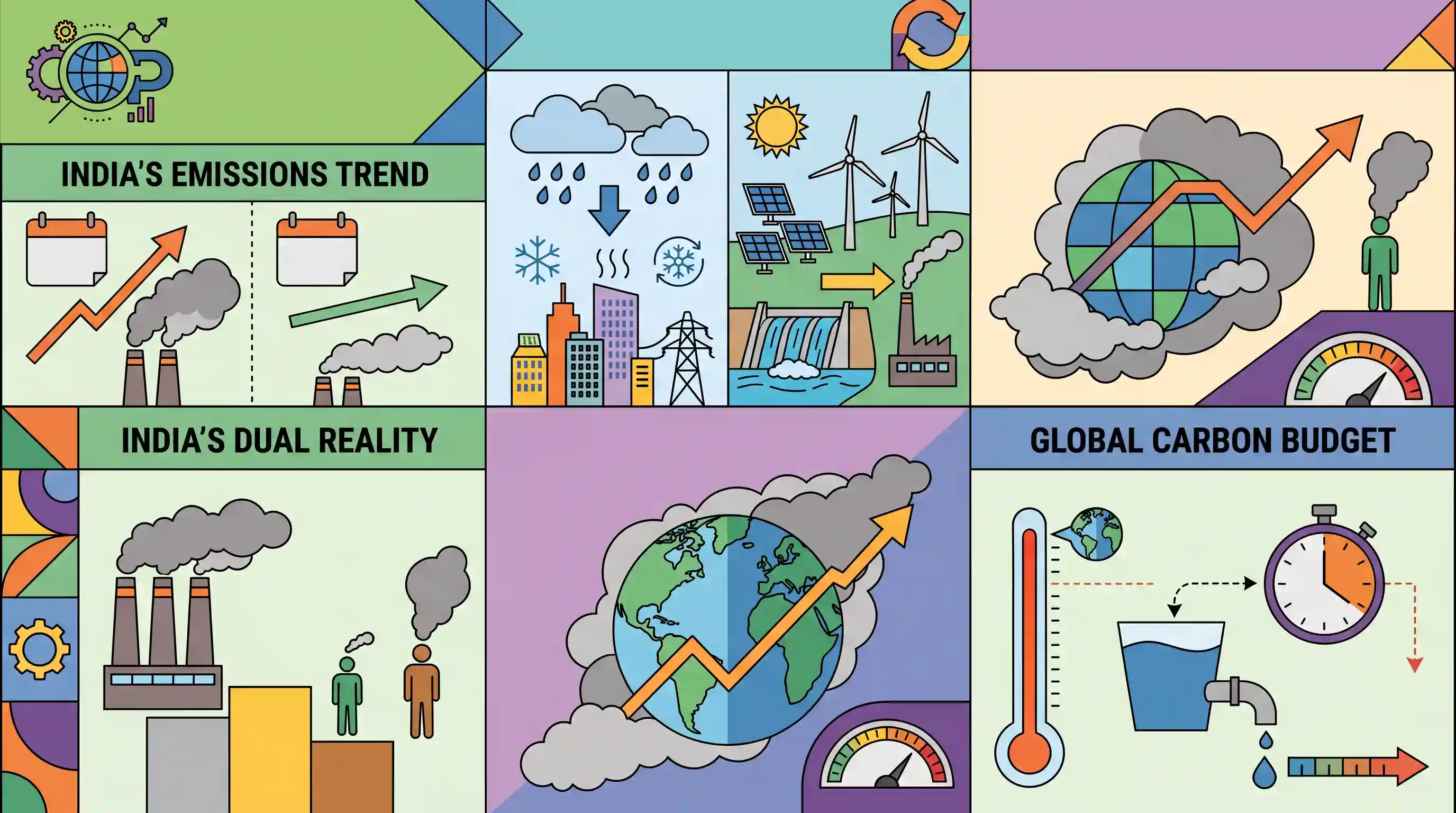
According to a report by the Global Carbon Project, India's carbon emissions grew by 1.4% in 2025, marking a significantly slower pace compared to the 4% rise recorded in 2024. This moderation was primarily driven by a favourable monsoon that reduced electricity demand for cooling, coupled with robust additions to renewable energy capacity that displaced a portion of coal generation. Despite this progress, global emissions are projected to rise by 1.1% in 2025 to 38 billion tonnes. The report highlights India's dual reality in the climate debate: it is the third-largest overall emitter, yet its per capita emissions remain exceptionally low at 2.2 tonnes. Critically, the study warns that the global carbon budget required to limit warming to 1.5°C is virtually exhausted and will likely run out before 2030.
Key Points
- India's carbon emissions growth slowed down to 1.4% in 2025, a significant drop from the 4% increase observed in 2024.
- The deceleration is attributed to a favourable monsoon reducing the energy demand for cooling, alongside substantial growth in renewable energy which offset some coal usage.
- Global carbon emissions are projected to rise by 1.1% in 2025, reaching a total of 38 billion tonnes.
- India remains the world's third-largest carbon emitter (at 3.2 billion tonnes annually), but maintains a very low per capita emission rate of 2.2 tonnes (second lowest among the top 20 economies).
- The remaining global carbon budget for limiting warming to 1.5°C is estimated at 170 billion tonnes, which is expected to be virtually exhausted before 2030 at current emission levels.
Important Terms
Global Carbon Project (GCP)

An international research consortium under Future Earth and the WCRP that tracks global greenhouse gas emissions to provide a scientific base for climate policy debate.
UPSC context
GS Paper 3 (Environment); tested via its annual Global Carbon Budget report and global emitter rankings.
Carbon Budget
The cumulative amount of carbon dioxide emissions permitted globally to stay within a specific temperature limit, such as 1.5°C or 2°C above pre-industrial levels.
UPSC context
GS Paper 3 (Ecology); central to discussions on 'climate justice' and historical responsibility.
Paris Agreement
A 2015 legally binding international treaty aiming to limit global warming to well below 2°C, and preferably to 1.5°C, compared to pre-industrial levels.
UPSC context
GS Paper 2 & 3; fundamental for questions on India’s NDCs and global climate governance.
Per Capita Emissions
The average amount of carbon emissions produced per person in a country, used to compare individual footprints across nations.
UPSC context
GS Paper 3; underscores India's low individual footprint (2.2 tonnes) versus the global average.
Nationally Determined Contributions (NDCs)
Self-defined climate targets and action plans submitted by countries under the Paris Agreement to reduce emissions and adapt to climate impacts.
UPSC context
GS Paper 3; India’s targets (e.g., 45% intensity reduction) are key Prelims/Mains content.
Common But Differentiated Responsibilities (CBDR)
A UNFCCC principle recognizing that while all nations must address climate change, developed countries have a greater historical and financial responsibility.
UPSC context
GS Paper 2 (International Relations); critical for understanding India’s stance in climate negotiations.
Prelims Trap
India’s total absolute carbon emissions declined in 2025 due to a favourable monsoon and robust renewable energy additions.
India's emissions growth rate slowed down to 1.4%, but absolute emissions still increased. A declining growth rate does not mean a reduction in total emissions.
Static Concepts Connected
What is the Global Carbon Budget in the context of the Paris Agreement?
- Definition: The maximum amount of cumulative net global anthropogenic CO2 emissions permitted to keep global warming below a specific temperature threshold (like 1.5°C).
- Scientific basis: It is derived from the scientifically established near-linear relationship between cumulative CO2 emissions and global surface temperature rise.
- Exhaustion timeline: The current remaining budget for 1.5°C is approx. 170 billion tonnes, projected to be exhausted before 2030 at current emission rates.
What is the Global Carbon Project (GCP)?
- Nature of organization: It is an international scientific research consortium established in 2001, not an intergovernmental UN agency.
- Umbrella initiatives: It operates as a global research project under the Future Earth initiative and the World Climate Research Programme.
- Key output: It produces the annual Global Carbon Budget report, quantifying global greenhouse gas emissions and their primary drivers.
Cross-Topic Patterns
Monsoon dynamics & energy demand
A favourable monsoon directly suppresses thermal power demand by reducing cooling needs and boosting hydro-generation, linking Indian geographical climatic phenomena directly to its national carbon footprint.
CBAM vs. per capita reality
India’s low per capita emissions (2.2t) will be used to counter absolute-emission-focused trade barriers like the EU's CBAM, reasserting the principle of Common but Differentiated Responsibilities (CBDR) in trade talks.

Expect a 2026 prelims question pairing the Global Carbon Project's non-UN origins with India's "emission growth vs absolute decline" trap.
Linked PYQs · 5
Linked PYQs · 5
- 2022MainsGS3
Discuss global warming and mention its effects on the global climate. Explain the control measures to bring down the level of greenhouse gases which cause global warming, in the light of the Kyoto Protocol, 1997.
- 2022MainsGS3
Do you think India will meet 50 percent of its energy needs from renewable energy by 2030 ? Justify your answer. How will the shift of subsidies from fossil fuels to renewables help achieve the above objective ? Explain.
- 2021MainsGS3
Describe the major outcomes of the 26th session of the Conference of the Parties (COP) to the United Nations Framework Convention on Climate Change (UNFCCC). What are the commitments made by India in this conference?
- 2016PrelimsGS1
With reference to the Agreement at the UNFCCC Meeting in Paris in 2015, which of the following statements is/are correct? 1. The Agreement was signed by all the member countries of the UN and it will go into effect in 2017. 2. The Agreement aims to limit the greenhouse gas emissions so that the rise in average global temperature by the end of this century does not exceed 2°C or even 1.5°C above pre-industrial levels. 3. Developed countries acknowledged their historical responsibility in global warming and committed to donate $ 1000 billion a year from 2020 to help developing countries to cope with climate change. Select the correct answer using the code given below.
- 2025PrelimsGS1
Consider the following statements : Statement I: Article 6 of the Paris Agreement on climate change is frequently discussed in global discussions on sustainable development and climate change. Statement II: Article 6 of the Paris Agreement on climate change sets out the principles of carbon markets. Statement III : Article 6 of the Paris Agreement on climate change intends to promote inter-country non-market strategies to reach their climate targets. Which one of the following is correct in respect of the above statements?
